


This is the second of a three-part deep dive on Shopify (Nasdaq/TSX: SHOP). Part 1 covered the business model and how Shopify actually makes money. This part covers the expensive detour, the Amazon threat, and AI. Part 3 will cover the financials, capital allocation, and valuation.
On May 4, 2023, Shopify published a memo on its own newsroom that most companies would have buried in a Friday night filing. In it, founder and CEO Tobi Lütke told employees that about 20% of them were losing their jobs that day, and that the company’s biggest acquisition ever was leaving with them. Most of the logistics operation went to Flexport, a private freight forwarder, for equity and zero cash.
He also gave the whole episode a name. Logistics, he wrote, had been a side quest.
The stock jumped roughly 26% that day, one of its biggest one-day moves as a public company. But of course, that wasn’t the only reason. Q1 FY2023 results landed the same morning and beat expectations.
We ended part 1 with talking about why a company that grew gross profit nearly 15x between FY2017 and FY2025 by wrapping other people’s infrastructure spent four years and over $2 billion trying to own the heaviest infrastructure in commerce, then took a $1.34 billion write-off (FY2023) to hand it away.
This report is about why they went in, why they got out, and what the episode teaches you about the two threats that came next: Amazon, and AI.
The company that competes with none of its customers
Shopify supplies the tools of commerce to millions of merchants and competes with none of them for the sale.
Part 1 showed that Shopify’s monetization runs on other people’s rails. Payments clear through the card networks, installments run on Affirm, lending runs through a partner bank, shipping labels ride on the carriers. Shopify builds the merchant-facing layer, the checkout, the risk models, the admin, and lets specialists carry the capital-heavy layers underneath — that is what horizontal means.
A vertical company owns every layer of one shopping destination: Amazon owns the marketplace, the warehouses, the delivery vans, the ad system, and sometimes the products… In some ways, it competes with its own sellers for the sale.
A horizontal company supplies one layer to every destination: Shopify sells commerce software and checkout to any merchant who wants their own store, and runs no marketplace of its own.
The strategic consequence: Amazon wins when the sale happens on Amazon. Shopify wins when anybody else does.
And for most of its life, “anybody else” meant the independents: the millions of merchants Part 1 described who don’t want to be beholden to a marketplace and its fees.
Or as Tobi Lütke famously stated, “Amazon is trying to build an empire, and Shopify is trying to arm the rebels”.
The past few years added a group nobody expected on a platform built for garage startups: the giants themselves.
“This is increasingly making Shopify the go-to commerce platform for merchants of all sizes,” Harley Finkelstein, Shopify’s President, told investors on the Q3 FY2024 earnings call. On the same call he named Reebok among the quarter’s enterprise signings, and grouped it with On Running and Victoria’s Secret as the kind of iconic brands now coming to Shopify.
The tool the independents used against the giants is now sold to the giants too. Nothing about the model had to change to allow that, which is the whole point of being horizontal.
So that’s the blueprint for Shopify: supply everyone, own almost nothing physical. Which makes what happened next strange… Between 2019 and 2023, Shopify spent four years trying to own the heaviest layer it had always rented.
The “side quest” every merchant carried
By the late 2010s, Amazon had trained a generation of buyers to expect two-day delivery, and an independent merchant on Shopify could not promise anything close to it on their own.
Lütke described the merchant’s side of this vividly in the May 2023 memo: “To run your store you work with extremely carefully designed software. To run logistics, you will use pen, paper, and phone calls a lot… Instead of every merchant individually taking on their own side quest, Shopify decided to accept it on their behalf.”
So in June 2019 it announced the Shopify Fulfillment Network, and on the following earnings call put a price on the ambition: roughly $1 billion over five years. In the fourth quarter of 2019 it bought 6 River Systems, a warehouse robotics maker; the FY2019 40-F puts the final purchase price at $394 million.
Then the pandemic sent e-commerce businesses to the moon, and Shopify pressed harder. In July 2022 it completed the acquisition of Deliverr, a fulfillment technology company, for $2.1 billion, nearly all of it in cash. It was, and still is, the largest acquisition in Shopify’s history.
This was because fulfillment was the one merchant problem software alone couldn’t fix. If Shopify could pool millions of merchants’ parcels into a single network, it could rent Amazon-grade delivery to the smallest store the same way it already rented them bank-grade checkout: one more service in the stack, priced low, adopted voluntarily.
The dates show how conflicted the company already was. The Deliverr purchase was completed in July 2022. That same month, Shopify announced its first major layoffs, cutting roughly 10% of staff, about 1,000 people. In a single month, the company completed that record purchase and already admitted that the growth forecast behind it had broken.
And the day after the layoffs, on the Q2 FY2022 earnings call, Lütke was still describing the vertical integration of logistics as the big bet Shopify was making.
Ten months later, the bet became a side quest.
The $1.3 billion admission
The first admission came in that July 2022 memo, and it was about headcount. “It’s now clear that bet didn’t pay off,” Lütke wrote of his wager that the pandemic had permanently pulled e-commerce adoption years forward, adding that “placing this bet was my call to make and I got this wrong.” The market’s response was to send the stock down 14%.
The second admission was the May 4, 2023 memo, and this one came with a transaction attached. Shopify had agreed to sell most of its logistics business to Flexport, and the sale closed on June 6.
Flexport paid entirely in its own shares, a 13% stake on top of what Shopify already held, taking its total ownership into the high teens, plus a board seat. Flexport became Shopify’s official logistics partner.
In Lütke’s words, “Logistics was clearly a worthwhile side quest for us, and started to create the conditions for our main quest to succeed.”
Against the value of the Flexport shares it got back, Shopify wrote off every dollar of goodwill the Deliverr deal had created, plus the intangibles and net assets of the businesses it sold. The net result is a single line in the FY2023 income statement, “Impairment on sales of Shopify’s logistics businesses”, for $1.34 billion.
When we sum it all up, roughly $2.5 billion went out across 6 River Systems (FY2019) and Deliverr (FY2022). What came back was Flexport stock worth $528 million at closing, carried at $602 million at December 31, 2025, per the FY2025 10-K.
Shopify has since put in more, .buying $260 million of Flexport convertible notes in December 2023, worth $326 million at the end of FY2025, which tells you it still believes in the mission. It just no longer believes that it should be the one running the warehouses.
Why was the bet wrong? The clearest way to see it is the mismatch between the two businesses.
Shopify’s software model takes a tiny cut of each sale but keeps almost all of it, because software costs little to run once it is built. That is what produces the high margins Part 1 described. Warehouses are the opposite. They swallow huge amounts of cash up front, and the delivery business itself earns thin margins on heavy physical work.
But the deeper issue was scale. Beating Amazon’s delivery promise would have meant matching a network Amazon had spent two decades and tens of billions of dollars building, and the roughly one billion Shopify committed over five years was never going to close that gap. So the bet asked Shopify to accept lower profitability and a heavy capital bill, with no realistic path to the prize that would have justified them.
It did not help that the timing was the worst possible, with rising rates punishing exactly this kind of capital-heavy, long-payback spending.
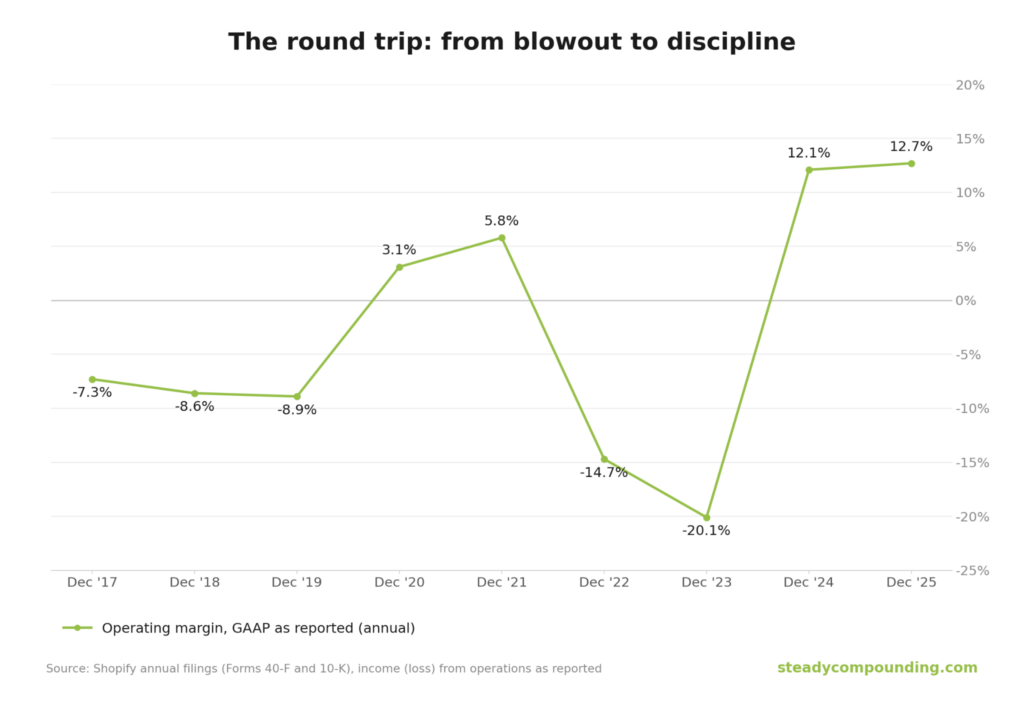
Operating margin had climbed to +5.8% in FY2021, then collapsed to -14.7% in FY2022.
The collapse in margins had two causes: Shopify had spent two years hiring for a demand curve that flattened, and from July 2022 it was carrying Deliverr’s costs on top.
FY2023’s -20.1% looks like the worst year on the chart because the impairment and severance sit inside that number. Strip those out and the slimmed-down company was already profitable. Shopify earned a GAAP operating profit of $122 million in Q3 FY2023 and $289 million in Q4 FY2023.
What follows is plain operating leverage. Revenue kept compounding above 20% while the cost base stayed cut, and operating margin reached +12.1% in FY2024 and +12.7% in FY2025, the best two years in Shopify’s history.
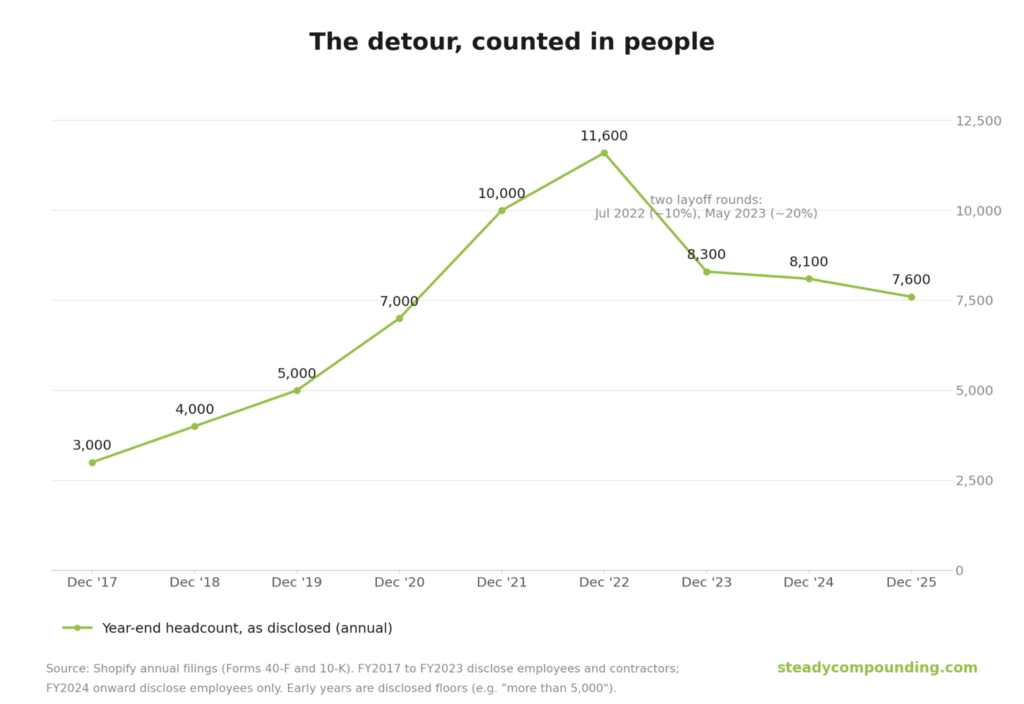
Headcount tells a similar story. Shopify ended FY2022 with about 11,600 employees and contractors and ended FY2023 at about 8,300 after the two rounds of cuts. The count has kept drifting down since, to roughly 7,600 at the end of FY2025, even as revenue grew about 64% over those same two years.
The front door keeps moving
Shopify’s merchants bring their own buyers. Shopify owns the checkout and the back office; it does not own demand. And this opens up a weak spot because someone else controls the top of the funnel, the place where buyers start. Whoever controls that place can tax or redirect the stores behind it.
We call that place the front door. In five years, control of it has been contested three times.
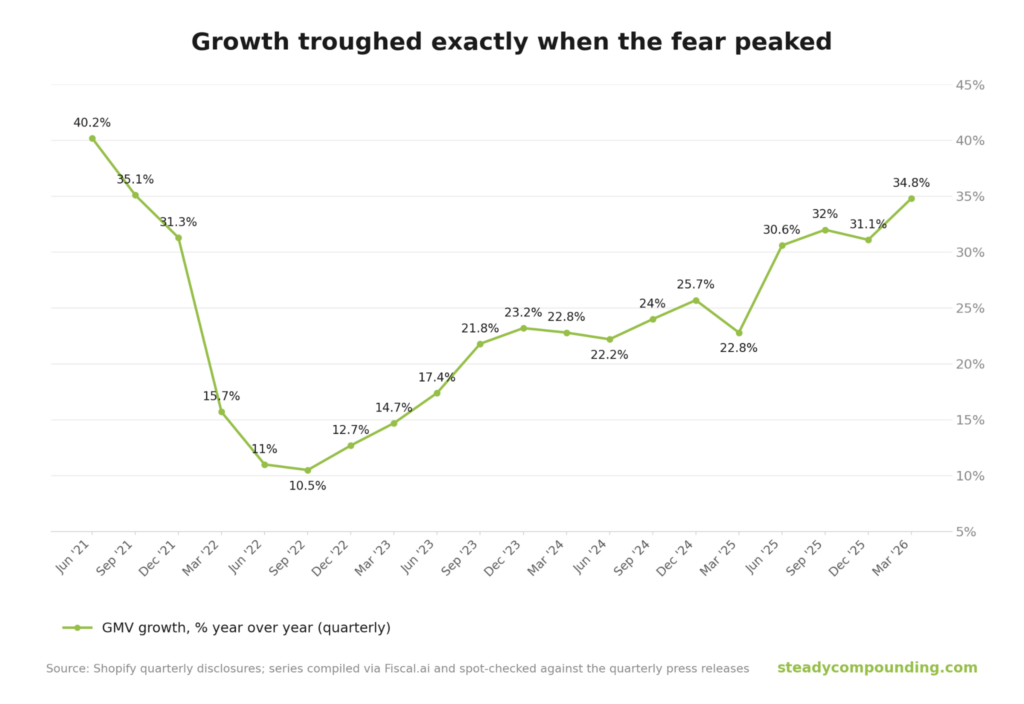
When App Tracking Transparency (ATT) shipped in April 2021, GMV was still growing 40% year over year. From there, growth slid every quarter into mid-FY2022, where it spent two quarters stuck at 11% and then 10.5%, on $46.9 billion of volume in Q2 and $46.2 billion in Q3, the slowest prints in Shopify’s history as a public company.
The door’s first guardian was Meta. For a decade, the default way most Shopify merchants found customers was targeted Facebook and Instagram advertising. Apple broke that when iOS 14.5 shipped ATT, and Meta told investors in February 2022 that the change would cost it on the order of $10 billion that year. By mid-2022, Meta’s revenue was shrinking year over year for the first time in its history. Shopify’s growth followed the same slope down.
During that period, management’s own post-mortem that July pointed to the pandemic demand bet rather than the ad crash. But when targeting broke, customer acquisition costs jumped for Shopify’s merchants.
I read the chart above as circumstantial evidence of how exposed the front door is, and I note that the recovery traced Meta’s own.
The second contest came from Amazon, which tried to take the door outright. In April 2022, it launched Buy with Prime, which put Prime’s checkout, Prime’s wallet and Amazon’s fulfillment network behind a button on merchants’ own websites.
For Shopify, that one button threatened three things at once: the checkout, where Part 1 showed all the monetization lives; the customer data behind the checkout; and the fulfillment network Shopify was, at that exact moment, spending billions to build. Shopify treated it by warning merchants who installed the button: “You have a code snippet on your storefront that violates Shopify’s Terms of Service.”
Then the detour ended, and so did the standoff. In August 2023, three months after the Flexport sale, Amazon announced a Buy with Prime app built directly into Shopify’s own checkout.
A Prime member taps the button on a merchant’s site and pays with the card in their Amazon wallet, and Shopify Payments processes the transaction through Shopify Checkout. The customer data stays in the merchant’s admin. Amazon supplies the delivery promise, and once Shopify stopped selling fulfillment, that network turned from a rival product into a feature merchants can switch on.
The quieter signal is that across the last eight Shopify earnings calls, Q2 FY2024 through Q1 FY2026, Buy with Prime is not mentioned once, by management or by a single analyst. Analysts ask about the threats they still believe in, and this one fell off the question list.
When the buyer is an agent
The door is moving again, and this time it looks like a chat window. The buyer is an AI agent, a chatbot that finds and buys things on a shopper’s behalf.
In Part 1, I quoted Shopify’s president on monetization working “across any new channel,” and flagged those last three words. AI is that channel.
In January 2026 it launched Agentic Storefronts, which let a merchant list its Shopify catalog inside ChatGPT, Microsoft Copilot, and Google’s AI Mode and Gemini, all managed from the Shopify admin. The same month, Shopify co-developed the Universal Commerce Protocol with Google, an open standard for how AI agents transact with any merchant. Etsy, Wayfair, Target and Walmart helped build it. And a new Agentic plan opens Shopify’s catalog and checkout infrastructure to brands that don’t run Shopify stores at all.
Shopify is now selling its back end to other platforms’ merchants.
The economics (or the entry fee to this door) of this channel is at the top of everybody’s mind, and management has answered it the same way twice.
“For Shopify merchants, the economics are the same as the transaction happened on the online store when it comes to agentic,” Harley Finkelstein, Shopify’s President, said on the Q4 FY2025 call. “Specifically on something like ChatGPT, which requires Shopify payments, monetization is through payments.” A quarter later, on the Q1 FY2026 call, he described ChatGPT’s move to in-app checkout as “literally the Shopify store front within the chat.”
His fuller argument on the Q4 FY2025 call was that large language models do not bypass Shopify’s checkout, because the complicated back end of commerce is exactly the part nobody else wants to rebuild. An AI can generate a webpage in an afternoon but it cannot generate fraud screening, tax calculation, chargeback handling, inventory sync and returns, and it has no reason to try when all of it sits one protocol integration away.
If that holds, an agentic order and an online-store order pay Shopify identically: the AI owns the conversation, and Shopify Payments runs underneath.
The part nobody wants to build
The three episodes above share an ending. Each time, the checkout came out untouched.
Every front door, whatever it looks like, ends at a transaction, and the transaction is the unglamorous half of commerce. Shopify already holds the catalog, the inventory and the customer record that any front door needs, so a front-door owner can plug in instead of rebuilding any of it.
One clarification, though. Calling Shopify a back end… perhaps undersells it. The company owns the entire merchant side of commerce, storefront included, and rents only the demand side. Amazon has a front door of its own to defend, so a new one is a threat to it. Shopify has none, so a new front door is just another place its merchants can sell.
Owning the front door is a tough fight, because every platform wants to be where buyers start. Nobody is fighting to do the merchant’s taxes, fraud detection and all the unsexy stuff.
Shopify’s strategy
If we look at Shopify’s history, this is their strategy in one sentence: supply every merchant, own the checkout and the back office, rent the front doors from whoever holds them, and keep the entry price too low to attack.
Everything in this report is that sentence being tested. Apple’s ATT tested the front-door dependence, and the model bent without breaking. Amazon went at the checkout directly, and ended up processing payments through it. Now AI is testing both at once, and so far the answer routes through Shopify Payments.
The one time the company abandoned this strategy, it cost roughly $2.5 billion invested (FY2019 and FY2022) and a $1.34 billion write-off (FY2023). What I take from the episode is less about logistics than about the people running the company. They make big bets in public, and when one fails, the CEO signs the memo himself and doesn’t throw good money after bad.
In July 2022 that confession was “I got this wrong.” In May 2023 it was a side quest and $1.34 billion. Most managements make you find the mistake in a footnote. This one put it in the headline.
What’s next
The discipline that ended the detour now shows up on every line of the financial statements, and Part 3 is where we dive into the numbers and its valuation.
Compound wisely,
Thomas
Disclaimer: This report constitutes the author’s personal views only and is for educational purposes only. It is not financial advice in any shape or form. Disclosure: I do not hold a position in Shopify at the time of writing (this is a disclosure and NOT a recommendation)