



When stocks drop 20%, 30%, or even 50%, our first instinct is to search for reasons.
We scour the news. We look at X or Reddit for explanations. We watch CNBC for expert commentary. We convince ourselves that if we just understand why the stock is falling, we’ll feel better about our investment.
This is not just unproductive—it’s harmful.
Here’s the uncomfortable truth. Even the strongest companies experience dramatic drops. Amazon has fallen more than 50% multiple times. Meta dropped 80% from its peak. Netflix? Same story. Even Berkshire Hathaway, Warren Buffett’s fortress of stability, has seen ~50% drawdowns throughout its history.
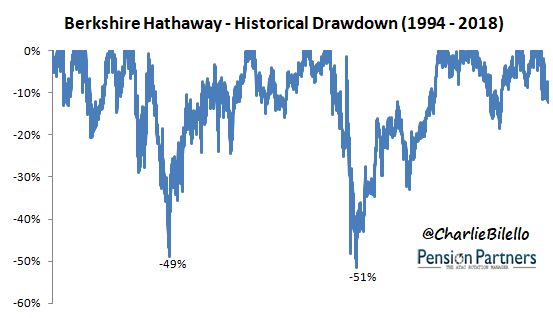
And here’s the kicker—some of these happened while the businesses were actually throttling along just fine.
Take Netflix. When it dropped 25.8% after hours in April 2022, I wrote about why the business fundamentals remained intact despite the market chaos (LINK). When Disney supposedly “overtook” Netflix in the streaming wars later that year, I documented why Netflix was still executing its strategy fine (LINK).
Looking back at what I wrote during those drawdowns, the analysis holds up. The market was panicking. The business wasn’t.
This is normal.
“If you’re not willing to react with equanimity to a market price decline of 50% two or three times a century, you’re not fit to be a common shareholder and you deserve the mediocre result you’re going to get.”
Charlie Munger
When Your Amygdala Takes the Wheel
The stock market has a unique ability to hijack our emotions.
One day you’re a rational investor who understands business fundamentals. The next day, you’re watching your portfolio bleed red and your primitive brain—your amygdala—takes control. Fear floods your system.
Logic doesn’t live here anymore.
This is where preparation becomes your superpower.
The Investment Thesis—Your Emergency Plan
Before you buy a single share, write down your investment thesis.
Not in your head. On paper. Or in a document. Somewhere you can reference when the inevitable storm hits.
What should this include? Why you’re buying the business. What could go wrong (be specific). Under what conditions you would sell.
This isn’t just an academic exercise. It’s your emergency plan for when your amygdala gets hijacked.
When the stock drops 30% and every fiber of your being screams “SELL!”, you can return to your thesis. If the fundamentals haven’t changed, if the business is still executing according to plan, then the market is simply being the market.
The Position Sizing Truth Nobody Talks About
But what if you’ve done all this and you’re still losing sleep?
Then we need to dig deeper into your portfolio construction.
Did you size this position too heavily?
Here’s where brutal honesty becomes essential. When a stock rises 50%, we think, “I should have bought more.” When it drops 30%—which is perfectly normal market behavior—we get anxious, check our accounts obsessively, and question every decision.
The cognitive dissonance is remarkable.
Position sizing is deeply personal. What works for me won’t work for you. What works for a 25-year-old with decades ahead won’t work for someone saving for retirement.
The right position size is one that lets you sleep at night during a 50% drawdown.
If you can’t handle the heat, you need a smaller position. Not because the business is bad. Not because the market is wrong. But because your emotional well-being matters more than capturing every percentage point of upside.
Here’s what nobody tells you. The investors who make the most money aren’t the ones who pick the best stocks. They’re the ones who size their positions correctly and can sit through the volatility that shakes everyone else out.
Finding Your Volatility Threshold
Think of volatility as the price of admission to the equity markets.
You want the long-term returns? You pay with short-term emotional discomfort. Can’t withstand the volatility? You won’t capture the rewards.
It’s that simple.
The solution isn’t to eliminate volatility—that’s impossible. The solution is to size your positions so that volatility becomes background noise rather than a five-alarm fire.
Start small. Build confidence. Then scale.
Never—and I mean never—size a position so large that a 50% drop would materially impact your life. Your highest-conviction ideas will experience significant drawdowns. Not might. Will.
Document how you feel during these drawdowns. Be honest. Then adjust.
The Sleep Test
Here’s a simple framework.
If a 30% drop in a position would keep you awake at night, you own too much. If a 100% gain would make you regret not buying more, you own too little.
Find your sweet spot.
The Market Doesn’t Care About Your Feelings
Markets will go up. Markets will go down. Often, these movements have nothing to do with business fundamentals and everything to do with sentiment, fear, greed, and algorithmic trading.
Your job isn’t to predict these movements. Your job isn’t even to understand them.
Your job is to own great businesses at position sizes that let you remain rational when everyone else is losing their minds.
Volatility isn’t a bug in the system—it’s a feature.
Master your relationship with it, and you’ll capture the rewards that come to those who can sit still when sitting still is the hardest thing to do.
The next time your stock drops 30% and you feel that familiar panic rising, ask yourself one question.
Is this about the business, or is this about my position sizing?
Nine times out of ten, you already know the answer.
This article is quite good with the most important principles, i believe, a sound investor could adopt. On the flip side, a quick buy/sell type of investor will trash the principles above as they don’t generate the quickest turnaround in a portfolio.
I guess a question i would like to know more about is how to balance my personal portfolio so i am comfortable when a stocks skyrockets or plummets 30%!
Hi Del,
Great question! Here’s my approach:
Ask yourself: “If this dropped 50% tomorrow, what % of my portfolio would I be okay with it representing?” That’s your max position size.
For most people, this lands at 5-15% per holding. Start smaller (3-5%), then add during drawdowns as conviction builds.
Track how you feel during 20%+ moves—if you’re losing sleep on drops, you’re oversized. If kicking yourself on gains, you’re undersized.
The right balance is personal.
Thomas