



This is Part 2 of a three-part series on MercadoLibre. Part 1 covered the founding story and early survival. [Read it here.]
Betting the Company
By 2008, MercadoLibre had survived the dot-com bust, absorbed its main rival, and gone public on Nasdaq. From the outside, everything looked fine. But Marcos Galperin saw trouble coming.
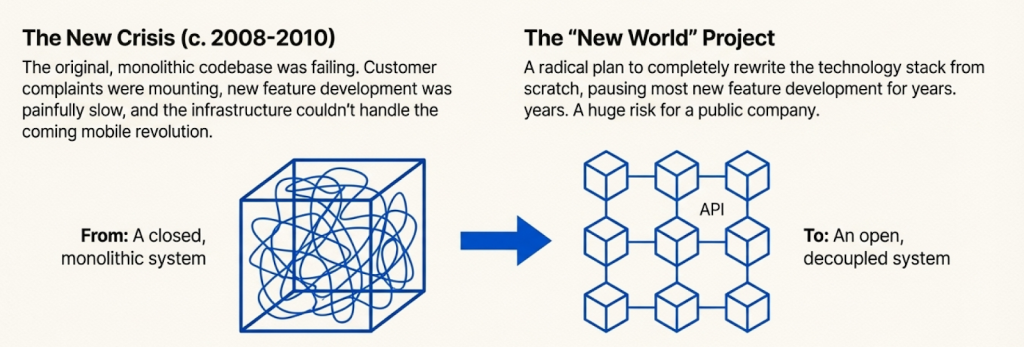
The company’s technical infrastructure, built in-house since 1999, was showing its age. Customer complaints mounted. The codebase had grown into a monolithic tangle that made new feature development painfully slow. And with Apple’s iPhone driving a mobile revolution, Galperin knew the platform needed to handle traffic patterns it was never designed for.
His response was radical. As later recounted in The Generalist’s profile of the company, Galperin moved to a cubicle next to CTO Daniel Rabinovich’s office to learn firsthand what the technical team was dealing with. What emerged from those conversations was “New World,” a plan to completely rewrite MercadoLibre’s technology stack from scratch.
For a public company to pause nearly all new feature development for years while rebuilding its core infrastructure was audacious. Investors might not tolerate it. Competitors could leapfrog them. If the migration failed, the company could lose years of momentum.
The 2013 10-K described the transformation:
“Since 2010, we have been working on a deep technology overhaul that is allowing us to switch from a closed and monolithic system to an open and decoupled one. We are splitting MercadoLibre into many small ‘cells.’ A cell is a functional unit with its own team, hardware, data and source code. Cells interact with each other using Application Programming Interfaces, or APIs. All the Front-Ends are also being rewritten on top of these APIs.”
On October 1, 2012, MercadoLibre unveiled its revamped platform at a launch event in São Paulo, opening its APIs to the developer community. The architectural shift came with an organizational one. Self-sufficient cells replaced monolithic divisions, each with end-to-end ownership of their domain, communicating through standardized APIs rather than internal coordination.
The payoff was transformational. According to Wolf of Harcourt Street’s coverage of the Climbers & Scalers podcast, Rabinovich observed that the company’s hiring curve had been “completely flat for 10-13 years” before starting “an exponential curve since we finished New World.” The new architecture unlocked the organization. Teams could scale without the diminishing productivity that plagued the old monolithic system.
Building the Logistics Moat
Logistics in Latin America presented a distinctive challenge. The region spans 18 countries across multiple time zones, with infrastructure quality varying dramatically between urban centers and rural areas. National postal services were often unreliable. The density economics that worked for e-commerce in more developed markets didn’t translate directly.
Before building its own network, MercadoLibre relied on a fragmented system of regional carriers, from informal motorcycle couriers navigating congested city streets to small trucking operators with limited geographic reach. But these arrangements couldn’t scale with transaction growth. In 2013, Galperin launched Mercado Envíos as a more systematic solution.
The initial offering was modest: a visibility tool that let buyers track packages shipped through third-party carriers. The company acted as an intermediary, providing tracking information without controlling the underlying logistics.
The ambition grew quickly. In June 2016, MercadoLibre acquired Axado, a Brazilian logistics software company specializing in transportation management systems, for $5.5 million per SEC filings. By 2017, the company could offer fulfillment and warehousing services in Brazil, its largest market, with a fulfillment center operating in Louveira, São Paulo State, and cross-docking centers in Campinas, Barueri, and São Paulo. Free shipping launched across Brazil, Mexico, Chile, and Colombia that same year.
Then came the crisis.
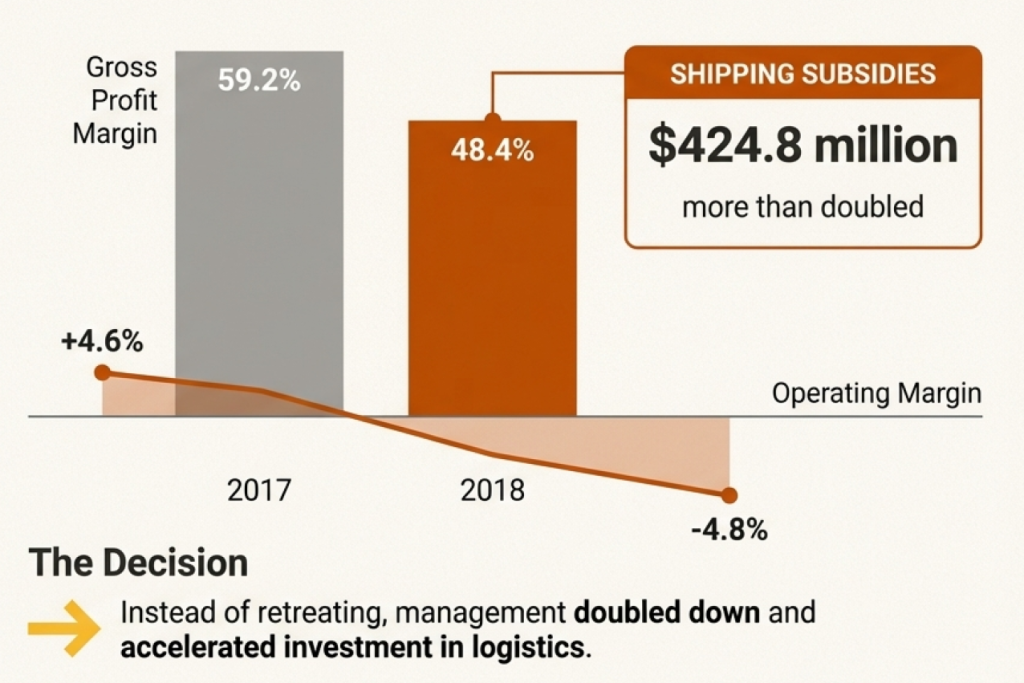
In early 2018, carrier costs in Brazil spiked sharply. The financial impact was immediate and severe. Gross profit margin collapsed from 59.2% in 2017 to 48.4% in 2018, an 11 percentage point drop in a single year. Operating margin swung from positive 4.6% to negative 4.8%, producing an operating loss of $69.5 million. Shipping subsidies more than doubled to $424.8 million, a 134% increase from $181.6 million the prior year.
A nationwide truckers’ strike compounded the chaos. The 2018 10-K documented the disruption: “In May 2018, there was a nationwide truckers’ strike in Brazil in which truck drivers, dissatisfied by the increase in fuel prices, blocked roads throughout the country, preventing the delivery of goods and gasoline to Brazilian businesses.” MercadoLibre experienced “a general slowdown in commercial transactions” during the strike.
Some might have retreated. Galperin doubled down.
Rather than cut back on logistics investment to protect near-term margins, management accelerated the buildout. They expanded fulfillment centers across the region and broadened free-shipping coverage. It was a strategic choice to sacrifice near-term profitability for control over a capability management viewed as essential to long-term competitiveness.
By 2019, Mercado Envíos shipped over 300 million items for the year, up from 45 million just four years earlier. Shipping penetration reached 81% of items sold. The network spanned six countries.
The Fintech Flywheel
Logistics wasn’t the only flywheel spinning up. MercadoLibre had been building financial services infrastructure since launching Mercado Pago in 2003 as a payment solution for marketplace transactions. But the real expansion came later.
Mercado Crédito, the lending arm, launched for merchants in Argentina in Q4 2016. Brazil followed in Q2 2017, Mexico in Q3 2017. Consumer credit rolled out more gradually: Argentina in 2017, Brazil in 2018, Mexico in 2019.
The credit business leveraged something traditional banks couldn’t easily replicate: transaction data. MercadoLibre could see a merchant’s sales history, payment patterns, and customer relationships in real time. This data advantage allowed for faster underwriting and better risk assessment than traditional lenders could achieve with the same customer base.
By the end of 2017, the company had extended $115 million in credit to merchants and $12.5 million to consumers. The credit portfolio stood at $73.4 million outstanding. Small by bank standards, but growing fast and generating valuable data with every loan.
The Pandemic Payoff
Even Galperin couldn’t have known how vital those infrastructure investments would prove to be. When COVID-19 hit in early 2020 and lockdowns shuttered physical retail across Latin America, MercadoLibre’s logistics network was ready.
Latin America saw explosive e-commerce growth in 2020 as consumers shifted online. MercadoLibre’s numbers reflected the surge:
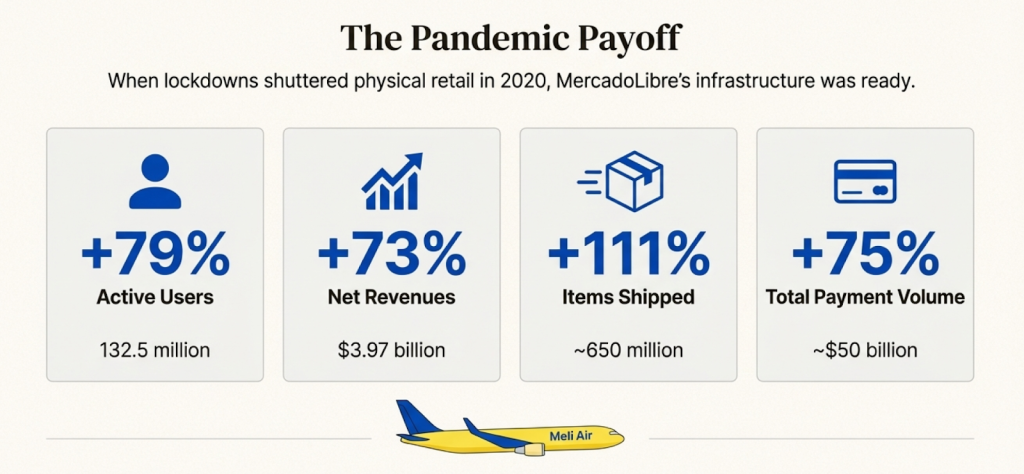
In 2020, the company unveiled Meli Air, a fleet of dedicated aircraft covering routes across Brazil and Mexico to speed deliveries. What had started as third-party carrier integrations had become a continental logistics network with fulfillment centers, cross-docking facilities, aircraft, and a dense web of neighborhood pickup points called “Meli Places.”
The Architecture of Compounding
The decade from 2010 to 2020 revealed MercadoLibre’s operating philosophy. When the technology stack needed rebuilding, they rebuilt it from scratch, spending years without releasing new features. When logistics costs spiked and margins cratered, they invested harder into the very thing crushing profitability. When competitors might have optimized for near-term earnings, they optimized for long-term infrastructure.
Each piece reinforced the others. The technology platform enabled the payments system. Payments data powered the credit engine. Credit financing helped sellers grow, which increased marketplace selection. Better selection attracted more buyers. More buyers meant more shipments. More shipments justified more logistics investment. Lower shipping costs enabled free shipping. Free shipping drove conversion. And the cycle continued.
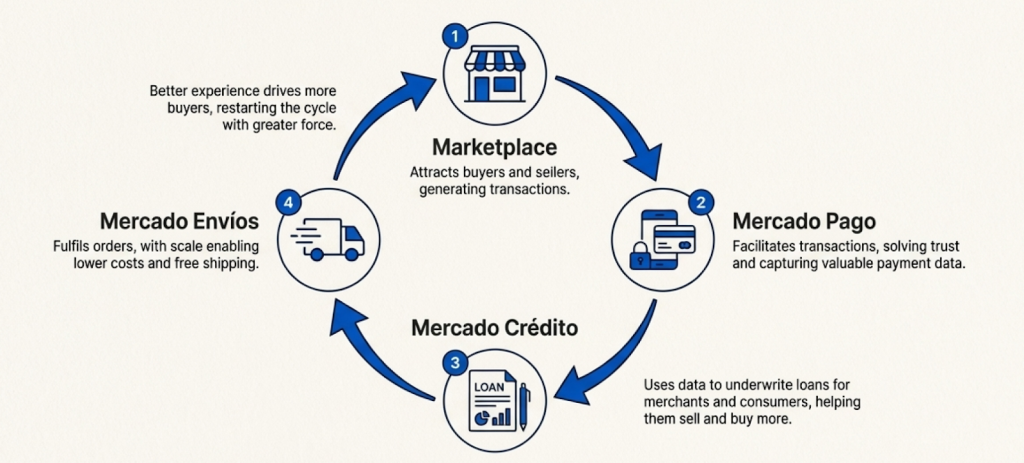
The 2018 margin collapse looked like a disaster in real time. In retrospect, it was the cost of building a moat.
Ariel Szarfsztejn, now Commerce President, put it plainly in a 2025 earnings call: “We would not be a 50 plus billion dollar GMV company today or a year if it were not because of building our logistics infrastructure and launching our free shipping program back in 2017.”
The soft-spoken computer geek from Buenos Aires had built something that exceeded even the vision he’d pitched to John Muse in that Stanford classroom. Not just eBay for Latin America, but a commerce and fintech ecosystem with logistics infrastructure that no competitor could easily replicate.
Next: Part 3 examines MercadoLibre’s current challenges, including margin pressures, competitive dynamics, and the question of whether the flywheel can keep spinning.
>> Click here to subscribe for free to get it when it’s ready.