


I just spent 14 days in Croatia, followed by 3 days in Istanbul. And today I want to jot down four things I took away from this trip: one about health, one about people, one about empires, and one about economic policies.
1. The Mediterranean Diet Is Absurdly Effective (For Me)
About 7 to 8 days into Croatia, my pants and shirt started feeling loose. I didn’t think much of it until I weighed myself. I had lost over 3kg.
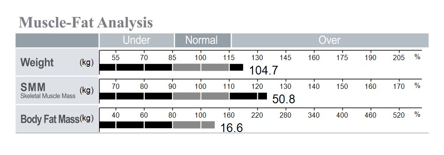
Some context. I did a health screening before this trip. I went in at 104.7kg and I’m 197cm tall. And if anything, I was less active on this trip than when I am back home. I averaged about 8,000 steps a day in Croatia, well below my usual 12-14,000 in Singapore. So this wasn’t a case of walking the weight off.
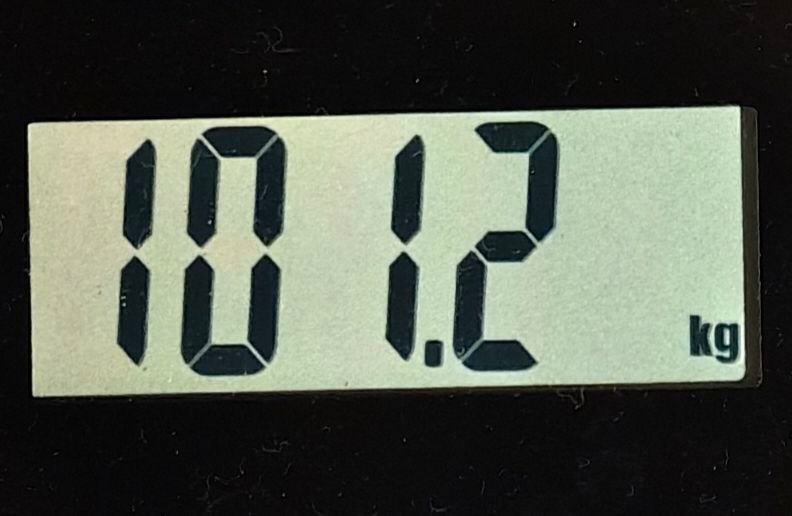
By the end of my Croatia trip, my weight had dropped to 101kg. (I was holding my phone when I weighed myself. It’s 229 grams, yes, I checked.)
Losing 3.7kg in 14 days sounds like an aggressive calorie deficit, but that doesn’t match how I felt. I was energetic the entire trip. I was never hungry. The portions were huge and I was full after every meal. I didn’t track a single calorie. I didn’t hit my step target. I even had gelato every other day.
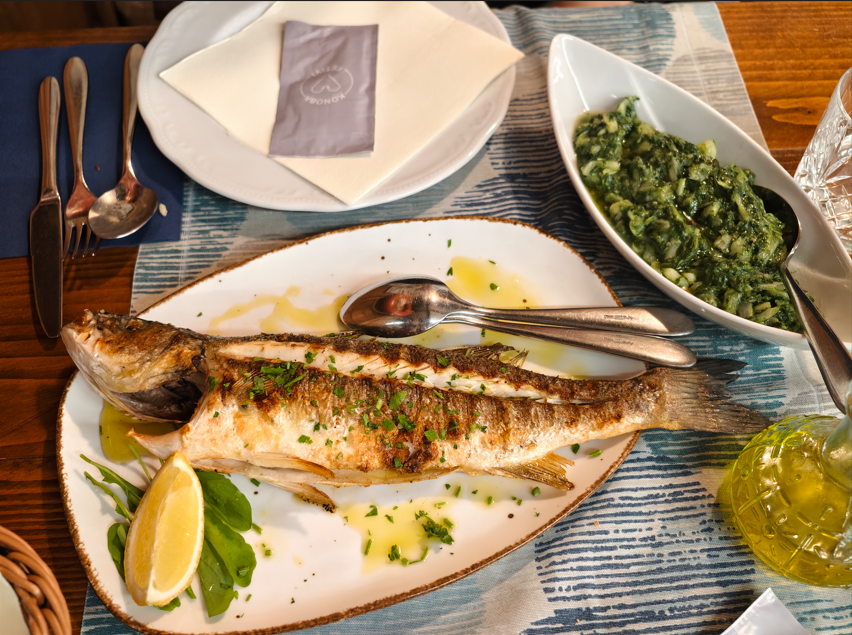
What I did eat: grilled fish, olive oil drizzled on everything, fresh vegetables, and plenty of it. No wine, which is apparently the one part of the Mediterranean Diet I skipped.
Some of the weight loss was probably water. Singaporean food is high in sodium and refined carbs, so dropping both would shed water weight quickly. But even so, something was clearly working.
I’ve heard plenty of good things about the Mediterranean Diet before. But there’s a difference between hearing about it and accidentally running a two-week experiment on yourself. Delicious, healthy, filling. Turns out you can have all three.
2. A Bakery in a War Zone
The second lesson came from the tour guides in Croatia’s cities, and the stories they shared about the Croatian War of Independence.
Between 1991 and 1995, Croatia fought for independence as Yugoslavia dissolved. At its core, it was a war between a Croatian state seeking independence and Serbia wanting all territories where Serbs lived to be under Serbian control. Serbs were roughly 12% of Croatia’s population, but backed by the Yugoslav army, they pushed for roughly one third of the land.
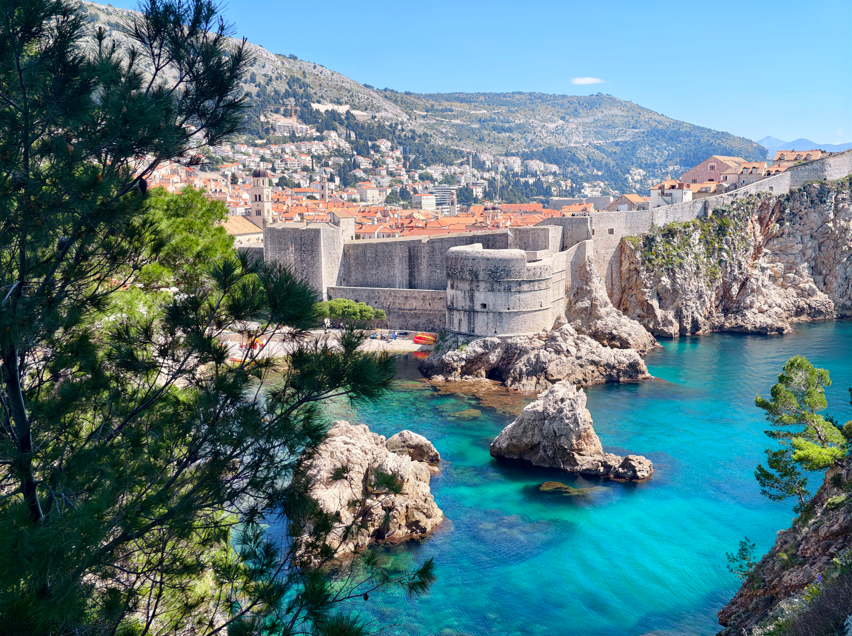
An estimated 250,000 to 300,000 Croats were expelled from their homes, their houses looted or destroyed. Even Dubrovnik, a UNESCO World Heritage Site, was shelled. 56% of the buildings in the Old Town were damaged. The historic walled city sustained 650 direct hits from artillery rounds.
Our tour guide in Dubrovnik was a teenager when the war broke out. Her house was bombed. Her grandfather had to protect the children who would otherwise have been taken away, and they fled from place to place. She had relatives who lost their limbs and their lives.
But of all the stories I heard across Croatia, the most impactful came from our guide in Trogir.
Her grandmother believed one of her sons (the tour guide’s uncle) had been killed in the war. Heartbroken, this woman, living in a rural village, took her entire life savings and set out to find her son’s body so she could bring him home for a proper burial.
She couldn’t find him.
Eventually, she walked into a bakery and asked if anyone had seen her son’s body. They said no. She placed all her life savings on the table and told them: this is yours if you can find my son’s body. Please let me know.
The people at the bakery refused the money and said they would help, but not for the money. The grandmother left it on the table regardless.
Months later, her son came home. Alive. With her life savings in his hand. The bakery had found him and passed the money back.
In the middle of a war where Croats and Serbs were killing each other, where homes were being bombed and families torn apart, the people at that bakery who helped this grieving mother find her son were Serbs.
Not everyone supports the war. There can still be kindness across enemy lines.
You can still see the war in Dubrovnik today, if you know where to look. The city was rebuilt after the shelling, and they tried to stay faithful to the originals, but the new terracotta roof tiles are a brighter orange while the surviving old ones have weathered into a darker shade. From above, the city is a patchwork of old and new. It’s beautiful, but once you know what you’re looking at, it’s a scar.
The tour guides all shared something similar. The pain never fully goes away, even if their rational minds tell them to let bygones be bygones. But they all said the same thing about the next generation: the children don’t carry the same weight. And that gives them hope that pain from the war will heal.
3. The City That Held for a Thousand Years
The third lesson came from my short 3-day visit to Constantinople, or Istanbul as we know it today, and it sent me down a rabbit hole.
Constantinople is a highly strategic piece of land because of one thing: location, location, location.
The city sits on the Bosphorus Strait, the narrow waterway connecting the Black Sea to the Mediterranean via the Sea of Marmara and the Dardanelles. This made it the single most important chokepoint for trade between Europe and Asia, and between the Mediterranean world and the grain-rich Black Sea region. Whoever controlled it controlled an enormous flow of commerce. Russia, Ukraine, Georgia, Romania, and Bulgaria all depend on this chokepoint for naval access to the wider world. This remains strategically relevant today.
Up until 1453, for most of its history as a major capital, Constantinople was under the Romans. And over those centuries, many tried to take it. The city faced armies from Persians, Arabs, Bulgars, Vikings, fellow Christians, and Turks. All failed. Until the Ottoman siege under Mehmed II in 1453.
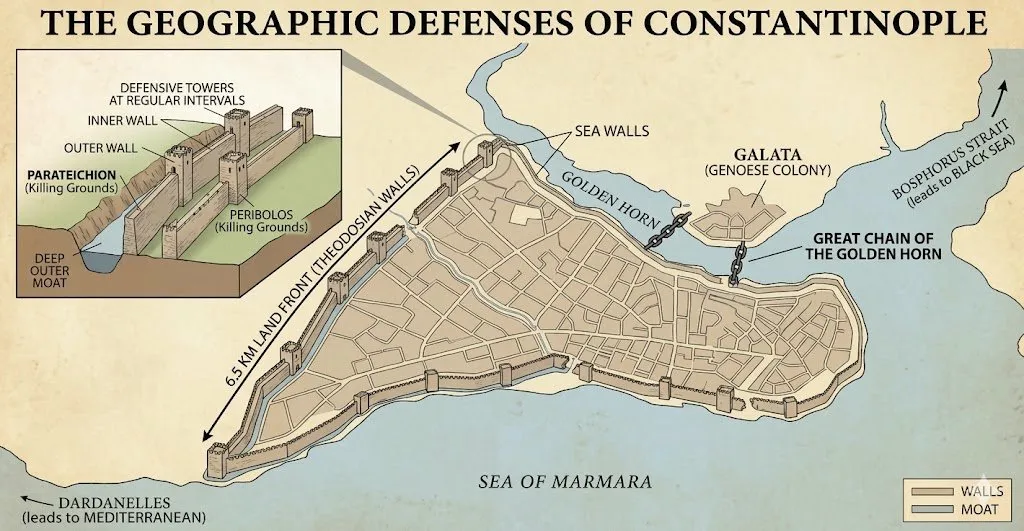
Turns out, Constantinople didn’t just control one of the most important chokepoints in the world. Its geography created a natural fortress as well. The city sits on a triangular peninsula. Two sides were protected by water: the Sea of Marmara to the south, with strong currents and its own sea walls, and the Golden Horn to the north, which they sealed with a massive iron chain stretched across its mouth, blocking enemy ships from entering.
That left only the western land approach, a stretch of just 6.5 kilometres. That’s the entire land front that needed to be defended.
And defend it they did. In the early 400s, Emperor Theodosius II built the Theodosian Walls, an absurdly good defensive system. It wasn’t one wall. It was multi-layered: a deep outer moat, killing grounds, outer and inner walls, and towers at regular intervals. An attacker had to fight through every layer under constant fire from above.
No medieval army had the technology to break through that kind of fortification at scale. You could pound on one section, but defenders could reinforce faster than attackers could exploit a breach. A geography that funnelled armies into a heavily fortified 6.5km stretch of walls meant that Constantinople could defend itself against forces many times its size, again and again, for over a thousand years.
But the city that held for a thousand years eventually fell. And it wasn’t because the walls suddenly became weak. It was because everything behind the walls had rotted away.
By 1453, the Byzantine Empire was an empire in name only. After the Fourth Crusade sacked the city in 1204, the empire never truly recovered. Centuries of civil wars, territorial losses, and financial ruin meant that the “empire” had shrunk to basically Constantinople itself and a few scraps of land.
The population tells the story. At its peak, Constantinople held 400,000 to 500,000 people. By 1453, it was down to about 50,000. Entire neighbourhoods within the walls were abandoned. When Mehmed II showed up with 60,000 to 80,000 troops, Emperor Constantine XI could scrape together roughly 7,000 defenders. That’s not enough to properly man 6.5km of walls.
No navy. No treasury. No allies willing to help without strings attached. The city had survived for centuries by buying off enemies and playing rivals against each other. By 1453, there was no money left for any of that.
And Mehmed was not like previous attackers. The Arabs and Bulgars who had tried before were operating at the edge of their logistical reach. Mehmed? Constantinople was already surrounded by Ottoman territory on all sides. He didn’t need to mount a long-distance expedition. He just walked up from his own backyard.
He also brought something no previous attacker had: cannons. A Hungarian engineer named Orban had offered his services to Constantine XI first, but the Byzantines couldn’t afford him. So Orban went to Mehmed, who paid handsomely. The massive bombards he built could hurl stone balls weighing hundreds of kilograms at the Theodosian Walls, the same walls that had shrugged off every siege weapon for a thousand years. They were not designed for sustained artillery bombardment.
And in a stroke of genius, Mehmed bypassed the great chain across the Golden Horn by having roughly 70 ships dragged overland on greased wooden rails, dropping them into the harbour behind the chain. The defenders now had to cover the sea walls too, stretching their skeleton crew even thinner.
On May 29, 1453, after a 53-day siege, the walls were finally breached. Constantinople became Istanbul, and would remain the Ottoman capital for nearly 500 years.
Constantinople had arguably the greatest competitive advantage in history: an unbreachable defensive system backed by geography, wealth, and naval power. It held for over a thousand years. But advantages erode. The wealth dried up. The navy disappeared. The population shrank. And when a new technology came along that its defences weren’t built for, the thousand-year moat was finally breachable.
4. What Happens When the Central Bank Isn’t Independent
Still in Istanbul, there was another lesson staring me in the face, though this one was about modern Turkey, not ancient Constantinople.
I sat down at a casual spot and ordered a kebab. Nothing fancy. The bill came to 300 lira. I checked the Google reviews for the same place, and photos from a few years back showed kebab prices around 25 to 35 lira. That’s not a typo. Prices here change so fast that some of the menus had white stickers plastered over the old prices, one layer on top of another. Some restaurants had just given up on the lira entirely and started quoting in euros instead.
Our tour guide shared how prices had spiralled out of control over the past few years, and how the government is almost certainly underreporting the real inflation rate. The official numbers are bad enough.
Turkey’s official annual inflation rate was around 20% in 2021. By October 2022, it had hit 85%. It’s come down since, to around 31% as of March 2026, but independent analysts believe the real numbers are significantly higher.
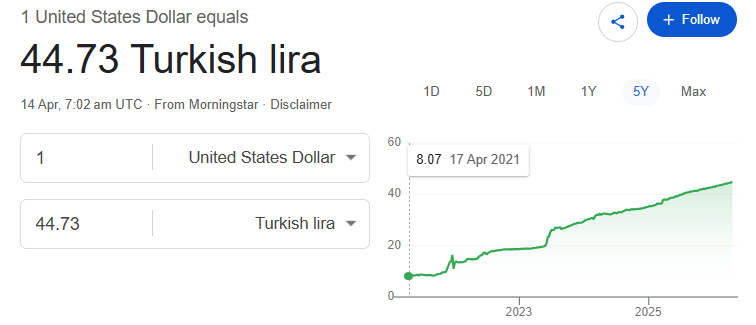
Meanwhile, the Turkish lira went from about 8 per US dollar in early 2021 to around 44 per dollar today. That’s over 80% of its value gone in five years. When your currency loses that much value and you’re a country that imports energy, materials, and technology, everything gets more expensive. Fast.
How did this happen? President Erdogan holds an unconventional economic belief: that high interest rates cause inflation, not the other way around. This is the opposite of mainstream economics, where central banks raise rates to cool an overheating economy. Erdogan has called himself an “enemy of interest rates” and has also cited Islamic beliefs against usury as part of his reasoning.
The problem is, he didn’t just believe this. He enforced it.
Between 2019 and 2021, Erdogan fired three central bank governors in roughly two years. The most dramatic was in March 2021, when he sacked Governor Naci Agbal just two days after the bank hiked interest rates to 19% to curb inflation. Agbal had been on the job less than five months and had been winning investor confidence. His replacement did exactly what Erdogan wanted: slashed rates from 19% down to 14%. The lira lost 44% of its value in 2021 alone.
And they kept cutting. By late 2022, the central bank had pushed rates down to 9%, even as inflation was running above 80%. The lira went into freefall. Ordinary Turks watched their purchasing power evaporate.
After winning re-election in 2023, Erdogan quietly reversed course. A new economic team was brought in and interest rates were hiked aggressively, eventually reaching 50% by March 2024. It was an implicit admission that the previous policy had failed, though Erdogan has never said so publicly.
The lesson is straightforward: when the central bank loses its independence, the consequences are severe and they fall hardest on ordinary people. A president who fires central bankers for doing their job, who replaces them with loyalists willing to cut rates into the teeth of 80% inflation, isn’t just making a policy error. He’s destroying the institutional credibility that takes decades to build and years to repair.
Turkey is still dealing with the aftermath. Inflation at 31% is better than 85%, but it’s not normal. The lira is still near record lows. And the trust that was broken between the central bank, investors, and the Turkish public hasn’t been rebuilt.
Four lessons from 17 days. Take care of your body. Remember that kindness exists, even in the worst circumstances. Know that no competitive advantage lasts forever. And remember that the institutions protecting an economy can take decades to build and just one person to tear down.
Compound wisely,
Thomas