


I remember an old saying many years back, “buy Mastercard (or Visa) and go to the beach.”
I can’t remember where I read this but this saying would work 20 years, 10 years ago, or even today.
The company has been an absolute compounding machine, and after taking a look at their Q2 2026 results, shareholders can probably continue sipping margaritas at the beach.
Gross dollar volume (GDV) is every dollar spent or withdrawn on a Mastercard-branded card anywhere on earth. It grew 8% to $2.88 trillion.
Switched transactions are the transactions Mastercard processes on its own network. They grew 9% to 47.4 billion.
Mastercard-branded cards grew 7% to 3.46 billion cards in circulation, planting the seeds for tomorrow’s GDV growth.
The asterisk inside that 8% is US debit, which grew just 1.3%. That’s Capital One moving its debit cards onto the network it now owns after buying Discover, not Americans spending less. Strip the migration out and US debit grew around 8%, per CFO Sachin Mehra. The drag stays in the numbers until it laps in early 2027.
Even though GDV grew 8%, Mastercard’s revenue grew 12% in constant currency, the cleaner comparison against volumes measured the same way. The extra growth came from its value-added services (VAS), which grew 18% to $3.83 billion.
Payment network revenue, net of rebates, grew 8%, right in line with spending. The gap to 12% is entirely services.
VAS is everything that isn’t part of the payment tollbooth: fraud and cybersecurity (Recorded Future), data analytics, consulting, marketing campaigns for banks, loyalty, identity checks.
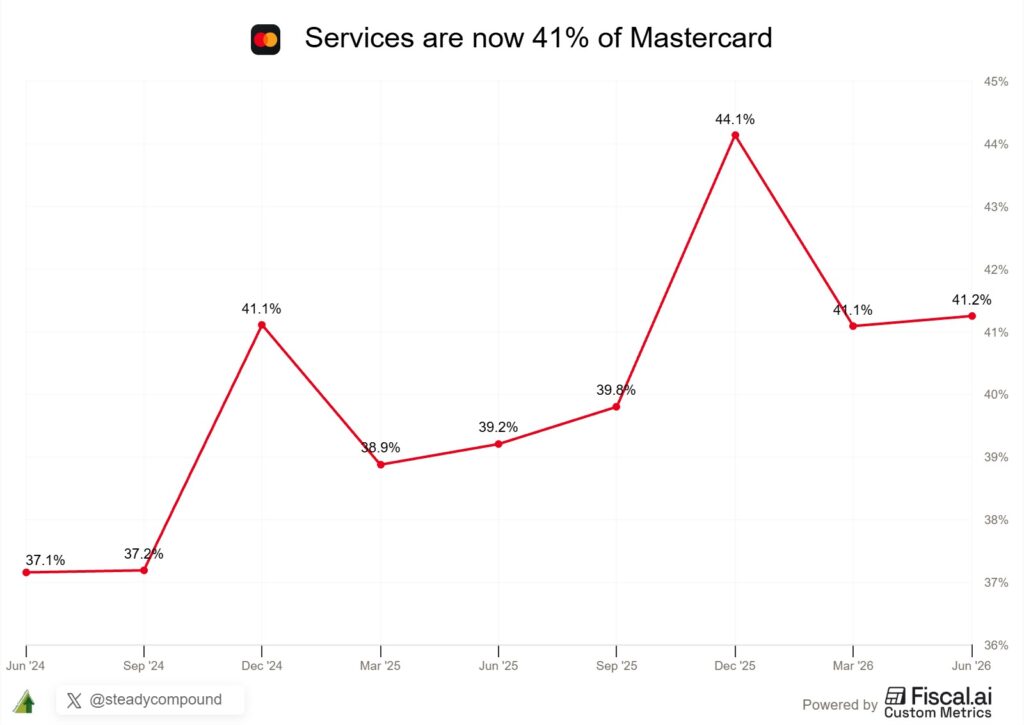
It’s steadily growing too, from 37% of Mastercard’s revenue two years ago to 41% today. This matters because Mastercard doesn’t have to dangle rebates for VAS. It also makes the network stickier, since a bank using multiple Mastercard services is less likely to flip over to Visa over a rebate.
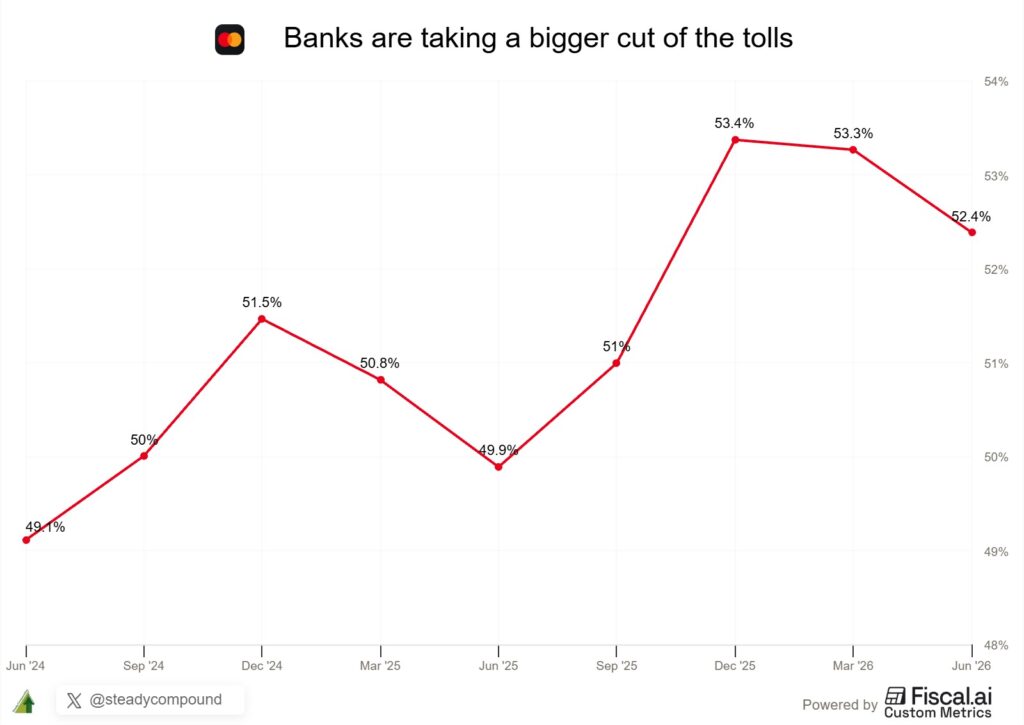
Rebates grew 20% in constant currency to $6 billion this quarter, more than twice as fast as spending. This is money paid back to banks to win and keep their card portfolios…in consumer terms, it funds our cashbacks, miles and signing bonuses.
Of every dollar of network fees Mastercard billed in Q2 2026, about 52 cents went straight back out as rebates, up from 50 cents a year ago (my maths from the filings: rebates divided by network revenue before rebates).
The filings attribute this rebate growth to two causes: growth in key drivers, plus new and renewed deals.
Most rebate contracts are tied to volume, so a strong volume year inflates the rebate line all by itself. The rest is deal activity, and this was a renewal-heavy quarter: Chase Freedom Flex renewed, Banamex locked in with exclusivity across nearly all portfolios, almost 19 million cards.
But Mastercard doesn’t chase deals like this at all costs. It let Lloyds’ credit portfolio go when the economics stopped making sense. Volume for the sake of volume, Mehra said on the Q2 2026 call, is not the game:
“There have been deals which we have competed for, but we’ve done it within the realm of what we thought made good financial sense for us. And if it didn’t work out, we’ve actually passed on it. For example, in Lloyds Credit… Volume for the sake of volume is not what this company should be chasing. Profitable volume, which is going to drive higher net revenue yield is what we’re going to chase.”
So did the rebate surge actually hurt the business? Spending on Mastercard cards grew 8%. Mastercard’s revenue grew 12%.
If the banks’ growing cut were eating the model, revenue would grow slower than spending. It grew faster, by four points.
The fee increases and the services business more than covered everything Mastercard handed back. Rebates are the cost of staying exclusive.
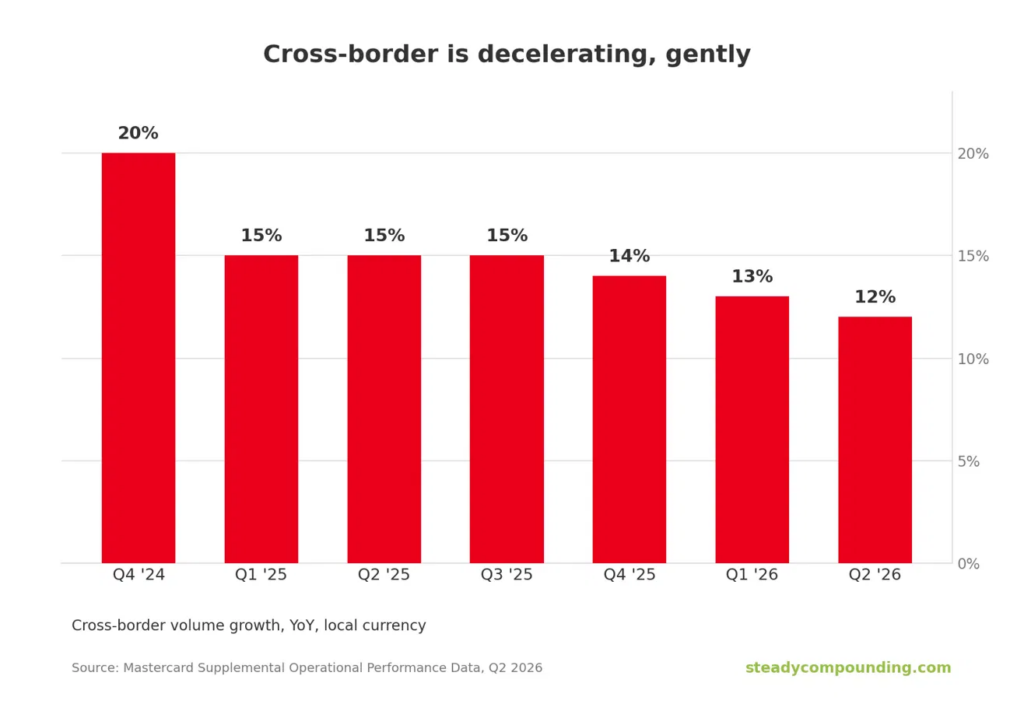
Cross-border volume grew 12%. This is spending where the cardholder and the merchant sit in different countries: travel plus overseas online shopping. It’s the most profitable volume on the network and the most macro-sensitive, and you can see the gradual deceleration over time.
The latest soft spot is travel, largely from the Middle East developments. From Mehra:
“And while cross-border travel was down sequentially, relative to the April metrics we discussed on our last earnings call, we saw improved growth in the quarter due to lower impacts from the developments in the Middle East and timing of holidays.”
Travel grew just 2% in April, the depth of the disruption, then came back to 8% in May and 7% in June as flight capacity returned. For the quarter, travel still grew 6% on last year. Slower than the rest of the network, but better than Mastercard had budgeted, and that gap against plan is part of why the quarter beat.
Also, Venezuela volumes were added to the metrics this quarter, so the 12% is slightly flattered.
While the growth decelerated, Mastercard raised prices. Cross-border assessment fees grew 20% on that 12% volume. From Mehra’s remarks on the call:
“Cross-border assessments increased 20%, while cross-border volumes increased 12%. The 8 ppt difference is driven primarily by pricing in international markets and mix.”
In other words, for pricing in international markets, Mastercard raised the fee schedule on cross-border transactions. And for mix, that’s because not every cross-border dollar pays the same toll.
If growth skews toward the expensive corridors and toward transactions needing conversion, the blended rate rises without anyone touching the price list. A transaction from Singapore to a US merchant, with currency conversion, carries a higher rate than a euro transaction between Germany and France inside one currency zone.
So let’s stack it all up. Volume grew 8%. Revenue grew 12%. Adjusted EPS grew 19% in constant currency to $5.04, with costs growing slower than sales and margins expanding along the way. Each line grows faster than the one above it. That’s the compounding machine, and it returned $5.7 billion to shareholders this quarter through buybacks and dividends. The first four weeks of July came in relatively stable and strong, and management now expects full-year revenue to land higher within its guided range.
This was also Mehra’s final earnings call as CFO after seven-plus years. He’s now Chief Business Officer, and Ling Hai took over as CFO on 3 August.
Only two things would pull me off the beach: cross-border growth slipping below 10%, or the banks’ share of the tolls (rebates as a share of gross fees) still climbing a year from now, once this wave of renewals has been digested. Cross-border is at 12%. The rebate share is climbing, which is exactly why the test sits a year out: if this is the renewal wave, it flattens once Banamex and Chase are lapped.
Nothing in this quarter changed the thesis. The margaritas are on Mastercard.
Here’s the thing about sipping margaritas at the beach. I can do it because I know exactly what I’m checking every quarter. Compounding machines have tells. A tollbooth everyone must pass through. Services growing faster than volume. Every line on the income statement is growing faster than the one above it.
The Lunch Break Investor shows you how to spot them, so the business does the heavy lifting while you live your life.
Grab your copy:
Compound steadily,
Thomas
P.S. If you’re in Singapore, come hang out at my book talk. Book Bar, 57 Duxton Road, Saturday 5 September, 2pm. Reggie from The Financial Coconut will be grilling me on the book and you’ll get to ask questions. Come say hi, I’ll be signing copies after.
Disclaimer: This research reports constitutes the author’s personal views only and are for educational purposes only. It is not to be construed as financial advice in any shape or form. From time to time, the author may hold positions in the below-mentioned stocks consistent with the views and opinions expressed in this article. Disclosure – I hold a position in Mastercard at the time of publishing this article (this is a disclosure and NOT A RECOMMENDATION).