


On 23 November, Nvidia gained about $950 billion in a single day because one man got his job back.
Jensen Huang co-founded Nvidia in 1993 and was its only CEO for 33 years, until he “resigned” on 12 November. In the two weeks after the scandal broke, the stock lost a third of its value. Eleven days after he left, the board reinstated him, and the stock jumped 31.5%.
I came across this meme recently, and I thought it was pretty illustrative of the risk.
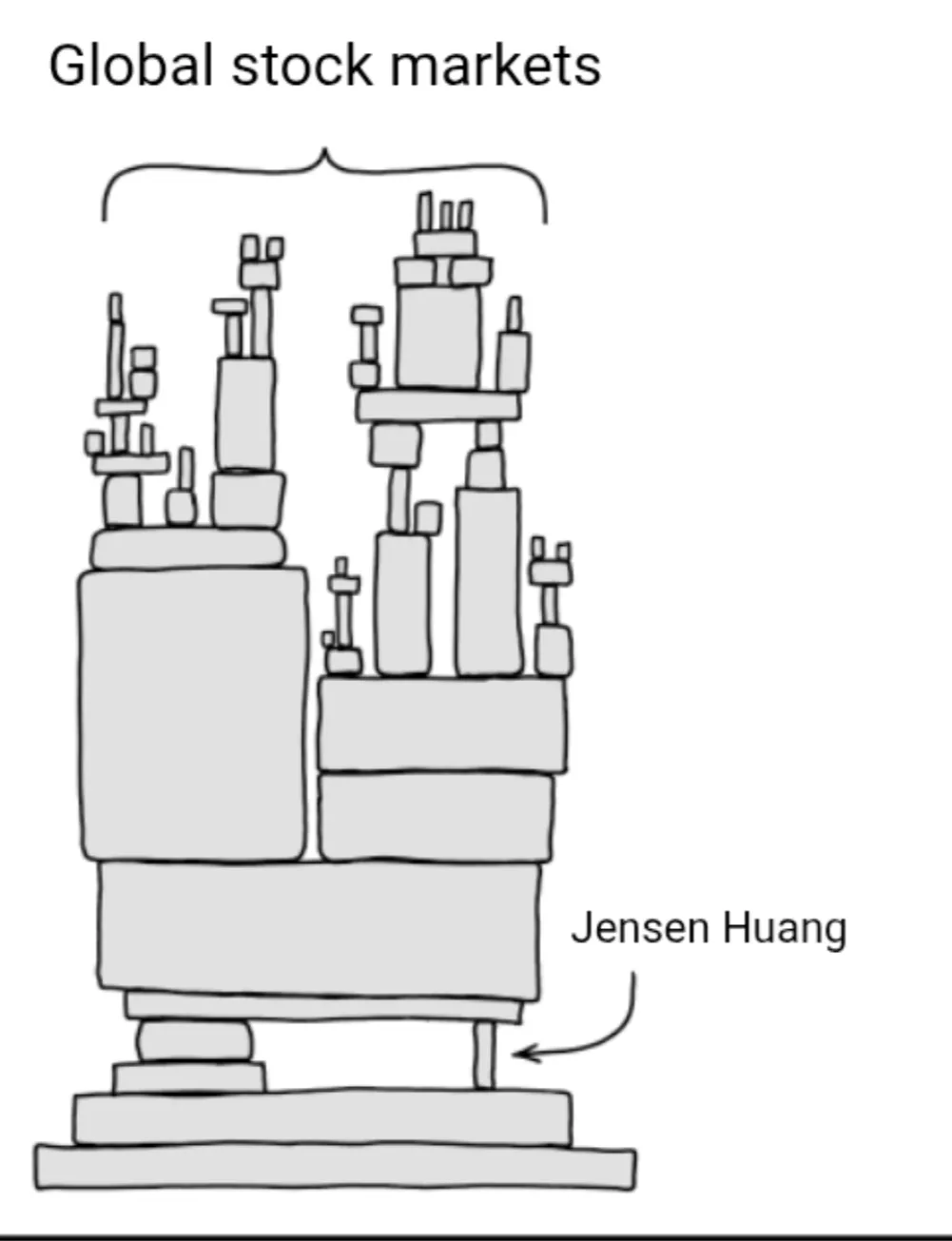
I don’t own Nvidia, and I don’t invest in chips. But I own Meta, so I can’t treat this as somebody else’s problem.
Key man risk
In investing lingo, this is key man risk. It’s when too much of a company’s value depends on one person.
It shows up wherever one person is the face of the company. When you think of Tesla, you think of Elon Musk. With Meta it’s Mark Zuckerberg, with Airbnb it’s Brian Chesky, and for a long time Apple was Steve Jobs. These people move the needle for their businesses, which is usually why we want to own them in the first place.
Buffett once repeated an old stock market saying that goes back to Peter Lynch: buy a business doing so well that “an idiot could run it, because sooner or later, one will”. With a superstar CEO, it’s hard to tell if we own that kind of business, and the day that person leaves is a bad time to find out. So what matters is whether there’s a plan for that day.
Apple had one, because it had time. Steve Jobs stepped away for health reasons three times between 2004 and 2011, and each time Tim Cook ran the company. When Jobs resigned in August 2011, his letter asked the board to “execute our succession plan”, and Cook was named CEO the same day.
Nvidia had nobody lined up. Jensen has long been against picking successors in advance (in a 2009 Stanford talk he called it “a toxic, toxic process”), and for years it was pretty much free rein for him. Nvidia was run like a startup, with about 60 people reporting straight to him by his own count, and no obvious number two. It didn’t even have a board chairman until the day he resigned.
So when he left, the CFO stepped in as interim CEO and the board hired a search firm. On 17 November, chairman Harvey Jones said on the earnings call that the board “does not intend to reinstate Jensen as CEO”. Six days later, it did.
Jensen is back, but I think this is a wake-up call for Nvidia’s board, and it’ll be interesting to see how they deal with succession planning from here on out.
Concentration risk
As outside shareholders, we can’t write a company’s succession plan. What we can control is how much of our portfolio depends on any one company. Having too much in a single name is called concentration risk.
Howard Marks likes to tell a story from his father. A gambler on a long losing streak finally finds a bet he can’t lose, a race with a single horse in it, and puts the rent money down. The horse makes it halfway round, hops the fence and is gone.
No matter how confident you are in a company, there’s no such thing as being all in and hoping for the best. Black swans like this do happen.
Extreme concentration can create wealth quickly, but it can destroy it even faster. I like to keep the number of stocks I own somewhere in the mid to high teens, so that no single company, and no single person, can sink the whole portfolio.
My book, The Lunch Break Investor, covers how to find and value good businesses, and it has a full chapter on building a portfolio like this.
Compound wisely,
Thomas