


What the COVID-19 crash taught me about my CPF, and what happened when I used the CPF Retirement Payout Planner.
This piece is a paid collaboration with the Central Provident Fund (CPF) Board. The views are mine.
SQ 656 to Fukuoka. I couldn’t have been more excited about seeing cherry blossoms for the first time in my life, after booking the trip nine months earlier.
But I never took that flight to Japan.
By March 2020, COVID-19 had stopped being news from somewhere else. Borders were closing. Friends were quarantined in five-star hotels, sending me photos of their meals, and I’m not gonna lie, I was a little jealous of their “new” working environment.
Travel shut down about a week before my flight, and that was the end of my Japan trip.
But that wasn’t the only bad news. The markets were falling at the same time.
In the US, the stock market’s emergency brakes kicked in four times in eight trading days, on 9, 12, 16 and 18 March. Each time, trading froze for 15 minutes because prices were falling too far, too fast. They’re called circuit breakers. And a few weeks later, Singapore used the same name for its lockdown.
I remember scrolling through Twitter during those days, and it was all chatter about how this could cause the next big recession, and how many years it could last. It was the same in the office. Everyone was drawing comparisons to the 2008 financial crisis, or even further back, to the Great Depression.
That was the fastest the US stock market had ever dropped over 30%. It was also the first bear market, a fall of more than 20%, that many had ever experienced, because there hadn’t been one in over a decade.
That month, I ran out of cash I’d set aside for investing.
When the stock market goes on a decline, I don’t try to guess where the bottom is. When good businesses go on sale I buy a bit, and if prices keep falling, I buy a bit more. That March I just kept buying as the market fell, until that cash dried up.
And just to be clear, my salary was still coming in, and my emergency cash was untouched. I have it set to cover two years’ worth of expenses, and yes, it’s more than the usual six months, but it allows me to invest with a level head, because I know my daily life would be unaffected by market fluctuations.
That month was also the only time I’ve ever invested my CPF.
The reserve I forgot I had
I don’t usually think about investing my CPF. For years I just kept it as a risk-free way of saving for retirement. It was my anchor.
Then my investing cash ran out, with prices still falling. It was frustrating, because there were great opportunities out there, but I had no more bullets. And that’s where I started to think about my Ordinary Account (OA), the CPF account used for things like housing. So I did something I’d never done before and invested part of it through the CPF Investment Scheme.
Why just the once? Two reasons.
First, the bar was high. My OA was earning 2.5% to 3.5% a year without me having to lift a finger while my cash in the bank back then earned close to nothing. So it made sense to use my cash outside of CPF first, because giving up a guaranteed 2.5% had a real cost.
Second, and more importantly, as I watched the markets fall, it calmed me to know that my CPF was stable. And mind you, I was still drawing a salary then. Imagine going through that in retirement, without a regular salary to fall back on. How much more nerve-wracking that would feel.
In retirement I’d lean even heavier on CPF as an anchor. To be honest, I hope I never have to retire because I can’t imagine doing nothing at all, and I’d want to keep my mind active doing things I love for as long as I can. But I have to plan for the years when I can’t work anymore, and that’s where CPF LIFE comes in. It pays me a monthly income from 65 for as long as I live, and I want it to cover at least my basic needs.
Former spreadsheet warrior
In my early twenties, when I was a spreadsheet warrior, I first tried to put a number on the basics. Food, transport, utilities, insurance, medical bills, you name it. I listed out all my expenses, adjusted for inflation, and estimated how much I needed to save for my golden years. I worked it out to the second decimal point and I was so proud of what I’d planned, and that I’d gotten it all sorted out.
Looking back now, I can’t help but think, ha! Cute attempt. My expenses look nothing like what I projected, which reminded me of the saying: it’s better to be roughly right than precisely wrong.
I’m not a big spender and I’m still not a fan of owning things, especially luxury. But I do prioritise health and experiences.
I try to eat better now. When you’re young, your body can put up with a lot. Now that I’m older, I’d rather it didn’t have to.
On holidays, I can no longer stay in a hostel with five other strangers moving in and out in the middle of the night, much less go backpacking.
And I pay for extra legroom now on flights. At 197cm and with age, my knees are less forgiving, especially on long-haul flights.
So obviously I kinda underbudgeted for my retirement, but hey, better to have tried and learned than not at all.
Because planning for retirement without a number is like opening Google Maps without typing in a destination. How are you supposed to get directions?
I understand why people put it off, though. Opening a blank spreadsheet to guess at your life decades from now is intimidating, and I say that as someone who likes spreadsheets.
But you don’t have to start from a blank spreadsheet. That’s what the CPF Retirement Payout Planner is for. You fill in a few details, make a few choices about the retirement you want, and voilà, you have a destination.
$5,000 today, $8,880 at 65
The planner helps you with three things:
- Set a payout goal, which is how much you would like to spend every month in retirement.
- Project your monthly payouts, based on your CPF balances, when you want payouts to start, and which CPF LIFE plan you pick.
- Simulate top-ups to close the gap between your payout goal and your projected payouts.
You can start with either of the first two. I went with the goal first, aka set the destination, then worked backwards.
The planner asked how much I’d spend every month after I retire, in today’s dollars. It then adjusts for inflation and shows what that works out to by the time I’m 65.
Great! This saves me from mutating back into a spreadsheet warrior.
But going by my track record, there’s bound to be some lifestyle inflation along the way, which was what broke my old spreadsheet.
So I gave myself some buffer and set it to the maximum the planner allows, $5,000 a month, with payouts beginning at 65 years young.
If you’re not sure what number to put, the planner’s retirement payout guide asks a few questions about the lifestyle you want, and suggests an estimated payout amount. I skipped it, since I already knew I wanted the maximum.
Then it asked me to pick one of three CPF LIFE plans. I went with the Escalating Plan because I want my payouts to keep up as prices rise. That just means they start lower but go up 2% every year.
And there it was.
After factoring in inflation, my $5,000 a month becomes $8,880 a month by the time I’m 65. That’s $3,880 more every month just to maintain the same lifestyle.
Easy peasy, lemon squeezy.
The exercise, I mean. Easier than opening up my once-trusty spreadsheet, for sure.
Next, my projected monthly payout from my CPF savings.
The planner offered a quick estimate or a personalised projection. Of course I personalised it.
It asked for my salary, bonus and expected yearly increment. I have relatives reading this, so I’m not going to reveal it here. They can keep guessing at the next Lunar New Year reunion.
So I used Singapore’s median income from MOM instead, which works out to about $4,300 a month plus a 1.8-month bonus, growing 3.9% a year.
Fair warning: I’ve just paired the planner’s maximum goal with a median salary, which is a bit like planning a five-star Fukuoka trip on a hostel budget. The gap is going to be big, and so will the top-up numbers later on. That’s down to the lifestyle I picked, and a more modest goal shrinks the gap with it. You can also use the planner to explore different projections and set goals based on your own retirement lifestyle and expectations.
Based on the income I entered, the planner projected $2,510 a month at 65. A little over a quarter of my $8,880 goal.
With my retirement goal and projected CPF payouts in place, I moved on to the final part of the planner: Your Options. This gave me an overview of how my projected payouts stacked up against my goal, and what I could do to close the gap. In my case, that left me with a shortfall of $6,370 a month.
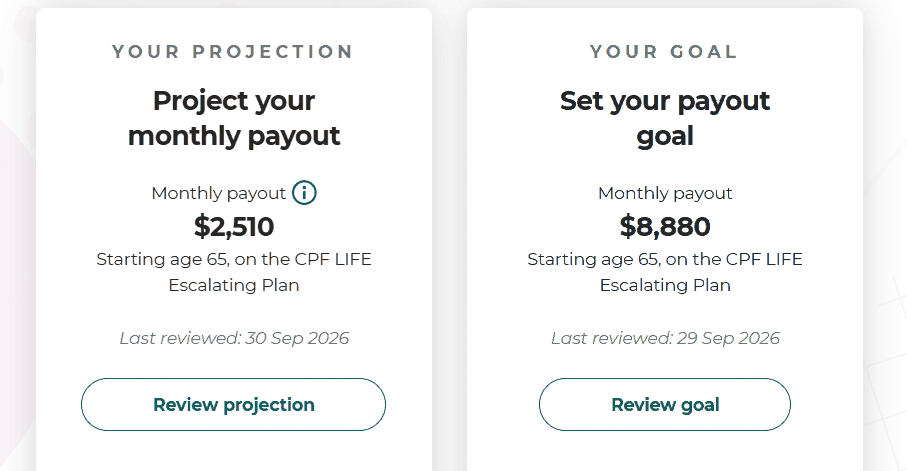
That didn’t surprise me. For the lifestyle I want, CPF was never meant to carry the whole thing on its own. But seeing the gap in black and white helps.
The planner suggested monthly or one-time top-up amounts to help close the gap. I tried the one-time option first and, as warned, the number came out high. I’ll spare you the figure, since yours will depend on your own retirement goal and CPF balances.
So I decided to see how much more CPF could provide by simulating a yearly cash top-up of $8,000, the maximum you can top up to your CPF and still get tax relief. The projected payout went up by $840, to $3,350 a month, which is over a third of my goal.
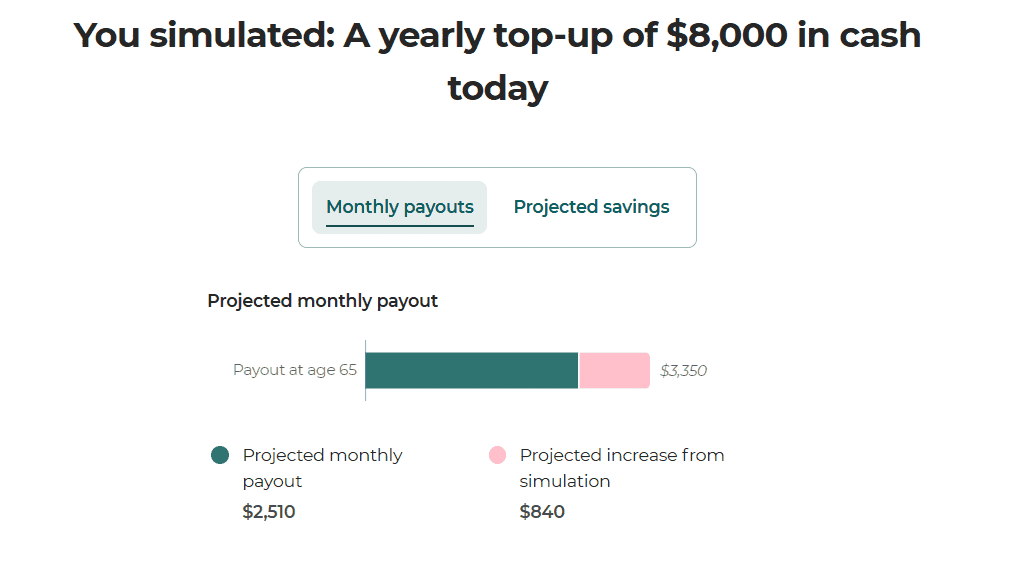
The Retirement Payout Planner gave me a clearer picture of how much I’d need in retirement and what CPF LIFE could provide. My old spreadsheet gave me a number precise to the second decimal point, and it was wrong, because even the most precise calculation is only as good as the assumptions behind it. Now I have a practical starting point I can revisit as my circumstances change, and a clear split of jobs: CPF LIFE pays the base for as long as I live, and my portfolio works on the gap. Roughly right beats precisely wrong.
My CPF is the part of my retirement that isn’t exposed to market risk. It kept growing steadily through March 2020, even as the market tanked. That’s my anchor. The rest is on my portfolio, and now I know the gap it has to plug.
If you’ve never put a number on your retirement, start with the Retirement Payout Planner. And if you’re near the north of Singapore, drop by CPF Board’s interactive Ready for Life roadshow at Northpoint City (South Atrium, Level 1), 20 to 22 November, 10.30am to 8pm, to learn more about how you can prepare for retirement. No registration needed.