


Microsoft reported its Q2 2026 earnings this week, beating across the board but the market shrugged it off and shares dropped 10% post earnings.
Financial Highlights
Revenue came in at $81.3 billion, up 17% year-over-year.
Operating income hit $38.3 billion, up 21%. Net income under GAAP was $38.5 billion, up 60%.
Non-GAAP EPS came in at $4.14, up 24%. Microsoft Cloud revenue reached $51.5 billion, up 26%.
A note on the GAAP numbers: The 60% net income growth includes a $7.6B gain from OpenAI investments following OpenAI’s recapitalization. The non-GAAP figures, 23% net income growth and 24% EPS growth, better reflect underlying operating performance.
Operating margins came in at 47%. Cash flow from operations was $35.8B, up 60% year-over-year.
Strong numbers by any measure. But the market is focused on three concerns.
Three Concerns
1. Azure Growth vs. CapEx
Azure’s 39% growth is strong by any measure. But analysts raised concerns about CapEx growing faster than expected while Azure growth came in slightly below expectations.
Keith Weiss from Morgan Stanley:
“I think one of the core issues that is weighing on investors is CapEx is growing faster than we expected, and maybe Azure is growing a little bit slower than we expected. And I think that fundamentally comes down to a concern on the ROI on this CapEx spend over time.”
The numbers: Quarterly CapEx was $37.5B. Two-thirds went to GPUs and CPUs, one-third to long-lived infrastructure.
Amy Hood explained that capacity is first allocated to first-party AI products and R&D, with the remainder going to Azure:
“If I had taken the GPUs that just came online in Q1 and Q2… and allocated them all to Azure, the KPI would have been over 40.”
In other words, if Microsoft weren’t investing in their own products, Azure’s growth rate would have been above 40%.
So where is that capacity going?
- First-party AI products: M365 Copilot, GitHub Copilot, Security Copilot
- R&D compute: Product teams building new AI capabilities
- Infrastructure replacement: End-of-life server and networking equipment
This is a deliberate choice. Microsoft is prioritizing its own software stack over renting raw compute to third parties.
In my opinion, I’m happy that management is taking the long view and investing in its own products because it’ll result in better margins and make them harder to compete with in the long run.
And so far, evidence does suggest that this trade-off is paying off. Microsoft’s first-party AI products are monetizing well.
M365 Copilot:
- 15 million paid seats
- Seat adds up 160% year-over-year
- Daily active users up 10X year-over-year
- Conversations per user doubled year-over-year
- Large deployments scaling: Publicis bought 95,000 seats, multiple customers at 35,000+ seats (tripled Y/Y)
GitHub Copilot:
- 4.7 million paid subscribers, up 75% year-over-year
- Copilot Pro+ subscriptions up 77% quarter-over-quarter
Fabric (data analytics platform):
- ARR now over $2B with 31,000+ customers
- Revenue up 60% year-over-year
Foundry (AI platform):
- Customers spending $1M+/quarter grew ~80%
- 250+ customers on track to process 1 trillion+ tokens this year
Microsoft is making a bet: that owning the AI application layer is more valuable than maximizing cloud infrastructure rental revenue.
Azure compute is increasingly commoditized. AWS, GCP, Oracle, and a growing list of alternative clouds can all rent you GPUs. Competing purely on infrastructure means competing on price, availability, and scale. Margins compress over time.
First-party AI software is differentiated. M365 Copilot isn’t just AI. It’s AI deeply integrated into the productivity tools that 450 million commercial users already depend on. It has access to Work IQ, the organizational graph of people, documents, communications, and relationships. A competitor can’t replicate this without replicating the entire M365 ecosystem.
The same logic applies to GitHub Copilot (access to the world’s largest code repository network), Security Copilot (integrated across Defender, Entra, Intune, Purview), and Dynamics 365 agents (connected to CRM/ERP data).
The margin profile is better. Renting raw Azure compute generates cloud infrastructure margins. Selling Copilot seats on top of an existing M365 subscription is largely incremental margin. The customer acquisition cost is near zero, the infrastructure is shared, and the switching costs are high.
By reserving capacity for its own AI products, Microsoft is trading near-term Azure revenue growth for higher-margin, more defensible long-term revenue streams.
2. OpenAI Concentration
This one is more concerning.
Approximately 45% of Microsoft’s $625B commercial remaining performance obligation (RPO) is tied to OpenAI.
That’s not a typo. Nearly half of the contracted backlog is one customer.
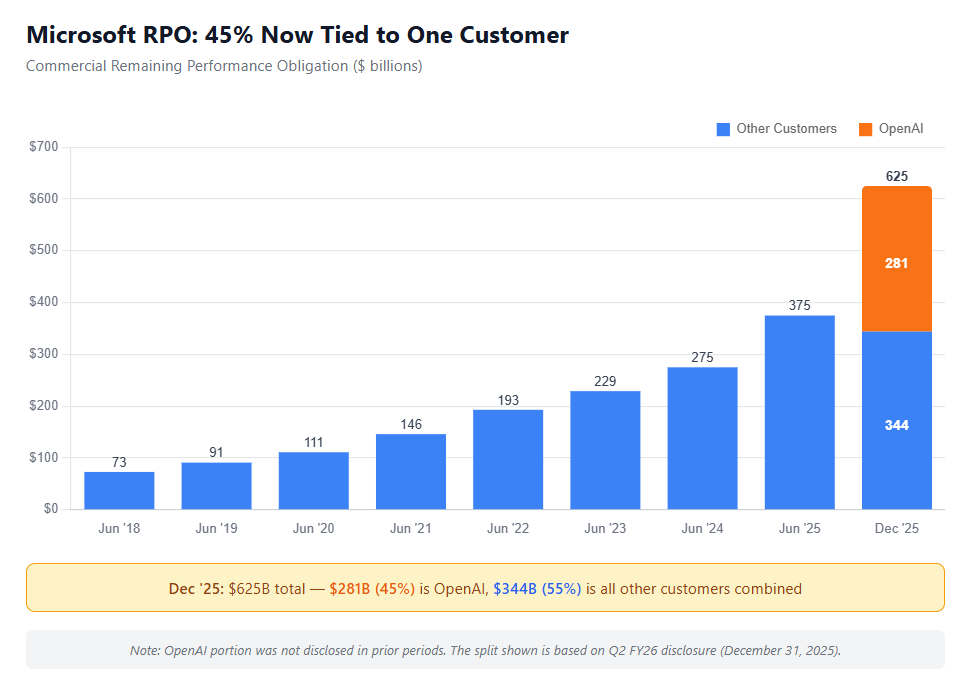
Management’s counter-argument is that the remaining ~$350B of RPO grew 28% and is “larger than most peers, more diversified than most peers.” This is true and worth acknowledging. The non-OpenAI business is healthy and broad-based.
But a 45% customer concentration would raise concerns in any context.
Especially so when OpenAI, despite its prominence, is a company that burns significant cash and relies on continued fundraising. It has strategic reasons to diversify cloud providers over time. And it’s developing its own custom AI chips in a partnership with Broadcom announced in October 2025, with deployments starting in late 2026.
Microsoft’s partnership with OpenAI has been enormously valuable. But the concentration risk is real. If OpenAI’s growth slows, or if the relationship evolves, the impact on Microsoft’s reported backlog and bookings growth would be substantial.
3. Depreciation and Obsolescence
Microsoft depreciates AI hardware over six years, but AI hardware cycles are shortening.
If the economic useful life is shorter than the accounting useful life, Microsoft may be understating depreciation. That would flatter current earnings at the expense of future write-downs.
Management’s defense: software optimization extends hardware utility. They cited a 50% throughput improvement on OpenAI inferencing workloads. Contracts are also structured to match hardware life. Amy Hood noted that most GPUs being purchased are already contracted for their full useful life.
Satya Nadella added:
“We do use software to continuously run even the latest models on the fleet that is aging… It’s not about buying a whole lot of gear one year. It’s about each year you ride the Moore’s Law, you add, you use software, and then you optimize across all of it.”
Segment Performance
Productivity & Business Processes came in at $34.1B, up 16%. M365 Commercial cloud grew 17%, driven more by ARPU expansion than seat growth. Seats grew 6% to over 450 million, while ARPU growth was led by E5 upgrades and Copilot attach. M365 Consumer cloud grew 29%. Dynamics 365 grew 19%. LinkedIn grew 11%.
Intelligent Cloud came in at $32.9B, up 29%. Azure grew 39%. On-prem server grew 2%, helped by the SQL Server 2025 launch.
More Personal Computing came in at $14.3B, down 3%. The weak spot. Windows OEM grew 5% on Windows 10 end-of-support tailwinds. Search grew 10% but missed expectations due to what management called “execution challenges.” Gaming was ugly. Revenue down 9%, and the company took impairment charges on gaming assets.
Forward Guidance
A few things to watch.
Q3 Azure is guided to 37-38% growth, a slight deceleration. Management pointed to tough prior-year comps and continued capacity constraints.
Cloud gross margins are guided to 65%, down from 67% in Q2. AI investments remain margin-dilutive near term.
Windows OEM is guided down roughly 10% as the Win10 end-of-support tailwind fades.
Full-year operating margins are now expected to be “up slightly,” an improvement from prior guidance.
Conclusion
Microsoft delivered a strong quarter. Revenue, operating income, and EPS all beat expectations.
AI monetization is underway. M365 Copilot, GitHub Copilot, and Fabric are generating billions in real revenue at impressive growth rates.
The strategic decision to prioritize first-party AI software over Azure infrastructure revenue is defensible. Differentiated software earns better margins and creates deeper moats than commoditized compute rental. If Copilot usage and renewals hold up, this will prove to be the right long-term move.
That said, the market’s concerns are fair:
- OpenAI concentration at 45% of RPO is genuinely unusual and creates exposure to a single customer relationship that Microsoft doesn’t fully control.
- CapEx intensity is elevated and the conversion timeline to returns requires trusting management’s allocation decisions.
- Cloud gross margins are compressing, driven by investments in AI.
The underlying franchise remains exceptional. 28% RPO growth ex-OpenAI. 450M+ M365 seats. Dominant positions across productivity, developer tools, and enterprise software.
Let’s see if Mr. Market gives us a window of opportunity.
Compound wisely,
Thomas
Disclaimer: This research reports constitute the author’s personal views only and are for educational purposes only. It is not to be construed as financial advice in any shape or form. From time to time, the author may hold positions in the below-mentioned stocks consistent with the views and opinions expressed in this article. Disclosure – I hold a position in Microsoft at the time of publishing this article (this is a disclosure and NOT A RECOMMENDATION).