


We Debuted at #1
The Straits Times bestseller list came out yesterday, and The Lunch Break Investor debuted at #1 on the non-fiction chart in its first week.
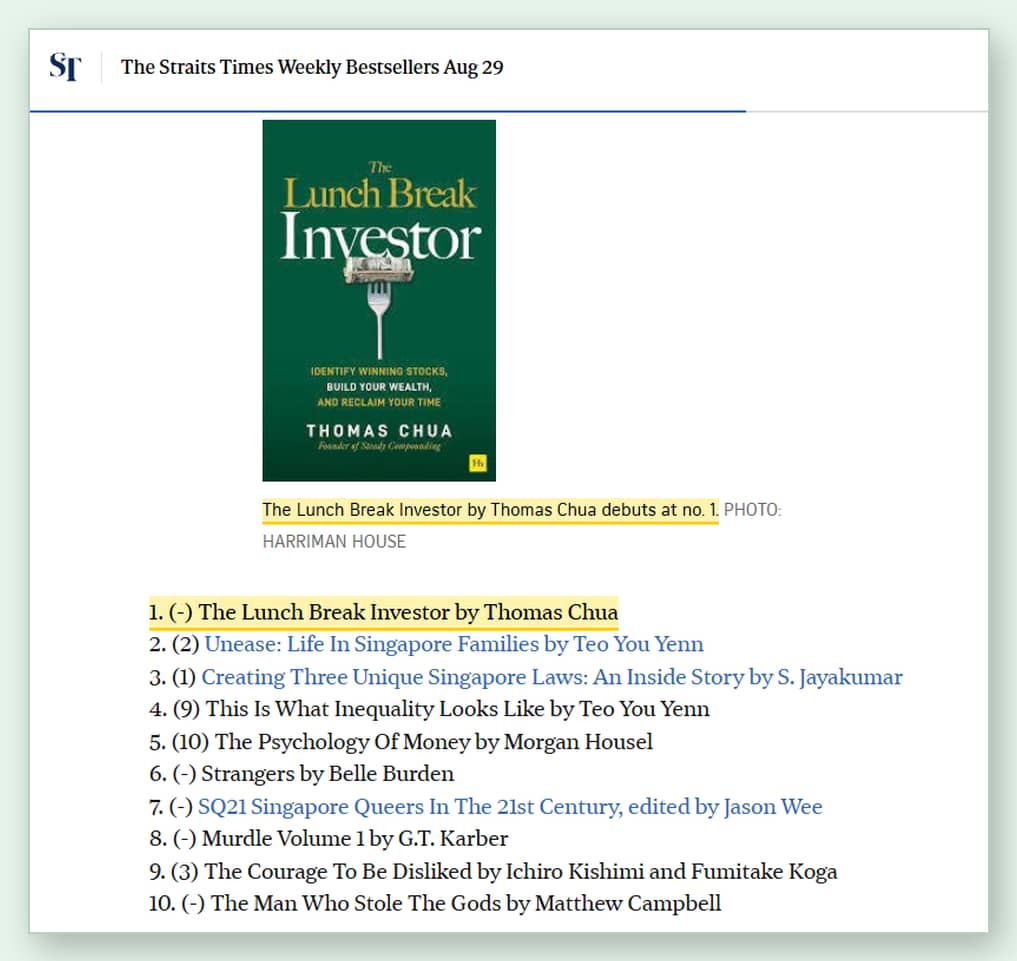
Thank you to everyone who grabbed a copy. This book took years to write and I’m overwhelmed… seeing it at the top of the list.
If you want to celebrate with me in person, come to my book talk at Book Bar, 57 Duxton Road, this Saturday 5 September, 2pm.
Reggie from The Financial Coconut will be grilling me on the book and you’ll get to ask questions.
This will be my second and last book talk in Singapore, so if you want your copy signed, head down with it, or even better, grab one that day. You can reserve copies here, recommended especially if you’re buying in bulk.
The most I’ve signed in one go for one person is 7 copies, so let’s see if we can beat that number this time.
For those buying online or outside Singapore: steadycompounding.com/book.
Compound Steadily,
Thomas
I. The Other Debt Chart Behind the $40 Trillion Headline
Morgan Housel started writing about finance in 2008, the year federal debt crossed $10 trillion and the number was treated as unmanageable. Last week it crossed $40 trillion. As a share of GDP, federal debt is now higher than it was just after World War II, and there is no world war going on.
The US government will spend over a trillion dollars on interest this year, more than it spends on defense.
But he points to a chart that shares that over the same 20 years the government was piling on debt, households were shedding it. Household debt as a share of GDP has fallen from about 100% to under 70% since 2008, and household debt payments are near their lowest in more than two decades. Add up every layer of debt in the economy, federal, state, household, corporate, and the total as a share of GDP is roughly flat over 20 years, and down from 2008. The debt moved from households onto the government’s books.
Part of the household number is not good news, since young people who can’t afford homes carry no mortgages. And Housel expects the government to handle its debt the way it did in the 1970s, through inflation rather than repayment.
II. Mastercard Q2 2026: Buy It and Go to the Beach?
I remember an old saying from many years back, “buy Mastercard (or Visa) and go to the beach.” After looking at their Q2 2026 results, shareholders can probably continue sipping margaritas.
Gross dollar volume grew 8% to $2.88 trillion. Revenue grew 12% in constant currency. The gap is entirely value-added services, which grew 18% and now make up 41% of revenue, up from 37% two years ago. VAS is everything that isn’t the payment tollbooth: fraud and cybersecurity, data analytics, consulting, loyalty. Mastercard doesn’t have to dangle rebates for it, and a bank using multiple services is less likely to flip to Visa.
Rebates grew 20% to $6 billion, and about 52 cents of every fee dollar went back to banks, up from 50 a year ago. This was a renewal-heavy quarter, with Chase Freedom Flex and Banamex locked in. But spending grew 8% and revenue grew 12%. If the banks’ growing cut were eating the model, revenue would grow slower than spending, not faster.
III. What Tech Companies Said About AI Last Quarter
Ser Jing at The Good Investors compiles AI commentary from earnings calls every quarter, and this edition of the series covers the Q2 2026 season across eight companies including NVIDIA, Tencent, Salesforce, and Sea.
The NVIDIA section carries the biggest numbers. Management guided for roughly 70% revenue growth in fiscal 2028 and called it a supply-constrained outlook, with customer forecasts pointing to growth doubling. The cloud industry backlog now exceeds $2 trillion. NVIDIA has also introduced a revenue-sharing structure for neoclouds, providing a minimum revenue guarantee that gives lenders confidence to underwrite data center projects, in exchange for a share of revenue above that floor. As management put it, they get paid twice, once on the hardware sale and again on the rental stream.
Tencent said GPU orders placed just a couple of months ago could now be resold at more than 30% profit, and framed their choice to keep the compute for their own models and products as playing a larger game.
Elsewhere, Sea is using transformer-based credit models that lifted loan approval rates by 10% at similar risk, and Salesforce pushed back hard on the SaaS-is-dead narrative with its strongest net new bookings growth in four years.
That’s all I have for you today!
Till next week.