


Meta just printed what CEO Mark Zuckerberg claims is the fastest revenue growth of any reported ad business on the planet. Revenue up 28% year over year to $60.8 billion in Q2 2026. The stock sold off anyway.
Sell the compute or feed MSL?
The market’s problem is where the compute is going. They’re hating on Zuck’s plan to direct a substantial chunk of it to Meta Superintelligence Labs (MSL), the frontier lab led by Alexandr Wang, instead of selling it at a fat premium to a compute-starved world.
In his words:
“A substantial amount of the compute goes towards training models to be a leading lab and I think that’s an important investment. But then the rest of it goes towards a set of different products and revenue opportunities, which spans from optimizing and improving our core business to building new consumer products that we’re releasing soon to the API, to the business agents work, to the developer tools work.”
And the offers coming in for that compute are wild, because the world is starved of it:
“There’s just nowhere near enough compute for all the demand… we are getting a large number of offers for the compute that we have… I also think it would be foolish to basically just sell all of the compute and take a short-term profit. But when you have the opportunity to build intelligence on top of it which will be a multiple and that compounds the value of the compute on top of that.”
How big a premium are we talking about? CFO Susan Li put a rough number on it:
“The market for pure compute is very, very strong… he talked about us getting offers for compute at multiples of what we paid for it. We are evaluating all of these opportunities.”
They’re being offered multiples of what they paid, and Zuck is saying no. That narrows the door on Meta becoming a compute reseller in any meaningful way, at least for now.
So there’s quite a bit of a conundrum between Meta and the market right now… Zuck thinks the right move is to think long-term and invest in MSL, instead of juicing up short-term returns by reselling their compute at multiples of what they originally paid. I think part of it was the ambiguity behind this heavy capex and opex spend for MSL, which was poorly communicated, especially when pitted against Satya of Microsoft and Andy Jassy of Amazon, who communicate the economics and returns profile of their AI spend extremely clearly. Zuck basically asked everyone to trust him.
But that’s just the MSL versus selling compute trade-off. The other use of capex is being funneled into improving their core business, where it’s undisputedly generating great returns… and I’m certain the market doesn’t have any problems here. So let’s take a look.
Meanwhile, the core business is humming
Family of Apps ad revenue grew 27% year over year to $59.4 billion in Q2 2026, driven by ad impressions up 14% and average price per ad up 12%.
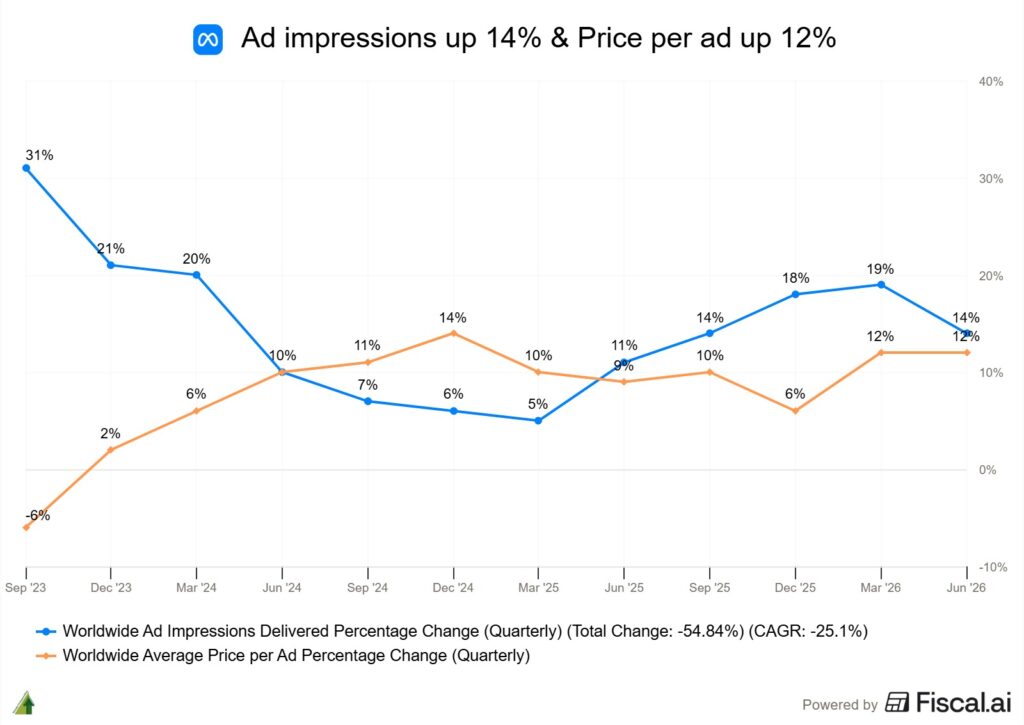
Daily Active People grew just 3%. So the impression growth came mostly from two other levers: users spending more time, and Meta showing more ads. CFO Susan Li confirmed both:
“Impression growth was healthy across all regions, driven by growth in engagement and users, as well as ad load optimizations.”
On the ad load piece, the expansion is deliberate and global:
“In Q2, we also expanded availability of ads on our newer surfaces, including completing our global ads expansion on Threads. On WhatsApp, we have introduced support for more types of ad destinations and advertiser performance goals in Status.”
The 10-Q says it even more plainly: impressions grew in all regions, “especially in Asia-Pacific, which was driven by increases in users and their engagement as well as the frequency of ads shown on our products.”
And users are not drifting away, quite the opposite:
“On Instagram, global time spent this quarter grew double digits year-over-year, largely driven by improvements to our Feed and Reels recommendations. On Facebook video time spent increased 9% globally year over year and over 10% within the US & Canada.”
I thought this was really impressive, because generally when you increase the amount of ads, users get annoyed, and when the experience degrades, time spent or active users fall off. But time and time again, Meta serves ads so in line with what users want that it doesn’t affect them.
And while to us as end users we don’t see the shift… there’s actually a massive shift underneath the Meta machine that has led to these massive gains.
The machine: LLMs quietly took over the ad system
For 15 years, Meta’s ad system was a prediction machine. It watched what you clicked, liked, and watched. Then it predicted the odds you would click the next ad. The content itself was mostly a black box of ID numbers. The system knew you watched a video. It had a rough idea what the video was about, likely drawn from the captions and tagging by the creator, but it never thoroughly understood the content.
That era is over. CFO Susan Li dropped this on the call, almost in passing:
“Earlier this year we reached a milestone of every public Reels and Feed post on Instagram being automatically processed through an LLM and analyzed across dimensions from topics to tone.”
Every single public post, read and understood by a language model. Those signals then feed ranking, recommendations, and ads.
On top of that sits GEM, Meta’s ads ranking model built on sequence learning. The way ChatGPT predicts your next word from the words before it, GEM predicts your next relevant ad from the sequence of everything you have done. And this quarter they went one step further:
“This quarter, we introduced Meta Generative Recommender, a paradigm shift in how our ads system works. Rather than scoring every possible ad individually, we are now using LLMs to reason about ad content and user preferences together, and predict the best ad for each person.”
Does it work? The receipts, straight from the call:
- Ad clicks on Facebook up 8.3%, conversions up 15.7%, from the new user-understanding models combined with GEM
- Early LLM pilots lifted app-event conversions 1% on Instagram
- The largest single ranking release in Reels history added 15 basis points of Instagram sessions
- Over half of recommended content on Instagram Feed is now less than a day old, double a year ago
If we were to follow the money chain, better matching means more conversions. More conversions means advertisers earn more per dollar. So they bid more in the auction.
Which is amazing, because when the supply of ad inventory rises, prices are generally expected to drop, but they’re so good at conversion that advertiser demand rose faster than the supply of ad inventory, so much so that it drove ad prices up 12%. Advertisers are paying more because they are getting more. That is the healthiest kind of price increase that exists.
The roadmap goes further. On the follow-up call, Li described shifting from content IDs to “a more descriptive and meaningful semantic ID system,” with the end goal of collapsing the whole multi-stage system into one unified model that, “similar to how LLMs do next-token prediction, can directly produce a set of tokens to show users.” In other words, the entire recommendation engine is turning into one big language model.
Price per ad, region by region
Price per ad in Q2 2026:
- US and Canada: up 20%, accelerating from 14%
- Europe: up 10%, decelerating from 19%
- Asia-Pacific: up roughly 1%
- Rest of World: up 21%
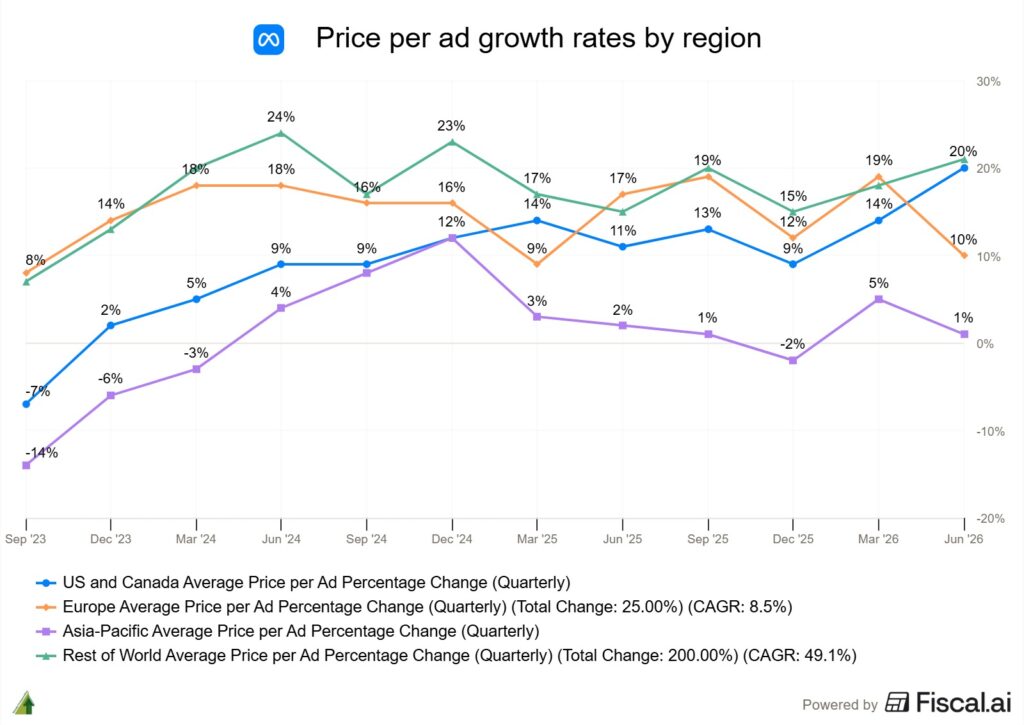
Needless to say, Meta is absolutely crushing it in US and Canada, which is already their most sizable and mature market… so let us turn our attention to Europe and Asia-Pacific.
Europe’s price growth roughly halved while impressions stayed healthy at 13%. That’s a regulatory hit, and CFO Susan Li warned us a full quarter early, on the Q1 2026 follow-up call:
“We had aligned in December ’25 with the EC on further changes to our consent model for personalized ads in Europe. In Q1 of 2026, users in Europe began to see the changes to the less personalized ads flow… we believe that the revenue impact from the updated user flows will be larger in Q2 than it was in Q1… Q2 and quarters going forward will have the full quarter impact.”
This quarter she confirmed it: less personalized ads are now fully rolled out across Europe and remain a headwind. For years, European regulation showed up in Meta’s filings as fines, and a fine only stings once. This one shows up in the pricing chart every quarter going forward.
For Asia, price per ad grew only 1%, significantly lower than every other region. But that isn’t weak demand.
Ad inventory simply grew way faster on the back of rapidly rising engagement, with impressions up 17%, and much of that new inventory sits in Reels and formats that, as the 10-Q puts it, “monetize at lower rates.”
Ad revenue by user geography still grew 19%. It’s growing well, just entirely through volume instead of pricing.
The bill
Now zoom out to the headline numbers, because this is where the market starts to sweat a little.
Revenue grew 28%. Adjusted operating profit grew 9%, and that is after stripping out a $2.4 billion legal charge and $1.2 billion of severance. Reported operating profit fell 8%. Operating margin went from 43% to 31%.
Free cash flow came in at $784 million.
Not $784 million a month. For the entire quarter. The same quarter last year produced $8.5 billion.
Where did the cash go? Capex. $31.1 billion this quarter, up 83% from a year ago. The full-year 2026 guide is $130 to 145 billion. With $50.9 billion already spent in the first half, that implies $79 to 94 billion in the second half alone.
Here is what that means. If operating cash flow keeps growing at the pace it did in the first half, the back half throws off roughly $85 billion. Take the midpoint of the capex guide, $86.6 billion, and free cash flow goes negative. Meta only stays positive if it spends at the very bottom of its own range. It has never done that.
And the balance sheet funding this is thinning fast. Net cash was $49 billion at the end of 2024. It is $6.6 billion today. Debt has gone from zero in 2021 to $83.7 billion.
Buybacks stopped three quarters ago. The last one was $3.3 billion in Q3 2025, and $25 billion of authorization is still sitting there unused. Meanwhile stock comp is running at a $27 billion annual pace, up from $20 billion last year.
Every spare dollar is going to the bet.
The gaping hole the metaverse left
Why is the market so quick to punish this? Because it has been scarred before.
Investors watched Meta pour money into the metaverse for years. Reality Labs lost $16 billion in 2023. Then $18 billion in 2024. Then $19 billion in 2025. The losses climbed every year while the word itself faded off the earnings calls. I counted. Across the last four calls, “metaverse” comes up exactly once.
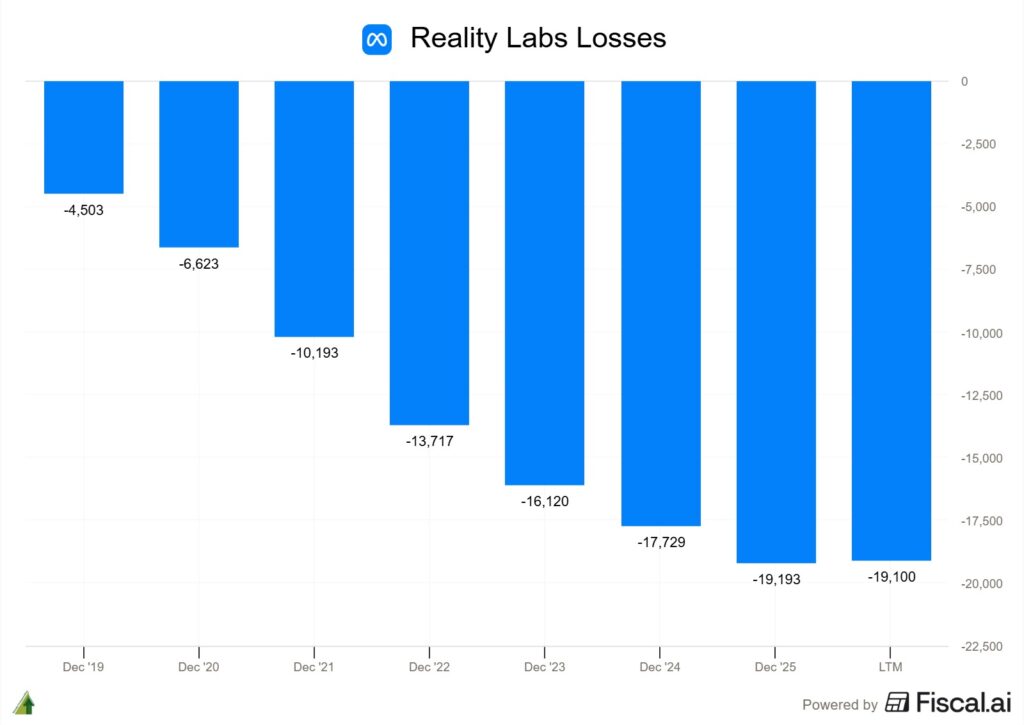
The narrative moved on but the spending never did, and that bet left a gaping hole in investor confidence. Now Meta is asking the market to fund an even bigger one, with less clarity than Microsoft or Amazon offer on theirs.
Zuck knows exactly what this moment rhymes with. In late 2022, with revenue shrinking and the stock in the gutter, he asked investors for patience, said those who stuck with him would be glad they did, and patience paid off. This quarter, he reached for the same line:
“I get that this is a big investment and it’s a big bet. We see the technology working. We’re happy with the trajectory of the lab. My personal bet is that the people who invest in this are going to be rewarded and feel very good over time.”
Why this isn’t the metaverse again
Here’s where I land, and it’s the reason I’m not in the bear camp.
Nothing is guaranteed. This could absolutely turn into another metaverse, years of spend with the story quietly retired at the end, and the skepticism would be well earned.
But there’s one structural difference, and it changes the risk math. The metaverse pain had no way out. If the bet failed, the money was simply gone. Nobody was lining up to buy Meta’s VR spend at a premium.
The pain this time round is salvageable. If MSL disappoints, Meta has two ways out. It can fold the compute back into the core business, which happens to be the best AI customer on earth right now, and the 15.7% conversion lift is the proof of what that compute earns internally. Or it can sell the compute into a market that is already bidding multiples of what Meta paid.
The metaverse had no bid. This compute has a queue of offers.
So yes, the free cash flow is ugly and the communication was even worse. But the market is pricing this bet as if there’s no way out, when Zuck is sitting on two.
I’m inclined to let Zuck cook, as usual.
Everything in this report came from free documents. Same access you have. The hard part is knowing where to look.
That’s what The Lunch Break Investor teaches: the exact process I ran on Meta, on any company, in about an hour.
Pre-order before August 18 and you get The Owner’s Manual, my financial statements course, free.
The book arrives August 18. The course arrives today.
Compound wisely,
Thomas
Disclaimer: These research reports constitute the author’s personal views and are for educational purposes only. It is not to be construed as financial advice in any shape or form. From time to time, the author may hold positions in the stocks mentioned below that are consistent with the views and opinions expressed in this article. Disclosure – I have a position at Meta at the time of publishing this article (this is a disclosure and NOT A RECOMMENDATION)
P.S. The book arrives August 18. The bonus arrives today.