

This quarter is the clearest sign yet that Alphabet is transforming into a different company and there’re a lot of misconceptions surrounding its Q2 2026… so let me go through them one by one.
Advertising has gone from 78% of revenue in Q3 2023 to 68% in Q2 2026, with Google Cloud coming in strong to change the revenue mix.
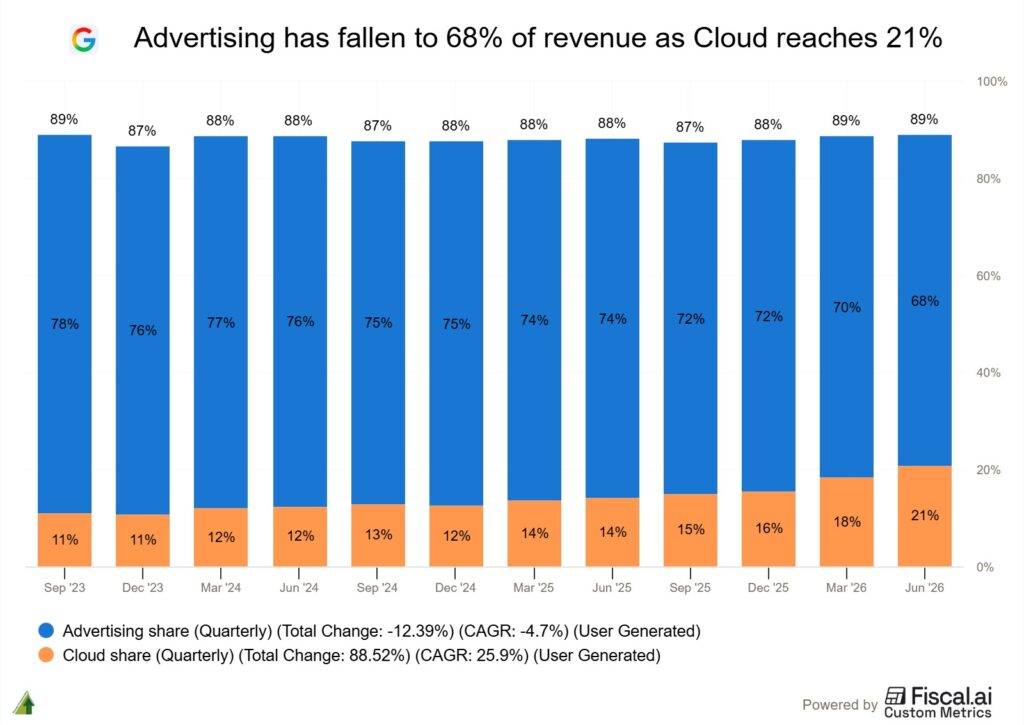
And it’s not because search has fallen or anything like that, they weren’t disrupted by AI, in fact, the opposite has happened, and AI has led to an expansion in search, as outlined by CEO Sundar Pichai on the Q2 2026 earnings call:
“Our AI-powered features are driving increased Search usage. Since expanding AI Mode globally last October, we’ve surpassed one billion monthly active users. And just like AI Overviews, AI Mode is driving an incremental increase in Search queries overall, and we’re now sending billions of clicks to websites every week through AI features in Search.”
There’s one point that I keep coming back to: with Search, it isn’t enough to be free, to be fast, you also need to figure out the economics of it. That’s where its AI peers will have a much tougher time, because firstly, Google is way better with ads, and secondly, they’re the only one vertically integrated from silicon to models to distribution.
On costs and efficiencies, CEO Sundar adds, “As we serve more of these queries, we have continued to drive efficiencies. Thanks to our engineering and hardware optimizations, this quarter we reduced the cost of AI Mode responses to its lowest level since launch, even as we have brought more advanced AI capabilities.”
And the growth in Search revenue has been a healthy one. Paid clicks grew a whopping 13% and cost-per-click rose 3%. More people are clicking on more ads, and advertiser ROI is holding up well enough that prices still rose even as the supply of clicks expanded.
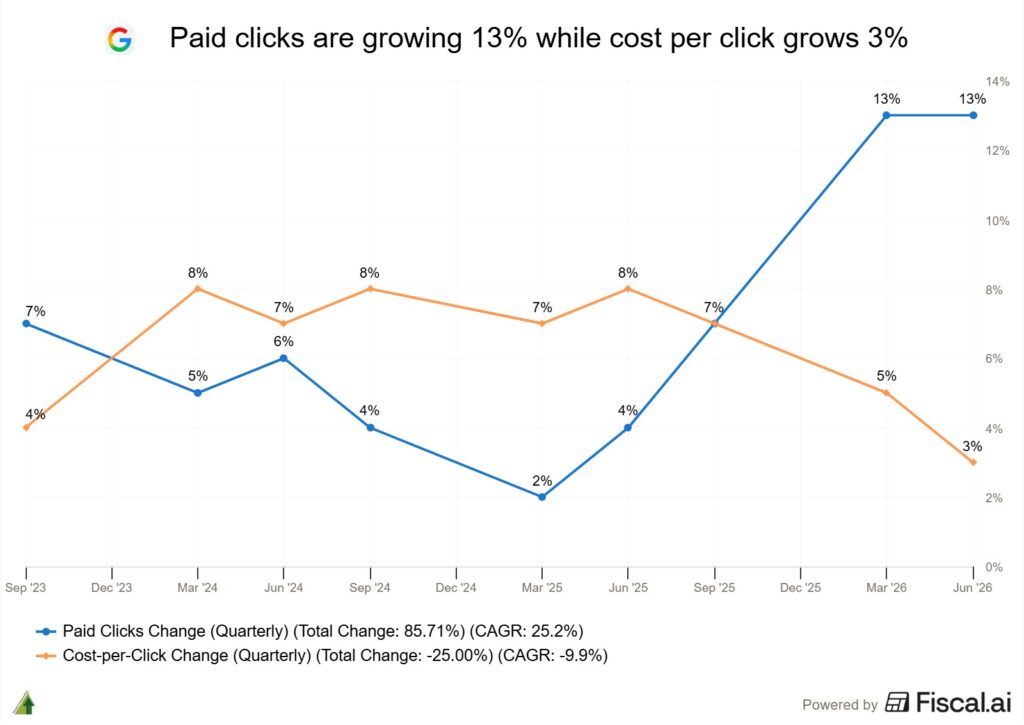
So yes, while Google is transitioning from a largely advertising player, capital light with high margins, to one that’s more capital intensive with lower margins, it isn’t doing so while its lucrative advertising business shrinks.
Search and Other: Grew 16.8% to $63.3 billion
YouTube ads: Grew 12.9% to $11.1 billion
Network: Shrank 0.7% to $7.3 billion
Total advertising: Grew 14.4% to $81.6 billion
So the entire advertising business contributed $10.3 billion of incremental revenue this quarter, and Google Cloud contributed $11.1 billion on its own!
Cloud grew 82%, and margins expanded with it
Google Cloud’s growth accelerated to 82%, to $24.8 billion, from 63% last quarter. CFO Anat Ashkenazi’s commentary points to GCP driving it, which means the non-GCP parts of Cloud, principally Workspace, grew slower and dragged the average down. GCP alone is running above 82%.
From CFO Anat: “Cloud revenues were up 82% to $24.8 billion, driven primarily by GCP, which grew faster than Cloud overall. Core GCP, AI solutions, and AI infrastructure were all important drivers of growth.”
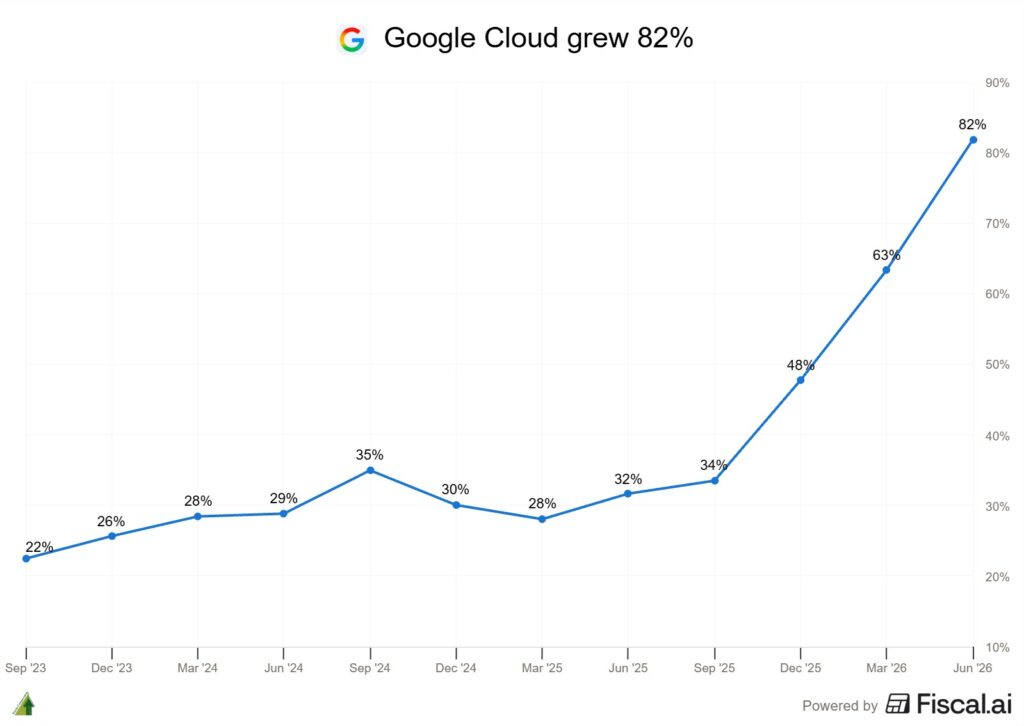
While there’s a lot of chatter that this growth rate was down to TPU sales, management pre-empted it in the prepared remarks: “Cloud revenue growth accelerated meaningfully, even after excluding the impact of TPU system sales.”
The TPU revenue is real, and it is early. A small slice this quarter, ramping through 2026, with the bulk landing in 2027.
CFO Anat: “This quarter was a small amount of that total agreement. We’ll continue to ramp up throughout 2026, but then you’ll see the vast majority of the revenue from that agreement come through in 2027.”
She also confirmed that while the TPU deals sit inside the backlog, “the vast majority of the $514 billion of cloud backlog is the GCP agreements.”
So where can we spot this TPU business brewing? On the balance sheet. Alphabet broke inventory out as its own line this quarter, having previously buried it inside other current assets, because it is now too big to bury. It went from $2.4 billion in December to $10.0 billion in June, quadrupling in six months. The 10-Q says what it is: hardware “related to TPU systems for sale to enterprise customers and devices.”
Anat tied it straight to the cash flow statement: Alphabet has to build the systems before it can sell them, so the cash goes out first.
That ties up working capital, and it’s the cost of standing up a new business rather than a sign the old one is fading. Advertising is still growing strong.
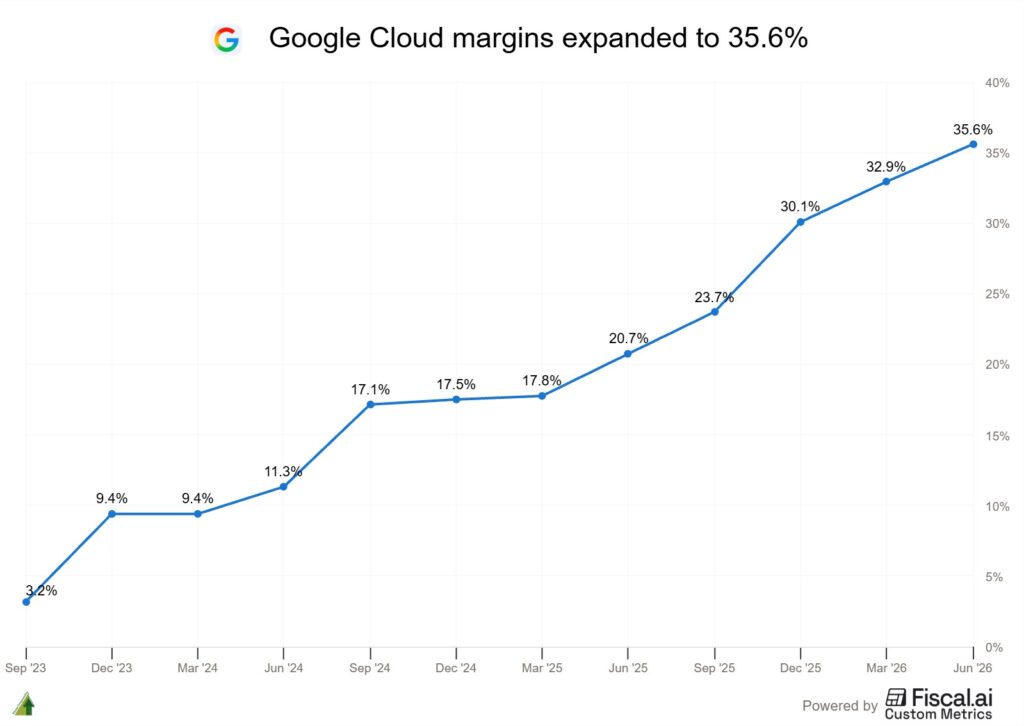
Cloud’s revenue growth also sent operating leverage into overdrive. Cloud revenue grew 82% while Cloud costs grew 48%, operating income more than tripled, from $2.8 billion to $8.8 billion.
With that, operating margins expanded 1,484 basis points to 35.6% for Google Cloud.
The depreciation debate
There’re some who would argue that Alphabet is understating their depreciation expense right now because there’s this chunk of “assets not yet in service” of $122.8 billion sitting on their balance sheet that isn’t getting expensed because it isn’t put to use yet. And that margins would start shrinking when these capacities start coming online.
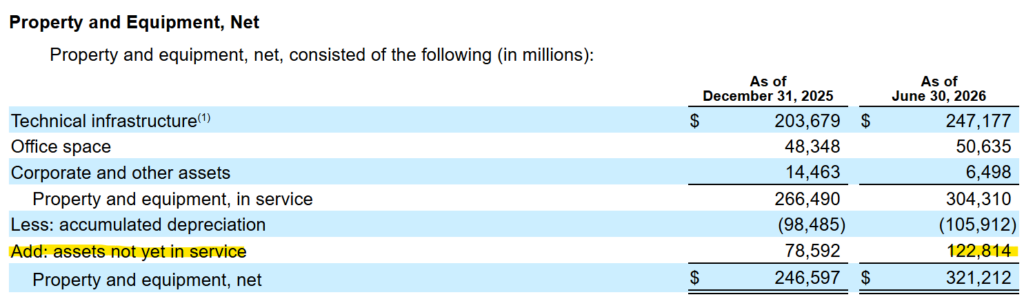
Not necessarily. If the capacity arrives already sold, margins may hold up well. The backlog says it mostly does: $514 billion of signed Cloud commitments, just over half of which Alphabet expects to recognise within 24 months. The first half is the proof of concept. Depreciation on property and equipment rose 43% over those six months, from $9.5 billion to $13.6 billion, and Cloud’s first-half margin still expanded 1,507 basis points, because first-half revenue grew 73%.
But if Cloud growth starts decelerating while the $122.8 billion switches on, then margin would compress fast, because the costs arrive on schedule and the revenue doesn’t.
I think the former is more likely, given that the current constraint is still supply (whether it’s chips or power). If margins were to shrink, it’ll likely be from the sale of TPUs entering the mix.
The $707 billion footnote
Everybody focused on Alphabet guiding 2026 capex to $195 to $205 billion (yes, it’s huge). That number can be revised, and it will be. It’s already the third version this year, the latest one citing ‘an acceleration in the delivery of capacity to meet growing demand.’
Buried in Note 10 of the 10-Q sits a number Alphabet cannot revise. Purchase commitments are the contracts it has already signed to buy chips, power and content in the years ahead.
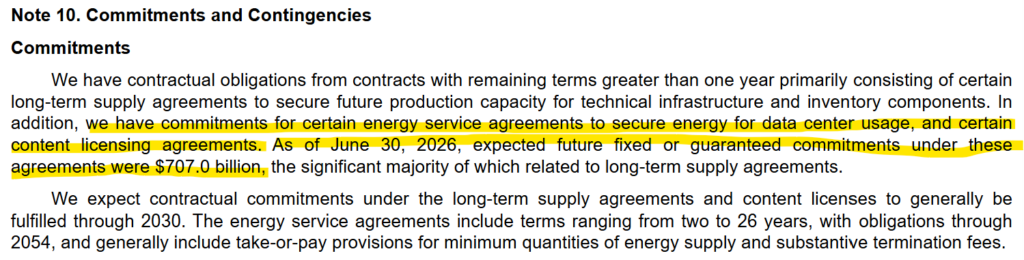
For years this note was a sleepy line about content licensing. It was $11.1 billion in September 2023 and shrank steadily to $7.7 billion by the end of 2025. Then the scope widened. In Q1 2026 it jumped to $232.7 billion as long-term supply and energy deals entered the note. In Q2 it hit $707.0 billion.
Alphabet added $474 billion of contractual promises in ninety days!
So what’s inside the $707 billion? Mostly long-term supply agreements for chips and components, plus content licences, and Alphabet expects to fulfil those through 2030.
The energy contracts are the long tail. Terms of two to 26 years, obligations running through 2054, and they “generally include take-or-pay provisions for minimum quantities of energy supply and substantive termination fees.” Take-or-pay means Alphabet pays for the power whether it uses it or not.
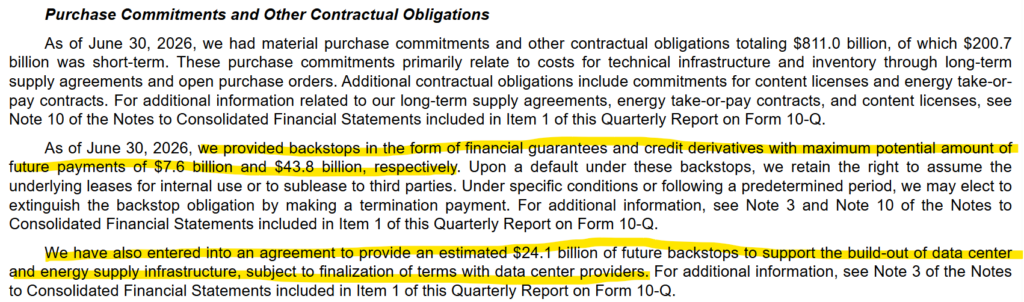
It goes further. Alphabet is now underwriting other people’s construction: $43.8 billion of credit derivatives backstopping data centre payment obligations, with terms running up to fifteen years. A further $7.6 billion of financial guarantees backstop suppliers buying long-lead power equipment for Alphabet’s future energy deals, running through September 2026, plus another $24.1 billion of backstops agreed but not yet finalised.
Now, before we freak out about this number, this isn’t speculative capacity that nobody asked for. Against $707 billion of commitments sits $513.9 billion of signed Cloud backlog, part of $519.5 billion of total contracted revenue. Customers can slow-walk consumption. They can’t walk away, because the backlog excludes cancellable contracts by definition.
Paying isn’t the issue either. Alphabet holds $242 billion of cash and securities, generates $53 billion of trailing free cash flow, and just showed it can raise roughly $106 billion in six months.
The bigger risk is duration. Alphabet’s promises to pay run to 2030 on hardware and 2054 on power. Just over half the promises made to Alphabet land inside 24 months, and customers can still delay, renegotiate, or fail. If AI demand cools, the power bill Alphabet has to pick up doesn’t.
The $707 billion wasn’t hidden. It sat in Note 10 of a public filing, free for anyone to read. Knowing where to look is the skill. That’s what The Lunch Break Investor teaches, one hour a day. It arrives August 18.
Why Alphabet sold stock, and why Berkshire bought it
I don’t think I’ve ever seen Alphabet sell stock to fund its business, the company always had more cash than it could put to use and roughly $15 billion a quarter went out to buy back its own shares for about three years running.
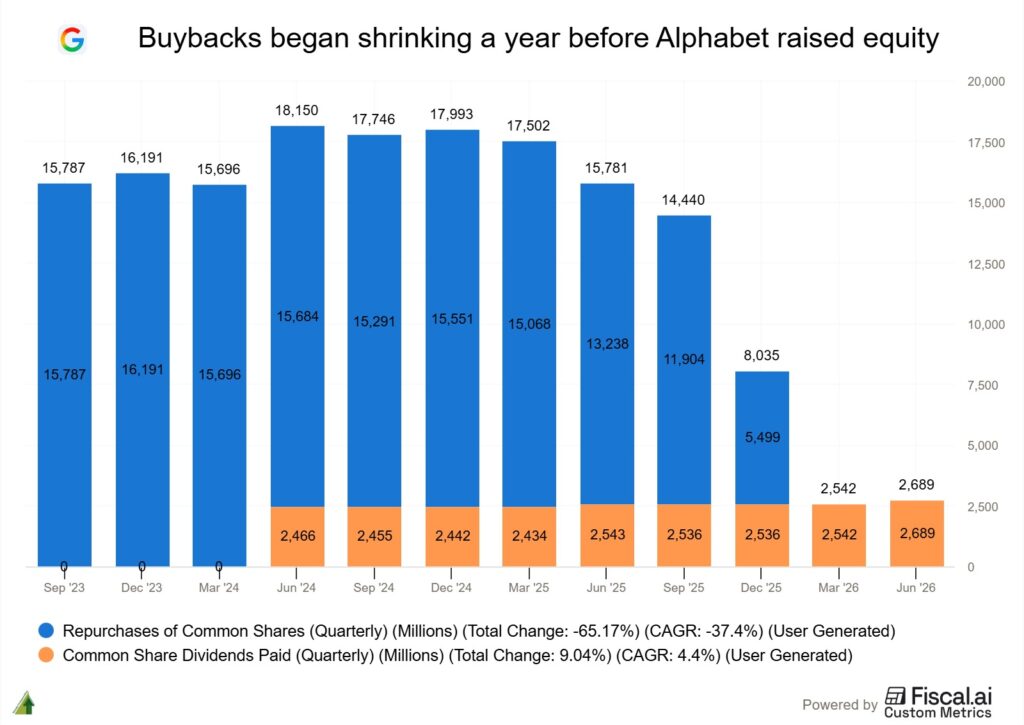
The buybacks held at that level through Q1 2025, tapered from the middle of the year, and hit zero in Q1 2026. Zero again in Q2. In June the direction reversed outright.
Capex is why. It ran $44.9 billion in Q2 alone and $80.6 billion across the half. Alphabet also paid $29.5 billion in cash for Wiz in March. First-half free cash flow came to $4.3 billion, and Q2 on its own was negative: $44.9 billion of capex against $39.1 billion of operating cash flow, the first negative quarter in the twelve I track.
In the first week of June, Alphabet went to the equity market. Within five days it had completed:
- $20.5 billion of new shares sold to the public, at $355.20 for Class A and $351.80 for Class C
- $10 billion of new shares sold privately to Berkshire Hathaway
- $19.1 billion of preferred stock paying 6.25%, converting into shares in 2029
Buffett told CNBC on 15 July that the position was his idea, not Greg Abel’s. Asked how it came about: “I initiated it.”
This also wasn’t a new position. Berkshire started buying in Q3 2025 and chose to add $10 billion on top.
Conclusion
I can see why investors are rattled. The commitments are enormous, and Alphabet is racing to bring compute online as fast as it can. When uncertainty rises, the multiple usually shrinks, even when the earnings don’t.
I would worry if the cash cow were cracking. It isn’t. Search grew 16.8% on more clicks at higher prices, and this whole transition is being funded by a core business that keeps executing.
So I’m watching two things from here. Whether Search keeps growing on both volume and price. And whether demand holds, which will show up in the backlog before it shows up anywhere else.
I’m not going to lie though, it’s comforting that the Oracle himself put his stamp on this one.
Compound wisely,
Thomas
P.S. Every number in this piece came from Alphabet’s 10-Q and earnings call. Public documents, read one hour at a time. The Lunch Break Investor is the six-step process behind it. It arrives August 18.
Pre-order before launch day and The Owner’s Manual, my $300 financial statements course, is free. The book arrives August 18. The course arrives today.
→ Pre-order: steadycompounding.com/book
Disclaimer: This research report constitutes the author’s personal views only and is for educational purposes only. It is not to be construed as financial advice in any shape or form. From time to time, the author may hold positions in the below-mentioned stocks consistent with the views and opinions expressed in this article. Disclosure – I hold a position in Alphabet at the time of publishing this article (this is a disclosure and NOT A RECOMMENDATION).