


During the Q4 2025 earnings call, one statement by CEO Glenn Fogel stood out to me:
“Almost 90% of our accommodation business is coming from either independent hotels or homes, alternative accommodations, small brands. Those are not sophisticated players at all. You got to establish connectivity with them to get that availability, get that pricing, get that inventory, be able to keep it up because it’s always changing.”
Almost 90% of their room nights come from independent hotels, alternative accommodations, and smaller chains.
These aren’t your mega chains like Hilton and Marriott with a ton of resources and distribution to develop their own loyalty program, run their own marketing campaigns and handle every other operational detail like payments, or have the bandwidth to reply to customers in all the different languages.
And because these are smaller chains and boutiques, there’s also the trust factor. Are you going to make a payment to a hotel you’ve never heard of in Europe for a trip that’s three to six months away?
The question isn’t “will travelers use AI agents to search for hotels?” They probably will. The question is: when that AI agent finds you the perfect family-run guesthouse in Puglia, who actually processes the booking?
That guesthouse doesn’t have its own booking engine. It doesn’t accept Alipay, Pix or UPI. It can’t provide 24/7 customer service in over 40 languages. It has no app, no loyalty program, no cancellation management system.
Booking provides all of that. And it does so for 4.4 million properties across 220 countries.
The AI agent needs someone to actually process that booking. That someone is Booking Holdings.
The Disintermediation Playbook—Again
I think it’s quite apt to describe Booking Holdings as the “cat with nine lives” of the internet era.
For over two decades, industry analysts, tech journalists, and hotel executives have predicted their imminent “disintermediation”—the idea that a new technology or market shift would finally cut out the OTA middleman.
The threats have come in waves. Hotel chains would take back direct bookings. Metasearch engines like TripAdvisor, Trivago, and Book on Google would replace OTAs. Voice assistants like Alexa, Siri, and Google Assistant would change how people book travel. Blockchain startups like Winding Tree would use distributed ledger technology to connect hotels and travelers directly, eliminating the middleman entirely.
None of them worked.
And now the freshest one: AI agents will communicate directly with hotel APIs to secure rooms, making the 15% commissions charged by Booking Holdings much harder to justify.
Before we get to why I think this latest threat will play out the same way, it’s worth examining the closest historical parallel: a case where the most powerful top-of-funnel player in the world tried to keep the full travel transaction inside its own ecosystem. And failed.
Launched in 2015, Book on Google (BoG) was a facilitated booking feature. When a user searched for a flight or a hotel on Google, they would see an option to complete the entire reservation and payment process without ever leaving the Google interface.
You stayed 100% inside Google:
- Pick your room
- Enter your name/email/phone
- Pay
- Get instant confirmation
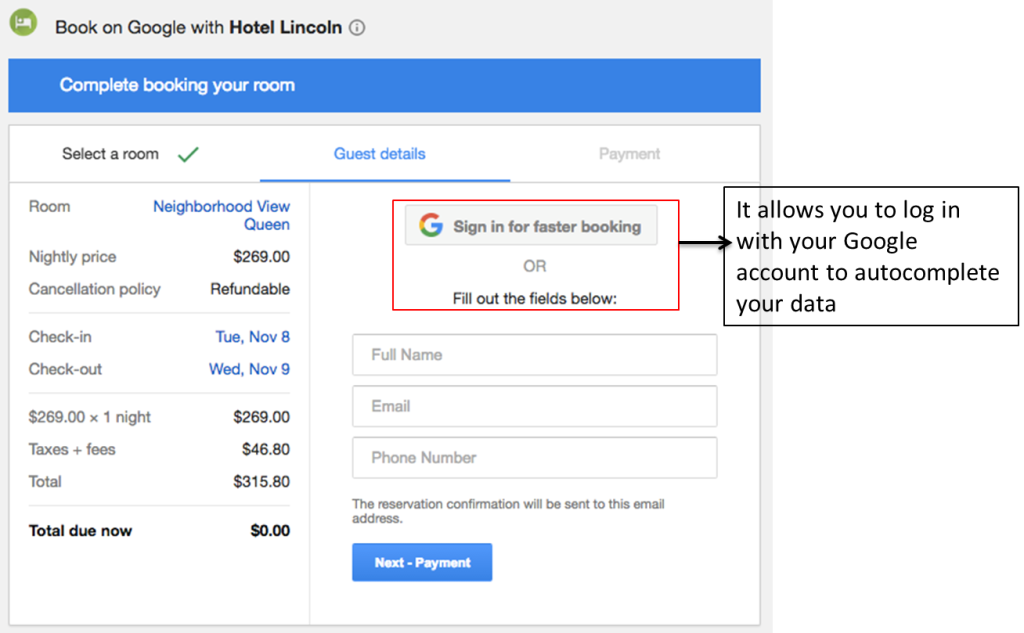
Image source here
Google securely hosted the checkout form and captured the payment data, but the airline, hotel, or OTA remained the merchant of record. The goal was to keep users inside Google’s ecosystem and make booking frictionless. Hotels saw a financial appeal because they could pay Google via CPC or commission-on-stay rather than the full 15% OTA commission.
Needless to say, it was one of the scariest disintermediation threats OTAs ever faced… analysts and executives openly said Google could become “the new Booking.com.” If people book directly on Google, OTAs lose the commission and the customer relationship. OTAs had to pour billions into Google Hotel Ads just to stay visible next to hotels’ own rates.
That was the prediction.
The reality?
BoG is completely dead. Google officially pulled the plug on “Book on Google” in mid-May 2022. Today, if you use Google Flights or Google Hotels, you are always redirected to an airline, hotel, or OTA website to complete your purchase.
What the Google spokesperson said was telling (LINK), “When we first launched Book on Google for hotels, we wanted to give users an easier way to complete their bookings, while also driving more conversions for our partners… But over time, we’ve seen that most people prefer to book directly on partner websites, whether through the hotel itself or with an OTA.”
Google is the top of the funnel, yet users much rather book directly on partners’ websites. And because Google wasn’t the merchant of record, it didn’t handle ticketing, post-booking customer service, cancellations, or refunds. If your flight was canceled or your hotel room was double-booked, calling Google wouldn’t help you—you had to deal with the partner. Without owning the full transaction, BoG was basically just a fancier redirect. The partner still owned the customer relationship and the liability. So what was the point?
And mind you, this behaviour isn’t unique to Google. It’s a recurring pattern: research here, book elsewhere.
TripAdvisor—the planet’s biggest travel research site—learned this the hard way. They launched Instant Booking in 2014 (later called book on TripAdvisor) to complete the full booking without ever leaving the site.
Users simply did not want to buy hotel rooms on a review site. They loved TripAdvisor for reading about the breakfast buffet, but when it came time to spend hundreds of dollars, they wanted to do it on a dedicated, transactional platform they trusted.
The conversion rates on Instant Booking were incredibly poor, and it cannibalized the highly profitable fees TripAdvisor used to make simply by redirecting traffic to OTAs.
Today, while the Instant Booking API still technically exists on the backend for certain partners, TripAdvisor has aggressively de-emphasized it. They have reverted back to their core “metasearch” model, acting as a highly profitable billboard that points you to an OTA or hotel website to finish the job.
Both Google and TripAdvisor learned that whatever the OTAs were doing weren’t as easy as they thought, and went back to collecting advertising dollars from Booking Holdings, which is effectively a way for them to share revenue with the rest of the funnel.
Why This Time Isn’t Different
Fast forward to today, investors are worried agentic AI is going to bypass OTAs and go straight to the hotels.
I think that misses the point for two reasons.
First, hotel quality is inherently unpredictable. Even within big chains like Hilton, there are properties that make you swear off the brand and ones that keep you coming back. With independent hotels and boutique stays, the variance is even wider — room size, cleanliness, design, location, service. I’m not going to trust an AI agent to make that call for me without going through the photos and reviews myself. And where do those photos and reviews live? On platforms like Booking.
Second, the whole notion that AI platforms are going to be the OTA itself has been put to test many times, by Blockchain, by Google, by TripAdvisor, and many others. And each time, they learnt that the business isn’t as easy as thought out to be.
Travel isn’t just a recommendation problem. It’s a payments problem, a trust problem, a regulatory problem, a customer service problem — all wrapped into one.
Finding a hotel is easy. Completing the transaction—processing payment in the traveler’s preferred method, confirming the reservation with the property, handling modifications, managing cancellations, providing multilingual customer support when something goes wrong at 2am—that’s the hard part.
And the hard part is exactly what Booking has spent decades and billions building.
What Fogel Thinks Will Actually Happen
When asked about this on the Q4 2025 earnings call, CEO Glenn Fogel laid out three arguments that I found compelling.
First, LLMs won’t want to go down the funnel. Being the merchant of record means handling payments in over 100 methods across 50+ currencies, managing refunds and chargebacks, navigating regulations in over 200 countries. Fogel described the regulatory alphabet soup: “DSA, DMA, DFA, EU AIA, P2B, DAC 7, I can go on and on. And that’s just EU.” It’s complex, expensive, and far from the core business of building language models. As Fogel put it: “So do we think that the large language models that are entering want to enter down the funnel down to where? I don’t think so.”
Second, even if they did, would customers follow? Booking’s Genius loyalty program has over 30% of its active users at Level 2 and Level 3, and these members have meaningfully higher direct booking rates. A mid-60% range of bookings already come through direct channels. Fogel’s point: “Even if that did happen, even if they were thinking about going in there, the question is will the customer want to be there?… Those people come to us because they actually find value using us.”
Third, the most likely outcome is symbiosis, not substitution. Fogel drew a direct parallel to Google, a top-of-funnel giant that Booking has coexisted with profitably for decades: “We’ve been competing, so to speak, with a top-of-funnel player who is very big for a very long time and people go there but yet then they come to us direct many of them. Why? Because we are offering them something of value… and by the way, it’s been very successful for that large person at the top of the funnel: Google. We’ve both done very well.”
I agree with Glenn Fogel. Over 26 years, he has successfully pivoted the company against every challenge thrown at it. I think AI platforms will likely be another traffic acquisition channel for Booking Holdings, just as Google has been for the past two decades.
And if we look at what’s already happening, the evidence supports this. Booking was featured in ChatGPT’s agent demo. They’re partnering with all the major AI platforms. CFO Ewout Steenbergen explicitly framed Booking’s supplier value proposition as “a competitive strength as agentic AI accelerates the pace of change” in his prepared remarks on the same call. Not in response to an analyst question, but as a proactive part of their strategic messaging.
I don’t think AI will be a threat to Booking Holdings. I think it’ll be enhanced by it.
Disclaimer: These research reports constitute the author’s personal views only and are for educational purposes only. It is not to be construed as financial advice in any shape or form. From time to time, the author may hold positions in the below-mentioned stocks consistent with the views and opinions expressed in this article. Disclosure – I hold a position in Booking Holdings at the time of publishing this article (this is a disclosure and NOT A RECOMMENDATION).
This was a really compelling and well written analysis, congrats. I will be looking out for your other research.
I’m glad to hear that!