


Recession is… over?
Monday’s stock market “crash” ended as quickly as it began.
The Nikkei tumbled 12.4%, and the Nasdaq lost 3%.
Echoes of recession were trending, and whispers of a huge looming bankruptcy grew loud.
When I said, “I’m going shopping in the stock market” on Monday (there’re interesting opportunities outside of the Magnificent 7), I received a reply from a reader who talked about the Fed, dollar shortage, banking crisis and mentioned that I’m being myopic for buying stocks when the market dips.

When I started investing in 2008, everyone said the markets are volatile and we should wait until things are better.
Many people still say that whenever the market dips.
There will always be intelligent-sounding excuses reasons to stay out of the market.
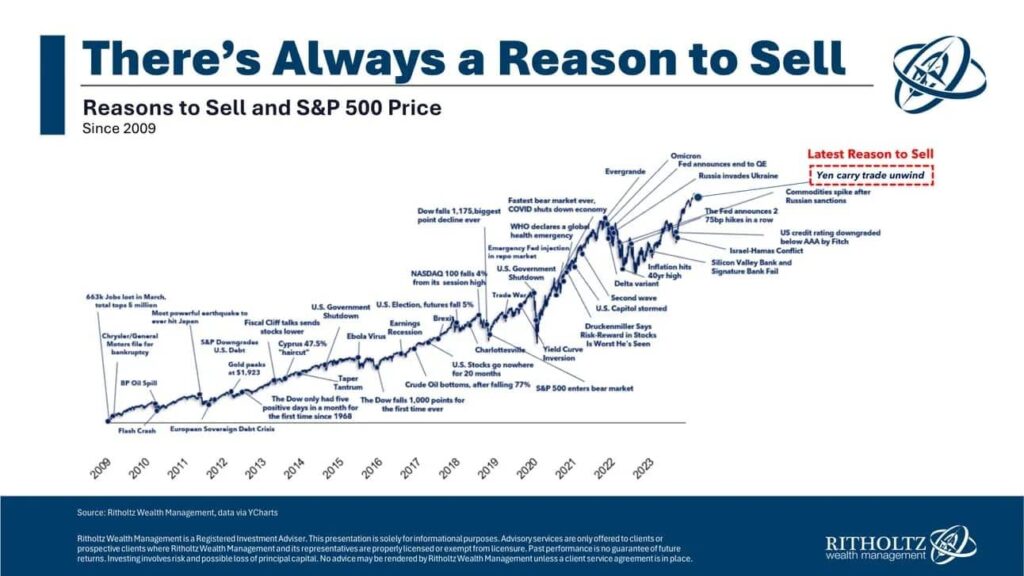
But here’s the truth: Opportunities and a rosy outlook never go together.
They don’t ring a bell at the bottom (or at the top).
Frankly, I have no idea what’ll happen over the next week or next month.
But if you hold a long-term view like I do, then many things become noise.
Before I end off, I came across an interesting short story by Morgan Housel (highlights are my own):
Demographic historian T.H. Hollingsworth once published an analysis of the life expectancy of the British peerage. It showed a peculiar trend: Before the 1700s, the richest members of society had among the shortest lives – meaningfully below that of the overall population.
How could that be?
The best explanation is that the rich were the only ones who could afford all the quack medicines and sham doctors who peddled hope but increased your odds of being poisoned.
I would bet good money the same happens today with investing advice.
People enjoy complex, intelligent, and sexy advice on health and wealth.
But what usually works are the simple things. Sound investing is simply buying something for less than what it is worth.
Compound steadily,
Thomas
I. Understanding Competitive Advantage by Michael Mauboussin
In his 2022 publication, Michael Mauboussin discusses how companies can sustain and expand their market leadership through innovation, competitive strategies, and adapting to evolving consumer preferences.
The paper underscores market share as a crucial gauge of a company’s strength and enduring viability.
Additionally, the article delves into the various factors that can impact market share, including economic conditions, technological advancements, and changes in industry dynamics.
>> Click here to read Understanding Competitive Advantage by Michael Mauboussin
II. Bruce Berkowitz – Avoiding Disaster and Generating Returns While Doing So
Some of my notes from the podcast:
- Focus on cash flow: Bruce emphasizes the importance of “counting cash” and analyzing a company’s cash flow to assess its true value and potential. He believes this approach helps filter out noise and provides a clearer picture of a company’s financial health.
“I do my best when I stick to counting cash… there was more than enough cash coming in (Wells Fargo) to handle the real estate occupancy issues at the time.” - Long-term perspective: Bruce aims for investments that can be held for multiple generations. He highlights the exhaustion of constantly finding new investments and seeks to benefit from economies of scale through longer holding periods.
“I wanted to try and find investments that have the ability to hold over multiple generations… I was trying to get more economies of scale.” - Roughly right is good enough: Bruce acknowledges the difficulty of being precisely right in investing and focuses on being roughly right. He understands that timing is uncertain and emphasizes understanding the key trends and potential outcomes.
“I try to be roughly right, because I don’t think I can do much better than roughly right.” - Importance of management and culture: While Bruce initially focused more on numbers, he now emphasizes the importance of good management and culture alongside sound financials. He believes that successful deals require both a good business and good people running it.
“In the past, more so on the numbers. And then I swung over to very heavy on the manager and culture and ownership. And now it’s both.” - Return of capital over return on capital: Bruce prioritizes the return of capital over the return on capital, especially as he gets older. He understands the importance of capital preservation and avoiding situations that could lead to a significant loss of capital.
“My mind is at the illogical extreme… I’m more focused on the return of the capital as opposed to the return on the capital.” - Cash as a strategic tool: Bruce views cash as a valuable asset, especially during turbulent times. It provides flexibility and the ability to take advantage of opportunities that arise during market downturns.
“When times get tough, everything’s correlated except for cash.” - Focus on understanding the business: Bruce stresses the importance of thoroughly understanding a company, its industry, competitors, suppliers, customers, and various other factors. He believes that deep knowledge is crucial for making informed investment decisions.
- Willingness to be contrarian: Bruce is not afraid to go against the grain and invest in companies that are out of favor or misunderstood by the market. He seeks opportunities where he can identify value that others may be overlooking.
- Alignment of interests: Bruce values having a level playing field with his investors, where everyone is on the same side of the fence. He focuses on creating value for his clients and emphasizes transparency and open communication.
III. Thoughts on Buffett Selling Apple by John Huber
explores Warren Buffett’s decision to trim Berkshire Hathaway’s Apple position.
It considers the rationale behind such a move, including portfolio rebalancing, managing risk, and capital allocation strategies.
The piece also reflects on Buffett’s approach to long-term investing and how selling a portion of a winning stock fits into his broader investment philosophy.
>> Click here to read Thoughts on Buffett Selling Apple by John Huber
That’s all I have for you today!
Till next week.