


Lululemon Deep-Dive
I will be publishing Lululemon’s research to Steady Compounding Insider Stocks members this week.
You may have wondered how Lululemon is able to command such premium prices for its products, or why it continues to thrive while giants like Nike and Adidas struggle to navigate China’s market.
This analysis uncovers the nuances that distinguish Lululemon from its competitors.Our analysis will examine the sustainability of its economic moat, pinpoint its most significant risks, and analyze its valuation.
P.S. Earlier this month, I delved into why Google is poised to stand firm against AI disruption. I also scrutinized whether Sea Limited is on the cusp of a pivotal turnaround.
Best,
Thomas
I. Is Diversification a Blessing or a Curse by The Smart Investors
The idea of diversifying your investments is hotly debated, with legends like Warren Buffett and Peter Lynch on opposing sides.
Lynch held up to 1,400 stocks in order to increase his odds of finding a winner, in contrast to Buffett who sees little value in diversification for those who know their game.
Diversification goes beyond the numbers of stocks; it involves the breadth of exposure to different kinds of businesses.
Investing in Berkshire Hathaway, for instance, can offer greater diversification than a 30-stock index like Singapore’s STI, which is heavily skewed towards a few industries.
Explore diversification strategies and their impact on investment success…
>> Click here to read Is Diversification a Blessing or a Curse?
II. Our investing strategy, who does the market smile upon by Made in Japan
The story recounts how Tatsuro Kiyohara, a Japanese hedge fund manager, over the span of 25 years, led Tower Investment Management’s K-1 fund to a staggering annual compounding rate of 20%.
Some of my key highlights from the article:
- “The goal is to find businesses that you can own for 3 to 5 years – and you’re looking for stocks that at least double.”
- “To him, the most important trait as an investor is how willing and able you are to learn from your mistakes. i.e. having good feedback loops.”
- “For the individual investor, he also does not recommend shorting – there is too much information symmetry and risk that is not worth your time.”
- “The psychology required as a full-time investor is different from a ‘part-time’ investor with a salaried income. Investing whilst having a stable salary is very different from putting all your wealth on the line. This becomes very clear in a market downturn. The fear you feel will be different.”
- “If assessing management correctly is the key to investing, also understand that there is a self-selection bias. If the Founder and CEO is that much more brilliant than you – you won’t even realize how brilliant he is.”
- “He says himself, that to win in large-caps you mustn’t miss the short window of opportunity that the market presents.”
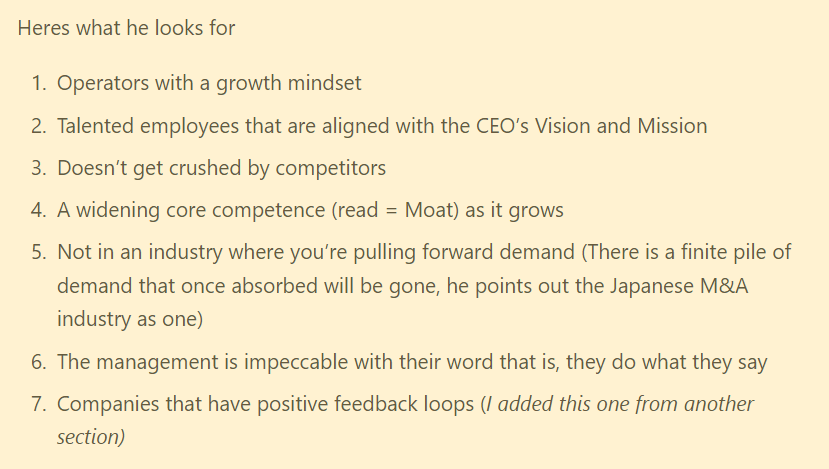
- What Tatsuro Kiyohara looks for in an investment:
>> Click here to read our investing strategy, who does the market smile upon
III. Know What You Own: Stocks vs. Businesses by Polen Capital
Polen Capital emphasizes the importance of viewing stocks as ownership of businesses, not merely speculative assets.
The long-term perspective encourages investors to focus on business fundamentals rather than short-term market fluctuations.
The article explains that understanding a company’s operations, customer base, and financial health is key to investing well.
It highlights the difference between investing and speculating, criticizing the speculative mentality that has led to significant losses in cryptocurrencies and NFTs.
A business owner’s mindset means looking for companies with sustainable cash flows and competitive advantages, doing thorough due diligence, and being patient.
Polen Capital says such an approach aligns with long-term wealth creation, compared to today’s short-sighted speculative strategies.
>> Click here to read Know What You Own: Stocks vs. Businesses by Polen Capital
That’s all I have for you today!
Till next week.