


Crushing the Stock Market in 2024
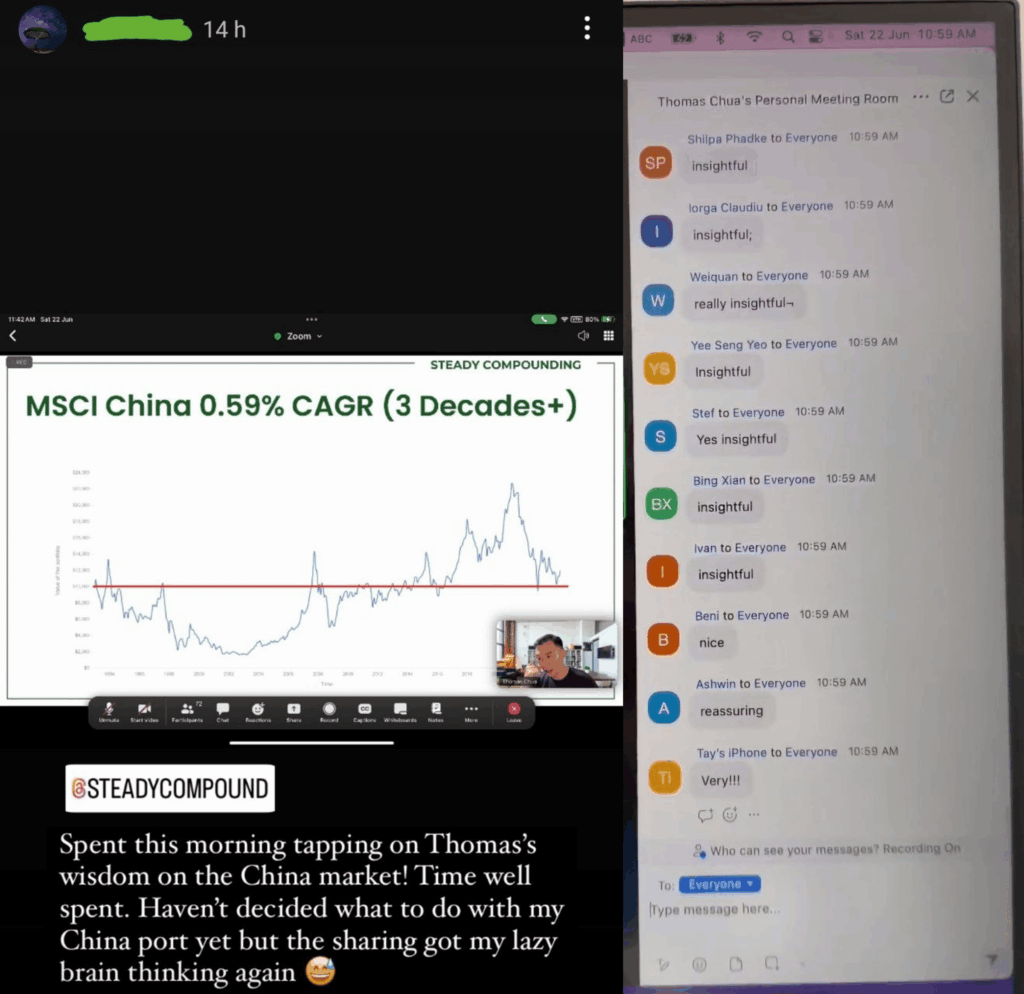
I had a fantastic time at yesterday’s webinar, addressing your biggest concerns about investing in 2024.
We delved into topics like reducing risk in the stock market, identifying bubble territory, the impact of index domination by a few companies, my thoughts on China, valuation, and buying & selling strategies.
It was great to see so many of my readers for the first time over Zoom, and I truly appreciated the vibrant energy in the chat.
Cheers, Thomas
I. Podcast with Howard Marks
If you only have time for one podcast this week, let this be the one.
My key takeaways from this podcast:
On risk management:
Risk Control: “Number one, risk control. I believe it’s easy to make money in the market. That’s especially true in the good years, and most years are good years. The challenge, the real skill, is to make money with the risk under control, so that if it turns out to be a bad year instead, you won’t do too badly.“
Risk Avoidance: “Sound risk management, first of all, importantly, is not risk avoidance. Risk avoidance usually results in return avoidance. If you want to make a good return, you have to take risk. I put out a memo last week on the subject, and I said, if you want to make money, you have to take risk. But you should not expect to make money just for taking risk. You have to do it skillfully.”
Probabilistic Outcomes: “Risk means more things can happen than will happen. It’s a very simple statement, but it’s very true. And so you have to appreciate the fact that under any set of circumstances, a variety of outcomes are possible, and you should always allow for the vagaries of the future.“
Strategic Decision-Making: “Assessing probabilities is very, very important. Structuring your bet, knowing when you have an advantage, knowing when you don’t have an advantage… It’s not what outcome is likely to happen, but it’s is the payoff better for investing in the team that will probably win?“
The limits of knowledge:
Randomness: “Number one, randomness or luck is every place in our business. You’re not dealing with physical laws like in physics or in engineering. You’re dealing with, in large part, people… Processes which are basically built around people can’t be predicted. So, while you can analyze and make informed decisions, there will always be an element of unpredictability.”
Cycles: “Well, the world is cyclical, and everybody knows that the market and the economy and politics move cyclically. And nothing moves in a straight line where human behavior is involved. And if you were to count on it doing so, you would get into big trouble.”
Illusion of Knowledge: “I wrote a book, a memo in October of 22 called the Illusion of Knowledge. There’s a great historian called Daniel Borsten. He says the enemy of knowledge is not ignorance. It’s the illusion of knowledge. It’s the fallacious belief that you know which stops you from inquiring. So I think that acknowledging that you don’t know something is extremely healthy.“
Contrarian investing:
Independent Thinking: “I want to stress that I don’t think it’s a good idea to routinely say, well, what does the consensus think? Let’s do the opposite. The process has to be much deeper than that. You have to say, what does the consensus think? What do I think? What’s wrong with the consensus thinking? Why did they think that way? What could make the error of their ways exposed?“
Psychological Strength: “If you want to be an exceptional investor, number one, you have to dare to be different. Your portfolio has to be different from other people, or else you can’t distinguish yourself. You have to be dare to be wrong, because you have to take on these unpopular positions. And number three, you have to dare to look wrong, because even if you’re right, that’s probably not gonna be clear for some time. And in that period, you’re gonna look wrong out a step, be criticized, feel inadequate. You have to be willing to live with that.“
Advice for young investors:
Don’t Aim for Perfection: “Due to the prevalence of randomness in the financial world, you can’t be an investor satisfactorily if you have to be right all the time…There’s nothing you can do in investing that will make you successful every time. If you’re right 60% or 70% of the time, you’ll be the smartest man in the world.“
Embrace the Puzzle: “But investing is a great puzzle with many, many considerations that have to be peeled like an onion… You need to enjoy the process of uncovering information, analyzing trends, and making decisions based on incomplete information.“
Learn from Experience: “You have to learn by watching somebody do it right. If you don’t have somebody to learn from who does it right, you’re probably going to make a lot of mistakes and maybe never catch on to the right way to do it. And you can read books and you can study, but I think that there’s nothing like an apprenticeship for imparting the wisdom that’s required to be a successful investor.”
If you’ve found these notes useful, click here to share this link with your friends (or bookmark it).
II. My All-Time High in Savings
Ben Carlson shares his journey to an all-time high in savings, driven by higher income and reduced spending during the pandemic.
He reflects on enjoying life now, balancing savings with spending on experiences.
Underscoring the value of memories over accumulating wealth for the future, Carlson emphasizes both long-term savings and present enjoyment.
>> Click here to read My All-Time High in Savings by Ben Carlson
III. Quiet Compounding
Morgan Housel’s “Quiet Compounding” emphasizes the power of long-term, steady investment growth.
He talks about people who have saved and invested quietly for decades, avoiding the public eye and external comparisons.
Rather than focusing on external validation, he says, this approach allows your internal compass to take center stage.
The piece underscores the benefits of internal benchmarks, independence, and a long-term perspective in financial success.
>> Click here to read Quiet Compounding by Morgan Housel
That’s all I have for you today!
Till next week.