


The Hard Part Was Making It Simple
Yesterday, my book, The Lunch Break Investor went out into the world, and I have been sitting with the response ever since. What keeps catching me is the trust. Many of you preordered a book you have not read, on nothing more than my word that it would be worth your time. Some of you bought several copies for friends and family. I do not take that lightly, and I wanted to say so before anything else.
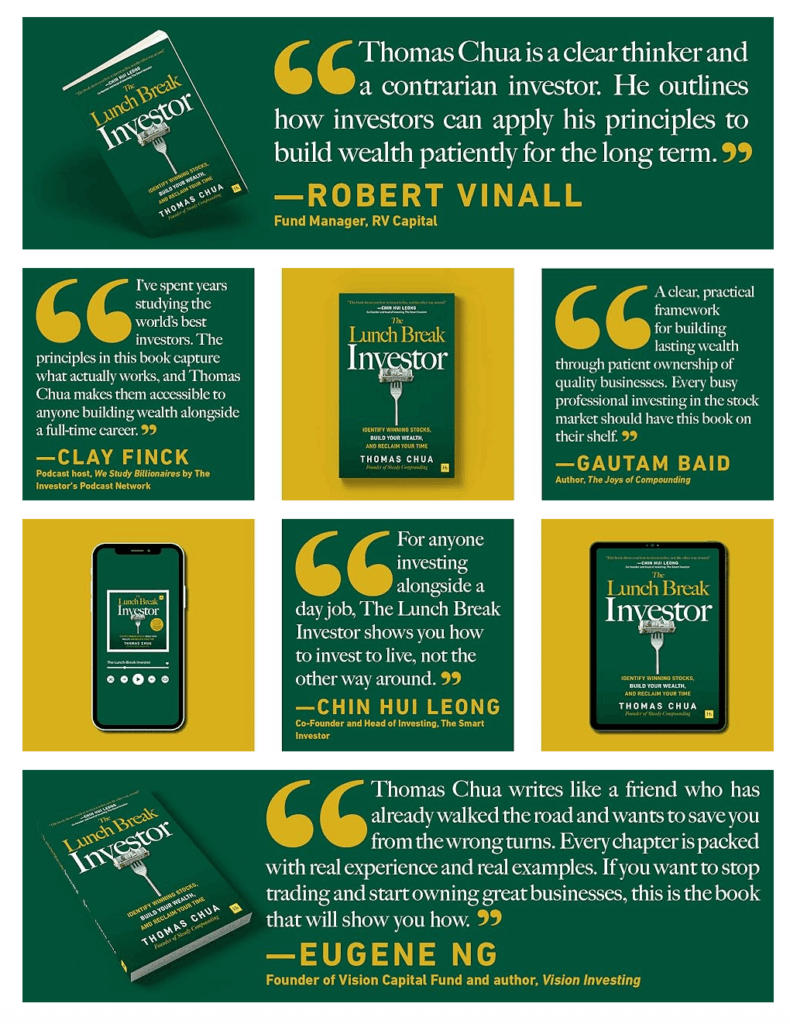
I also want to tell you why the book took me as long as it did.
The goal was for it to hold real value. That was never the hard part. The hard part was making that value easy to absorb, and those two aims fight each other more than you would think. Anyone can write something long and dense and call it thorough. Length looks like effort, and complication can pass for depth. But you do not need my effort. You need the idea, set down cleanly enough that you can pick it up on a Tuesday lunch break and actually use it.
So most of my time went not into adding but into cutting and making the writing sing. (The chapters I am proudest of began at roughly twice their final length.) And here is the part nobody warns you about. Every time I made myself say something in half the words, I understood it better than I had before. You cannot compress an idea you only half grasp. The work of making something simple turns out to be the work of understanding it completely, and there is no way around that work, only through it.
That is the book I tried to write. The one I wish someone had put in my hands when I started, before I spent years mistaking complication for rigour.
If you would like a copy, you can preorder it here: https://lnk.to/thelunchbreakinvestor. The link adjusts to wherever you are ordering from. If your country is not listed, Amazon.com will get it to you.
Compound Steadily,
Thomas
I. Dan Loeb on Talking a Value Investor Into the AI Trade
Dan Loeb has rebuilt his method several times over thirty years. He started Third Point in 1995 as a credit and event-driven investor, hunting the mispriced securities thrown off by spinoffs, demutualizations, and post-reorganization equities. That is the framework from Joel Greenblatt’s You Can Be a Stock Market Genius. Around 2013 he layered in a quality lens, learning to pay up for high return-on-capital businesses he could hold for years. Today the firm manages roughly $24 billion, more than half of it in credit, with the AI complex sitting at the center of the equity book.
What stands out is that someone trained in deep value finds the AI trade attractive this far into the rally. His case is that this is not the dot-com setup. The largest technology companies are funding their capital spending out of balance sheets that already generate enormous cash, and the multiples on strong reported earnings remain reasonable. He points to NVIDIA trading near 15 times 2027 earnings and 12 times 2028. The bear case, he argues, requires believing all that spending yields no return at all.
Loeb also walks through how he decides between a company’s debt and its equity, what he calls the fulcrum security, the slice of the capital structure with the best risk and reward. When most credit investors were nervous about the Twitter buyout debt trading near 96 cents on the dollar, Third Point bought it as its largest credit position at the time. The same comfort with the underlying business let them step into xAI’s debt when others stayed away.
The conversation closes with the activism that made his name. The Sony and Sotheby’s stories follow a pattern: companies that traded on status without earning it, where basic operating discipline and public pressure unlocked the value.
II. Chris Hohn on Running $77 Billion Across Fifteen Positions
Chris Hohn runs TCI, which the FT reports is the fifth most profitable hedge fund of all time and last year earned more after fees than any other firm. The number that frames everything is the shape of the book: roughly $77 billion across just fifteen positions worldwide, run by one portfolio manager and about half a dozen analysts. Where most funds of that size spread thousands of bets, Hohn concentrates. He holds for an average of nine years, closer to a private equity horizon than a trader’s.
What he concentrates on is pricing power. He looks for monopolies or duopolies that can push through price increases ahead of inflation, and he is unmoved by fast revenue growth on its own. That filter is strict enough that he counts only a little over 200 companies worldwide as investable, a number he says is shrinking as AI and climate uncertainty cloud more business models. It explains the portfolio’s tilt toward infrastructure, around 31 per cent in things like railways, toll roads, and airports, assets a competitor cannot easily build a second copy of next door. His largest single bet, 18 per cent of the fund in GE Aerospace, rests on the same logic: no new jet engine maker has entered the market in fifty years, and the qualification cycle for a new engine runs decades.
The most instructive moment is where the discipline cuts the other way. TCI held roughly $8 billion in Microsoft on the thesis that its bundle of Office and Teams locked in corporate customers. As AI productivity tools, including those from Anthropic, raised doubts about that lock-in, Hohn judged the thesis broken and sold the entire position this year. Former colleagues describe him as unattached to stocks regardless of how long he has owned them, which is what lets him exit at the moment the reason for owning disappears. Concentration without that willingness to leave would be recklessness; with it, it becomes a coherent method.
This is also a year of strain on that method. The fund was down 4.3 per cent to the end of April, its worst start since 2022, with the GE position off about 7 per cent as the Iran war hit airlines. Hohn’s response is that he has watched holdings halve and then more than triple, and that for his own capital, a large share of the fund, his time horizon is effectively unlimited. Whether you read that as conviction or as the risk of conviction, it is the clearest available picture of what a genuinely concentrated approach asks of an investor.
III. Christopher Tan on the One Financial Decision You Can’t Fully Outsource
Christopher Tan, who runs a fee-only advisory firm in Singapore, opens with a hawker centre encounter: an insurance agent pitching a retirement plan that supposedly beats the national pension scheme. When Tan pushed back, the agent defended the pitch with claims that were simply wrong, delivered with confidence and a fund illustration showing a bigger monthly payout plus a six-figure death benefit. On paper it looked better. It wasn’t.
The gap between the slide and the reality came down to a few things a layperson wouldn’t catch. The projected returns were lifted from an unusually strong stretch of market history and carried forward as if they’d repeat. The fees that drag on those returns went unmentioned. The headline death benefit was a projection, not the guarantee it was labelled as. And the structure quietly traded away longevity protection: a government annuity pays for as long as you live, while a market-linked product’s income lasts only as long as the fund sustains it.
The local details don’t travel, but the principle does. Financial decisions are among the few things we can’t hand off entirely. We can hire help, but we still have to understand enough to judge whether the help is any good, because the person selling to us is rarely the one who lives with the consequences. The sale happens today; the damage, if there is any, surfaces years later when it’s too late to undo. That asymmetry is the whole reason a little understanding pays for itself.
So the test is simple, and it works in any market. We keep asking until it makes sense. If someone advising us can’t explain a recommendation in plain language and keeps retreating into jargon, that is not a sign of sophistication. It is the signal to walk.
That’s all I have for you today!
Till next week.