


Come Say Hi on 22 August (Singapore)
The Lunch Break Investor comes out next month, and for readers in Singapore, I’ll be doing my first book talk on Saturday, 22 August.
It’s at Books Kinokuniya’s main store at Takashimaya, Level 4, from 4pm to 5pm, moderated by He Ruiming, co-founder of The Woke Salaryman. We’ll dig into the ideas behind the book, take your questions, and I’ll be signing copies after.
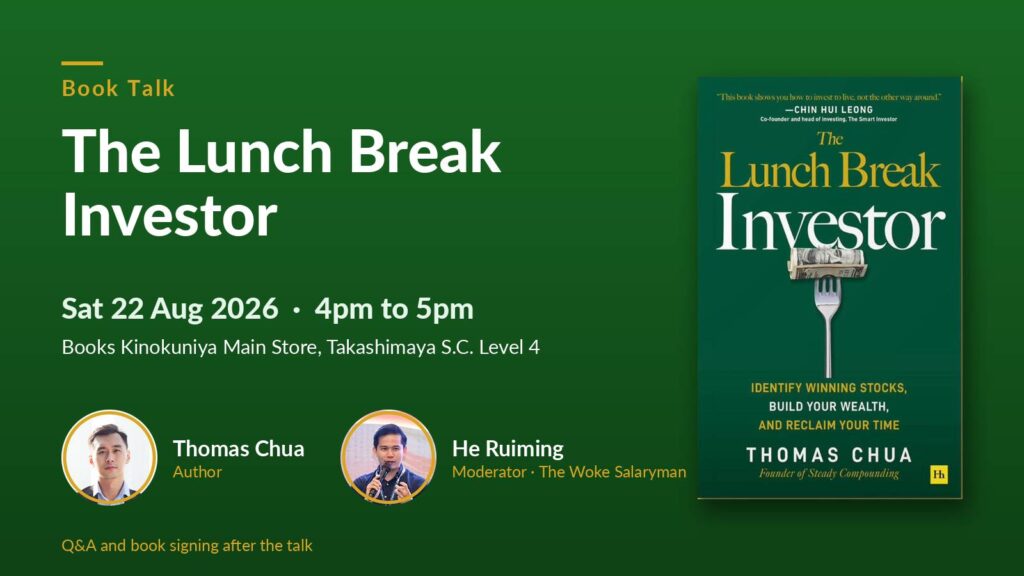
If you’ve already pre-ordered your copy elsewhere, come say hi. I look forward to meeting you.
Compound Steadily,
Thomas
P.S. If you’re not in Singapore, the book is up for pre-order at steadycompounding.com/book.
I. Pat Dorsey Has Changed His Mind About Moats
I’ve enjoyed Pat Dorsey’s books, The Five Rules for Successful Stock Investing and The Little Book That Builds Wealth. Both shaped how I think about competitive advantage. So it was fun to hear him on Capital Allocators explaining how he has since updated some of his own mental models, which is what any investor who’s constantly learning and evolving should do.
The first update is on return on invested capital. Dorsey built the original Morningstar moat framework by studying every company that earned over 15% returns on capital for more than 15 years. Today he says ROIC on its own is much less useful, because value creation has shifted toward things companies expense rather than capitalize. When a software company hires developers and writes code, all of that gets expensed, so the capital base looks tiny and the ratio looks great. In his words, there are lots of crummy software companies with high returns on capital.
The second update is bigger. When he launched Dorsey Asset Management in 2014, he weighted the moat at roughly 60 to 70% of the decision and management at 30%. He’s now the reverse, because he’s seen how much damage poor management can do to even a great business. He thinks Buffett’s famous line about wanting a business so good any idiot could run it has done more harm than good, since it gives investors an excuse not to interrogate the people running the company. And most CEOs never actually learn capital allocation on the way up. They get the seat by being good corporate politicians and running a division well, then suddenly they’re expected to allocate billions.
What he prioritizes now is the reinvestment runway, a company’s ability to keep redeploying capital internally at high rates of return. His math is simple. Very few money managers have compounded at 20% for a decade, but there are tons of businesses earning 20% returns on capital. A company that can plow its cash back into projects like that saves you from reinvesting the money yourself, and it takes capital allocation risk off the table, because management has an obvious place to put the cash instead of doing a dumb acquisition or buying back stock at the wrong time. A wide moat with nowhere to grow, like a mature marketplace, can end up being the worse investment.
His single biggest lesson from twelve years of running the fund is that you can never set the bar too high on business quality or management quality. Most of his errors came from compromising on one of the two.
II. Dividend Investing Is Dead?!
I’ve always remembered investors saying alcohol was the ultimate dividend stock because it does well in all climates. Recession? Drink to cope. Booming economy? Celebrate, drink. So when Diageo, the owner of Johnnie Walker and Guinness, cut its dividend earlier this year, it caught my attention. Todd Wenning writes that even five years ago a Diageo cut would have been unthinkable.
Wenning wrote a book on dividend investing and ran a dividend-focused newsletter before that, so this is him tearing down his own best-loved idea. His argument is that the environment changed in three ways.
First, the autopilot stocks are getting disrupted. The consumer staples giants that anchored dividend portfolios are fighting private label brands like Kirkland, influencer marketing, and GLP-1s changing how people consume. You can see it in the numbers: dividend growth at Coca-Cola, Colgate-Palmolive, J.M. Smucker, and Clorox, all Dividend Aristocrats with 25+ year streaks, has been slowing. And because these companies pay out 75% or more of earnings as dividends, their CFOs are handcuffed right when disruption demands reinvestment. A cut would confirm trouble and get the stock dumped from dividend funds, so boards hold on even when cutting is the right call.
He points out one tell worth remembering. Colgate-Palmolive, Sysco, and Stanley Black & Decker have all raised their dividends by a single cent in the past year, just enough to keep the streak alive. In his view, there’s no better sign that a board is worried about the dividend.
Second, boards have shifted to buybacks. Companies only got free use of buybacks after an SEC rule passed in 1982, and the average new board member today is 59, meaning they were 15 when that rule came in. The memory of dividend-first capital allocation is aging out of boardrooms. Buybacks are more flexible, more tax efficient in taxable accounts, and for most of the past decade the S&P 500’s buyback yield has exceeded its dividend yield.
Third, the index itself is getting younger. The average age of an S&P 500 company has fallen from 57 years to 15 since the 1950s. Campbell’s, Macy’s, Xerox, and Harley-Davidson have exited over the last decade, replaced by younger companies that never existed in a dividend era and have little reason to start paying one now.
His adaptation is to stop screening on dividend history and focus on how management allocates all of its cash flow. Is the buyback actually shrinking the share count or just soaking up stock compensation dilution? Is the balance sheet strong enough to respond to change? And if a company buys back a percentage of its shares each year, you can sell that same percentage of your holding to generate income yourself.
III. What John Donahoe Got Wrong at Nike
It’s rare to hear a CEO walk through his own mistakes in plain language, so this conversation with John Donahoe on How Leaders Lead stood out. Donahoe ran Nike from January 2020 to October 2024, led its big push into direct-to-consumer, and got, in his words, his butt kicked toward the end, both publicly and personally. He says he lost the locker room a little bit and that it was time for him to move on.
The strategy itself started from two principles he stands by. Consumers today want to get what they want, when they want it, how they want it, and the old lines between online shoppers and store shoppers no longer exist. And a brand has to know who its customers are. Nike sold mostly through retail, which meant it didn’t know who was actually buying its shoes, and that’s dangerous when competitors can offer targeted, personalized experiences. So Nike built out Nike accounts and even shared membership data with partners like Dick’s Sporting Goods and JD Sports.
Then he lays out what went wrong, and this is the part worth studying.
First, perception became reality. The push got labeled as Donahoe’s direct-to-consumer strategy, and wholesale partners concluded Nike no longer valued them. He was in their boardrooms saying otherwise, but the perception stuck, and competitors moved in and took the shelf space.
Second, and more subtle, his own metrics distorted the company. Because Nike was measuring digital growth and own-store growth internally, the organization optimized toward those numbers. That meant deliberately holding back the most scarce inventory for Nike’s own online channel, a non-consumer-friendly choice that inflated the very digital growth he was tracking. He admits he wasn’t fully aware it was happening. The scoreboard he set up was quietly bending the whole company, and part of the online growth he thought was demand was really just supply being steered.
His takeaway is about balance. When you push an organization hard in one direction, you have to actively ask how you might be perceived as going too far, and build guardrails against overdoing it. The risk now, he notes, is over-correcting into “digital is bad,” which is equally wrong. He credits his successor Elliott Hill with restoring a more balanced marketplace.
There’s a management lesson in here that applies well beyond retail. Whatever you measure, your organization will optimize toward, including in ways you didn’t intend and can’t see from the top.
That’s all I have for you today!
Till next week.