


Show, Don’t Tell
I’ve been telling you about The Lunch Break Investor since June.
Today I can finally show you.
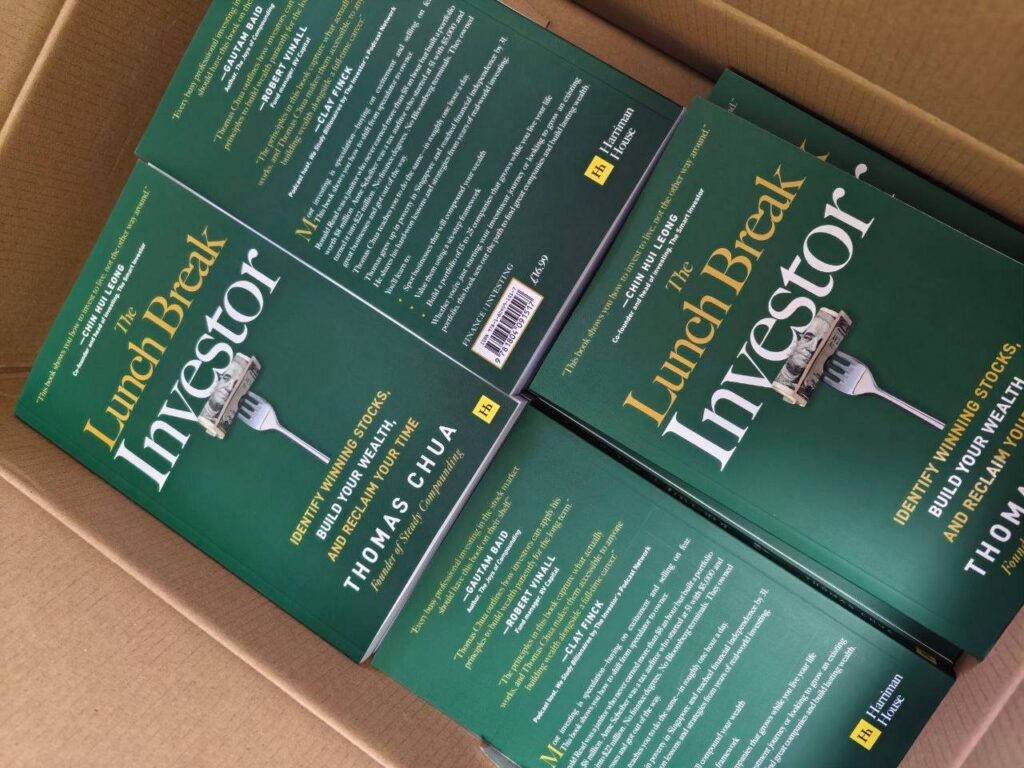
The early copies arrived this week!
The cover promises three things: identify winning stocks, build your wealth, reclaim your time.
It comes out on 18 August, and pre-orders are open at steadycompounding.com/book.
Compound Steadily,
Thomas
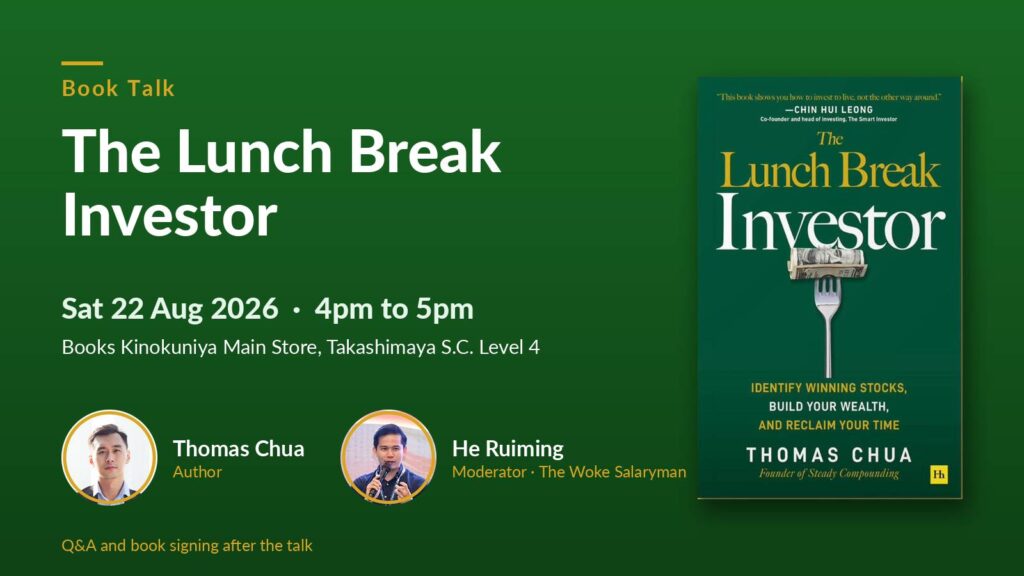
P.S. If you’re in Singapore, I’m giving a book talk at Kinokuniya’s main store (Takashimaya, Level 4) on Saturday 22 August, 4pm. Come say hi.
I. Some of the Unhappiest People in the World
A Reddit post went viral claiming that after the first two or three million dollars, a paid-off home, and a good car, there is no difference in quality of life between you and Jeff Bezos. A cheeseburger is a cheeseburger. Morgan Housel opens this episode with that post, and mostly agrees. Sure, Bezos flies private. But the highest dividend money pays is independence, and you don’t need a Bezos number to get it. Housel has spent a lot of time talking about money with very wealthy people, and what sticks out is not what money has done for them. It’s what money has not done and cannot do for them.
The episode title comes from Richard Nixon, of all people. In the Frost interviews, Nixon calls the crowd at the international watering places the unhappiest people in the world: “going to parties every night, playing golf every afternoon, then bridge, drinking too much, talking too much, thinking too little, retired, no purpose.”
Harvey Firestone said the same thing from the inside. In his 1926 autobiography, the tire magnate remembered paying $25 a month for a little house, with a grocery bill of $5 a week. Once rich, he daydreamed about that simplicity but wrote there was “no going back except as a broken man.” He built houses in Akron and Miami Beach far bigger than he needed, and admitted he had no idea why. His words, not mine.
Housel wraps it in one line: you know the price of your purchases, but the cost, the upkeep and what they do to your well-being, is very difficult to calculate.
II. Peter Lynch, Old but Gold
This one is old but gold. The interview is from 2002, with WorldCom and Arthur Andersen in that week’s headlines and the Nasdaq a couple of years into its collapse. Rukeyser opens with the question every bear market brings back: is it different this time, is buy and hold dead? Lynch says the same rules applied 50 years ago, applied five years ago, and will apply 20 years from now. Know what you own, and be able to explain it to an eleven-year-old in two minutes or less. “This sucker’s going up” is not a reason.
The most common mistake he sees investors make is skipping the balance sheet, and his example needs nothing beyond eighth grade math. Two companies, both at $4 a share, both losing a couple million a quarter. One has $100 million in cash and no debt. The other has no cash and $100 million of debt. The second one is about to go under. It’s impossible to go bankrupt if you don’t have any debt.
His own biggest mistakes were sells. In a stock all you can lose is 100%, while the winners can go up tenfold, his ten baggers. He sold Toys R Us way too early and watched it go up twentyfold after he sold. Same thing with Home Depot.
Rukeyser also asks why he was confident stocks would be a lot higher in ten years. They’re not lottery tickets, Lynch says. A stock is a share of a company, and companies will earn a lot more money in ten and twenty years. Corporate profits are up fortyfold since World War Two, and so is the market.
III. David Epstein: How Constraints Make Us Better
David Epstein’s new book Inside the Box is built on a claim from the economist Herbert Simon: “It is a myth, widely believed, but not less mythical for that, that people are most creative when they are most free.” The conversation with William Green covers a lot of ground, so I’ll stick to the one idea with the widest use: the Theory of Constraints.
It started with an Israeli physicist, Eliyahu Goldratt, and a friend’s chicken coop business. The friend had hired more workers for his assembly line and production hadn’t budged. Goldratt found the work piling up at one slow step, moved a single worker there, and output tripled. That’s the whole theory: a system’s output is capped by its single slowest step, and effort applied anywhere else doesn’t matter.
Decades later, a gearbox maker ran the same audit and traced its bottleneck to a 15 person design office switching between projects about 55 times a day. One rule, stop starting and start finishing, tripled the designs going out the door and cut delivery from a year to two months.
The best story is a swimmer, Sheila Taormina. She missed the 1992 Olympic team in the 200 meter freestyle and decided to retire. In her final class at the University of Georgia she learned the Theory of Constraints, and made applying it to her own training the class project. The audit showed her coaches had her grinding aerobic volume, the thing she was already great at, while her actual limiter, small as she was for an elite swimmer, was power. She switched coaches, rebuilt her training around the weak link, came back four years later swimming exactly three seconds faster, and won gold on the 4×200 freestyle relay in Atlanta.
Epstein ran the same audit on himself as a college runner. His bottleneck was recovery, so he cut from 80 miles a week to about 35, and went from walk-on to university record holder.
That’s all I have for you today!
Till next week.