


Why We Choose Steady Compounding
This week, a hedge fund that was up 439% for the year nearly blew up.
Situational Awareness is an AI-focused fund run by a former OpenAI researcher. It launched less than two years ago, and by the start of July it had swelled to $45 billion in assets. Then AI stocks sold off hard, and because the fund was reportedly running around four times leverage, one bad month was all it took.
The margin calls came in, and the entire public stock portfolio was sold to Ken Griffin’s Citadel in a single block. Even after all that, the fund is still up roughly 80% this year (likely due to their private equity position, Anthropic, that’s offsetting the catastrophic cash losses from the public market bloodbath… but this is just my guess). It just very nearly didn’t survive to enjoy it.
Reading the news, my first reaction was that this story feels familiar. We have seen it before.
In March 2021 it was Archegos, Bill Hwang’s family office. Concentrated bets on tech and media stocks, roughly five times leverage through swaps, and when the positions fell, $20 billion of wealth evaporated in two days. (Hwang was later convicted of fraud over how those positions were built, which is its own saga. The overlap with this week is the leverage and the margin calls, not the fraud.)
In 2022 it was Three Arrows Capital, the crypto fund run out of Singapore. Same shape. Riding the sector bull wave, leveraged up, gone within weeks once prices turned.
And in 1998 it was Long-Term Capital Management, which had two Nobel Prize winners on the team and still needed the Federal Reserve to organise a rescue because of, you guessed it, leverage.
And it isn’t just the famous cases. I know a few people personally who went through their own version of this. A bull market came along, they got intoxicated with the easy money, started taking on leverage to speed things up, and had their ass handed back to them when a speedbump came along.
I understand the temptation. When your portfolio grinds out a normal year while some AI fund is printing 400%, the slow path feels almost embarrassing, and leverage looks like the fastest way to catch up. In a bull market it even looks free, because every month it works, it feels a little smarter.
These funds all invested in different assets. What blew them up was the same every time: leverage. If the first half of this year made your portfolio feel slow, I hope this week serves as a reminder of why we invest the way we do. No borrowed money means nobody can ever force us to sell. It isn’t the fastest way to compound, but it keeps us in the game long enough for compounding to work.
That is also why I wrote The Lunch Break Investor. It’s the slow path in book form, a six-step system for analysing and owning great businesses one lunch break at a time. The book launches on August 18, and you can pre-order it here.
Compound Steadily,
Thomas
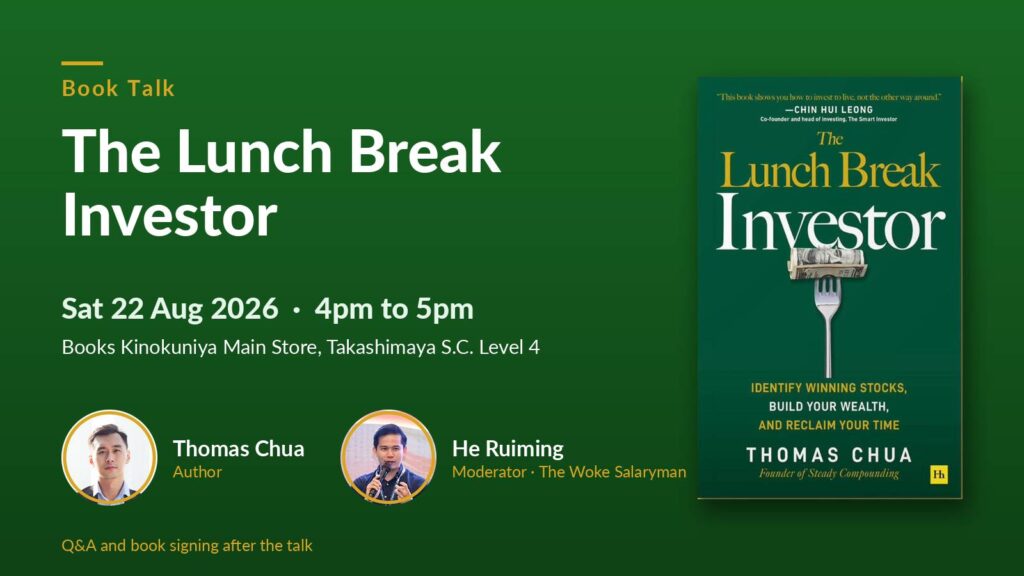
P.S. If you’re in Singapore, I’m doing a book talk at Kinokuniya Takashimaya (Level 4) on 22 August, 4pm, with He Ruiming from The Woke Salaryman moderating. Come say hi: details here.
I. Invisible Companies: The Moat of Not Being Noticed
Steve Ross started out renting his father-in-law’s funeral limousines out at night. He strung together a rental car company, parking lots, a cleaning business, flooring, painting and plumbing, and in 1969 he used that pile of ordinary businesses to buy Warner Bros. for roughly $400 million, about $3.5 billion in today’s money.
Jay Barney, Haiyang Zhang and Jerry Neumann start with the puzzle in that story. None of those businesses had a moat, anyone could open a parking lot, and plenty did, so the profits should have been competed away long before Ross could afford a movie studio. Their answer is that these companies were invisible. Competitors weren’t blocked from entering, they just never thought to look.
Constellation Software is the cleanest modern case. It has compounded at roughly 34% a year since its 2006 IPO buying niche software nobody else wanted, marina management, ski-lift ticketing, funeral home record-keeping, and it estimates there are still more than 38,000 of these businesses out there. If that’s even close to accurate, there’s a lot of neglected profit still sitting around.
The authors also go into why companies stay unseen, how invisibility gets lost, and how investors can hunt for these businesses, which mostly means doing the opposite of what our screens do: shrinking industries, small apparent markets, low-status work.
II. Mastercard and Visa on the Consumer: Still Spending
Few companies see consumer spending in real time the way the payment networks do, since a huge share of the world’s card swipes runs on their rails. Both reported their June quarter this week, and The Good Investors went through the earnings calls to pull out what management is seeing. The short answer is that the consumer is fine.
Mastercard, 2026 Q2 (constant currency):
- Worldwide gross dollar volume: +8% year-on-year
- Cross-border volume: +12%
- Switched transactions (the ones processed on Mastercard’s own network): +9%
- Cards in circulation: 3.7 billion, +5%
Visa, quarter ended June (its fiscal Q3):
- US payments volume: +10%, a growth rate Visa says it last saw in fiscal 2019 outside the post-COVID rebound
- US credit +11%, US debit +9%
- Cross-border volume: +12%, with cross-border e-commerce up 16%
The strength runs across the board. Visa’s highest spend band is growing fastest but it sees no weakening in the lower bands, and both discretionary and non-discretionary spending remain strong. Mastercard says the same across mass and affluent consumers, with affluent growth running higher, which management notes has been the pattern for some time now.
To be fair, both called out some one-off help in the quarter, higher fuel prices, the World Cup, and for Visa bigger tax refunds and the timing of retail promotions. But the first few weeks of July are holding up anyway, with Mastercard’s switched volume up 9% and Visa’s US volume up 9% through July 21, so it doesn’t look like the one-offs were doing all the work.
III. Forget Passion, Find Your Fascination
Jerry Seinfeld told a graduating class, “the hell with passion.” He suggested a different word instead: “Find fascination. Fascination is way better than passion. It’s not so sweaty.”
Ben Carlson picked the story up from Bill Gurley’s new book Runnin’ Down a Dream, and it fits his own path. He graduated with no passion he could turn into a paycheck. An internship turned into an entry-level analyst job, he realised how much he had to learn, and so he read every investing book he could get his hands on, One Up on Wall Street, The Intelligent Investor, Poor Charlie’s Almanack. Reading about markets grew the fascination, and it taught him that markets are really about people, behaviour, incentives and emotions.
The trend is going the other way. A study of 236,000 responses to the American Time Use Survey found the share of Americans reading for pleasure on a given day fell from 28% in 2004 to 16% in 2023, and the National Endowment for the Arts found fewer than half of adults read a book of any kind in 2022. The Atlantic, which Carlson quotes, adds that 57% of Americans placed a bet last year, making gambling a more common pastime than reading.
Carlson’s argument is that podcasts, YouTube and chatting with an LLM are shortcuts by comparison, and that reading more is still a way to gain an edge over others.
Reading was special for me too. I read the same books, and Lynch, Graham and Munger became my mentors in the library. It’s also a big part of why I wrote The Lunch Break Investor. It’s the book I wish I had when I first started, and you can pre-order it here.
That’s all I have for you today!
Till next week.