


Two Book Talks and a Thank You
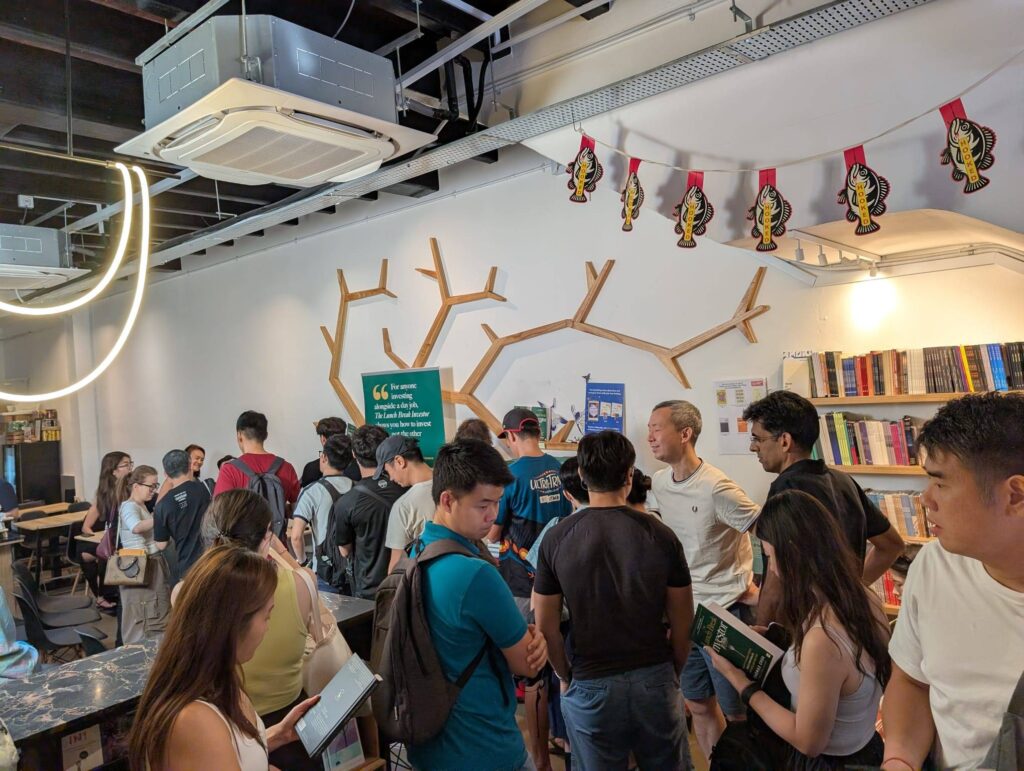
This was Book Bar on Duxton Road in Singapore yesterday afternoon, two weeks after the Kinokuniya talk, this time with Reggie from The Financial Coconut asking the questions. Thank you to everyone who came, and to everyone who had to stand.
What I appreciated most was that the Q&A with the audience went beyond investing, into frameworks for how to make tough life decisions.
After debuting at #1, The Lunch Break Investor is on the Straits Times bestseller list for another week, and I’m grateful for that.
The book is available at all major bookstores in Singapore, or you can order online at steadycompounding.com/book.
Compound Steadily,
Thomas
I. Is Active Investing Arrogant?
“These questions weren’t written using ChatGPT, they were written when I was on the toilet.”
That was He Ruiming, co-founder of The Woke Salaryman, moderating my book talk for The Lunch Break Investor at Kinokuniya in Singapore two weeks ago.
I hadn’t seen the questions, and he warned that some were spicy. He also disclosed that I wasn’t paying him, which explains a lot.
Ruiming buys a broad global index and calls it a day, and the title question was his. The rest weren’t much gentler. He wanted to know how I square investing in Meta and Amazon with shareholder value being a dirty word these days, why so many Singaporeans prefer dividend stocks to growth stocks, and what an hour a day looks like for someone without a Bloomberg terminal.
Click the thumbnail below to watch:
II. Greg Abel on Berkshire’s Japan Bet and the $10 Billion Alphabet Block
Greg Abel gave CNBC’s Squawk Box an update from Tokyo this week, where he was meeting the five trading houses Berkshire owns stakes in.
The Japan position is just over six years old. Berkshire went in at just over 5% of each company, was past 7% by the 2023 visit, and sits above 10% in all five now that the companies have agreed to lift the ceiling. Abel says the intention is to hold for many decades.
Let’s look at the debt. Berkshire funded the stakes with yen bonds, north of $15 billion by Becky Quick’s count from the latest filings, and Japanese bond yields are now at their highest in about three decades. Abel says the yen debt roughly matches the cost basis of the investments, has a little over five years left to run, and the gap between the dividends coming in and the interest going out is still significant. If the debt really does sit near cost basis, higher yields mostly shrink the carry and not much else.
On Alphabet, Buffett started the position around 15 months ago and kept buying. In late May, Abel got a Sunday morning call asking whether Berkshire wanted a piece of Alphabet’s upcoming equity offering. The block was $10 billion, Abel recommended a 6.5% discount, and after a call with Buffett they went back and did it on those terms. His reason for liking Alphabet is that Berkshire can see from inside its own companies what AI is doing for them, and Google is a significant player.
III. What Munger Would Say About AI Today (Probably)
In 1981 Michael Bloomberg was pushed out of Salomon Brothers with a $10 million cheque and built a machine that killed the edge he had watched men get rich on, which was having a price before the other guy. Within a decade there were ten thousand terminals on Wall Street desks renting for about $20,000 a year. The essay’s word for what that edge became is furniture.
Fun fact, I interned at Bloomberg at 19, mostly because I was so impressed by how much information that machine could pull up. I also felt super cool using it.
This essay from Footnote Capital treats the terminal as the first of four such waves, followed by free filings on EDGAR, the quants, and alternative data, where a 2023 study by Bonelli and Foucault found that satellite images of car parks, once they arrived, reduced the stock-picking ability of managers whose edge had been old-fashioned industry expertise instead of lifting the funds that covered the stock. That is the scarier version of the story.
AI, the essay argues, is the fifth turn of the wheel, and Munger’s mental models are the lens. A model trained on human feedback drifts toward the consensus in its training data, so a room of investors all consulting the same models is not a room of independent opinions. The same tool cuts the other way if you ask it for the most rigorous short thesis on a name you own, every reason it goes to zero, which is the bear case most investors never built because it was unpleasant.
That’s all I have for you today!
Till next week.