


Come Say Hi in Kuala Lumpur This Saturday
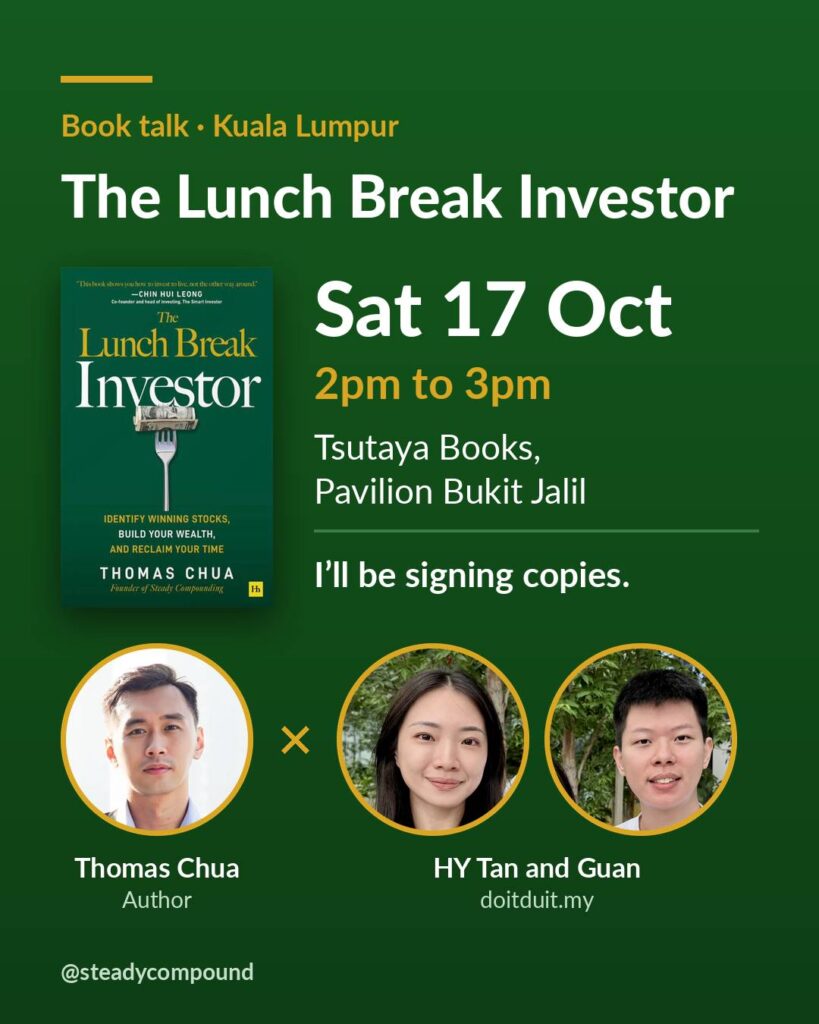
For my readers in Malaysia, I’ll be in Kuala Lumpur this Saturday, 17 October, for a book talk at Tsutaya Books, Bukit Jalil, from 2pm to 3pm.
It’ll be moderated by Guan and HY Tan, the duo behind DoitDuit. We’ll chat, answer your questions, and there’ll be a book signing after.
And just between you and me… because you’re on my email list, the place can take 50 people comfortably. The 51st will be less comfortable, so do come a couple of minutes early to grab your seat.
Compound Steadily,
Thomas
I. Charlie Munger’s Unreleased 2022 Conversation With Todd Combs
“What I am is a guy who has been able to take moderate obsession and a long attention span and turn them into pretty good results.”
That’s how Charlie Munger explained his success to Todd Combs in 2022, in a conversation that was never released publicly until this week. Shane Parrish got permission to share it, and in this video he goes through the ideas he found most useful.
II. How AI Agents Get Paid When They Shop for You
Mark Zuckerberg has said he wants to keep Muse (Meta’s AI agent) free as much as possible, and for Meta to profit over time by taking a small fee from transactions. Tanay Jaipuria tries to work out how much an agent could make this way.
In investing lingo, the cut a platform keeps from each sale is the take rate. Today it ranges from 0% if you buy something through a web browser to maybe 30% through the Apple App Store or Steam. How much an agent gets depends on how much work it does, and Jaipuria breaks it into three roles.
Buying assistant. You tell the agent exactly what to buy and where. The most it could do is negotiate a share of the payment processor’s fee, likely under 0.5%.
Affiliate. The agent helps you compare options and refers the purchase. Public programs pay anything from about 0% on flights to 1% on Amazon groceries, 4% on Expedia hotels and 8% on Viator experiences.
Aggregator. The agent handles the inventory, bookings and cancellations itself, like a Booking does today. Jaipuria says Booking might make 14% to 15% of what’s booked through it, while the affiliate fees it pays might only net out to about 5% to 7%.
He also runs through how the blended take rate could change over time and what advertising could add on top.
III. Li Lu on AI, China and Long-Term Returns
While the YouTube channel is in Chinese, this is a Graham and Dodd event at Columbia Business School and Li Lu is sharing his thoughts in English.
Li Lu points out that the S&P 500 averaged 14% to 15% a year over the last 16 years, but in the ten years before that it averaged exactly zero. Put the 26 years together and you get a high single digit return, which he says is roughly right over the long term. I’m guessing 14% a year feels normal to a lot of us by now.
On AI, he says every technology wave until now has been a tool, and this is the first one that has started to move from tool towards creature. He talks about a prospectus (he doesn’t name the company) that invites investors in at a $2 trillion valuation, and describes the story around it as an invitation to the IPO of a man-made god. His view is that either the technology doesn’t go there or society will unite to stop it, so it stays a tool and financial discipline applies eventually.
On China, he says the development model has always been a big objective that comes with a big cost. Over the last ten years the objective was moving manufacturing to the high end, and one of the main costs was the middle-class family’s balance sheet. By his numbers, a typical family had 70% of its net worth in its home when prices peaked in 2021, with a mortgage of roughly 50% on it, and prices have since fallen about 40% nationwide. So as an investor there, he says you always want to know whether you are the objective or the cost.
That’s all I have for you today!
Till next week.