


In my original Domino’s deep-dive, I said I was hesitant to initiate a position because I saw a structural step down in the company’s growth, and I didn’t think the lower valuation left enough margin of safety:
“While Domino’s “Hungry for MORE” strategy outlines clear growth targets, the recent slowdown in same-store sales growth and the uncertainties surrounding international expansion raise questions about the company’s ability to maintain its historical growth trajectory. The company’s valuation, while seemingly attractive compared to its historical average, may need to be reassessed in light of these challenges. I will circle back to look at Domino’s if its forward PE multiple hits 20x.”
Fast forward two years, and the stock has tanked further. The forward PE is now ~16x. This report is my attempt at dissecting what’s happened and figuring out whether Domino’s makes a good case today.
Let’s talk about why Domino’s is down about 24% since the start of this year.
Two guidance cuts
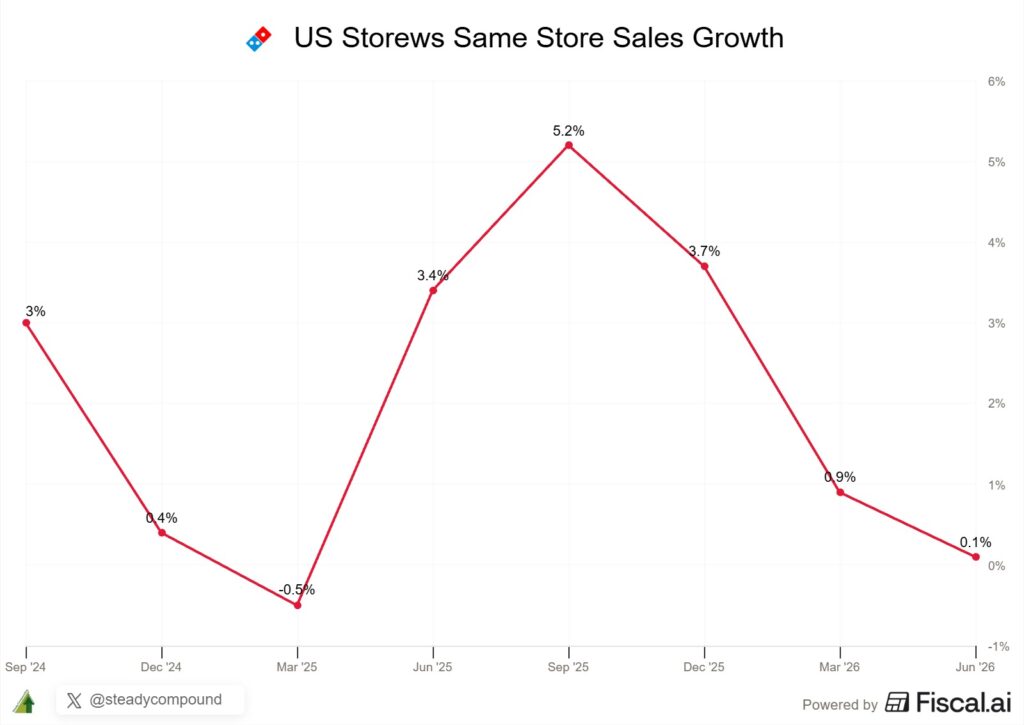
Domino’s told us in February that US same-store sales (SSS) would grow 3% in 2026. In April that became “up low single digits”, which sounds like the same thing until you hear CFO Sandeep Reddy define it on the Q1 call:
“Anything positive in the low single digits would be what the guidance implies.”
So 0.1% counts. On the same call, CEO Russell Weiner said his objective was still 3%. The CFO guided to anything above zero while the CEO stuck to three. I’m not holding my breath to find out where the next two quarters land.
And mind you, SSS came in at a meagre 0.9% in Q1 and 0.1% in Q2… so he wasn’t kidding when he said “anything positive”.
Operating income growth went from about 8% to “mid-to-high single digits”. Eight sits inside that range, and so does five. Management said the change was “due to our lower sales expectations”, so it was a cut, just worded in an avoidant manner.
In July the store guide slipped from 175-plus net new US stores to “approximately 175”. Net new means openings minus closures, and the plus meant at least 175 with room to beat it. Approximately means no promise of a floor. I don’t like the way management communicated these revisions in guidance, and it’s such a poor way of communicating that I need to point out the differences to you.
That’s two cuts to the guidance this year.
More orders, smaller tickets
There’s a bright spot though, and that is orders were up. CEO Russell Weiner said on the July call that order counts “were up meaningfully in total and individually in our delivery and carryout businesses.”
What fell was the ticket. Pricing added just 0.2% in Q2, and the quarter’s big launch flopped. Domino’s needed something to match last year’s Stuffed Crust, which lifted the ticket while it ran in Q2 2025. What it launched in Q2 2026 was a premium series with a new Slice Sauce. In Weiner’s words, “This did not resonate with customers the way it needed to. The messaging wasn’t compelling enough.”
So more people bought Domino’s and paid less on average. That reads as a marketing miss to me, and Weiner said as much: “I don’t believe this miss was due to macroeconomic headwinds. Those were assumed in our plan.”
I would add two things management didn’t dwell on (but probably should have).
The first is delivery. Same-store sales are dollar sales at stores open more than a year, and the delivery half of that (56% of US sales in 2025) has gone backwards, down 0.3% in Q1 and 0.7% in Q2, after growing 2.5% in Q3 2025 and 1.6% in Q4.
Now, remember Weiner’s claim that delivery orders were up in Q2? Then each delivery was worth less. Management doesn’t disclose the split, but more orders and lower sales means a smaller ticket per order. Uber and DoorDash brought some of those orders (Weiner called aggregators one of the reasons, and CFO Sandeep Reddy credited the loyalty programme too), but the ticket fell faster than the orders grew.
The second is pricing. Menu prices went up 1.3% in Q3 2025, then 0% in Q4, 0.9% in Q1 2026 and 0.2% in Q2. In February management said 2026 would see low single digit price increases, meaning somewhere between 1% and 3%.
Franchisees and the pipeline
This would have an adverse impact on the store pipeline too. After all, franchisees only open more stores if the returns make sense. On the July call, CFO Sandeep Reddy trimmed the US store guide because “we are seeing some pressure on our pipeline due to the macro, coupled with the challenging start to the year that has impacted franchisee profitability.”
Back in February, Reddy put the average US franchisee’s profit per store at about US$166,000 for 2025, up a grand total of US$4,000. In Q2, US retail sales grew 1.9% on a 0.1% comp (i.e. existing stores only grew 0.1%), so new stores did nearly all the work. If franchisees stop building, the whole system slows.
For the record, Domino’s added 45 net US stores in the first half, 19 in Q1 and 26 in Q2. “Approximately 175” needs about 130 in the second half. That’s plenty of catching up to do.
International
When we look abroad, international is 15,300 of the 22,531 stores and just over half of global retail sales, US$2.47 billion in Q2 against US$2.38 billion in the US.
But… it isn’t riding to the rescue. International comps fell 0.1% in Q2, dragged down by Domino’s Pizza Enterprises, the ASX-listed master franchisee that runs about a quarter of Domino’s international stores, with Japan its largest market by store count. DPE has been deliberately cutting low-margin orders to rebuild profit, so orders are shrinking faster than ticket can make up for.
Its new group CEO, Andrew Gregory, started in August after three decades at McDonald’s. Management still expects about 800 net international stores this year, and international retail sales grew 4.1% on the back of store growth.
It’s the same story as the US: new stores doing the work while existing ones stand still.
The CEO change
And in the middle of all this, Domino’s announced on 22 June that Russell Weiner retires as CEO on 1 October. Joe Jordan, COO and President of Domino’s US and his number two, takes over. Weiner isn’t leaving entirely. He becomes Executive Chairman designate on 1 October and Executive Chairman after the 2027 shareholder meeting, replacing Executive Chairman David Brandon.
The company frames this as the outcome of a “thoughtful succession planning process”. It came eight weeks after the first guidance cut, and the stock hit its 52-week low of US$282 the next day. Mr. Market doesn’t like uncertainty.
Weiner was the marketing architect behind modern Domino’s. He joined in September 2008 as Chief Marketing Officer from PepsiCo, led the 2010 Pizza Turnaround campaign, became President of Domino’s USA in 2014, COO in 2018 and CEO in May 2022. A marketer at heart, which makes a messaging miss on his final call sting a little more.
Jordan has been with the company for 15 years and knows the business well. But given the timing, the market reads it as forced even though the company says it was planned.
The buyback is doing the work
Without growth, the company keeps pulling the buyback lever to resuscitate shareholder returns, retiring shares at an annualized rate of 2.1%.
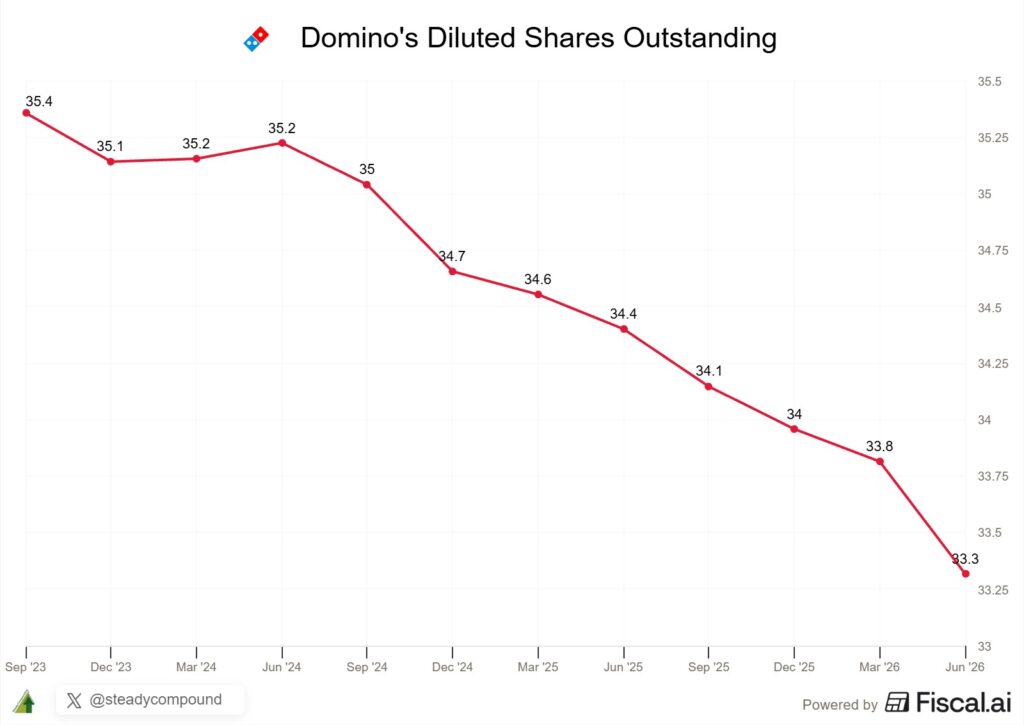
That is the franchise model doing its job. Domino’s owns 186 of its 22,531 stores, so franchisees carry the cost of building and running restaurants while the royalties land on Domino’s. Over the last twelve months that produced US$653 million of free cash flow, and US$389 million of it went straight back to shareholders as buybacks, with another US$245 million paid out in dividends.
Back of the envelope
So, is Domino’s a good investment today?
Well, the forward PE has had a massive rerating, from its three-years median of ~28x to ~17x. But Domino’s used to have twin engines driving shareholder returns: sales growth and share buybacks. Today it’s mostly the buyback.
If operating income grows mid-to-high single digits as guided and the share count keeps shrinking at roughly 2.1%, in line with the past three years, EPS compounds at 7% to 9%. Add the 2.5% dividend and you’d make 9.5% to 11.5% a year at a constant multiple.
That’s the bull case, and it is counting on a guide the first half didn’t deliver. If operating income grows 3% to 4%, which is roughly what Q2 delivered (3.1%), you’re looking at high single digit returns. And I wouldn’t expect the multiple to revert unless unit growth or same-store sales come back to life.
Based on the call, I’m not sensing a clear plan for that beyond a new pizza and Stuffed Crust inside Best Deal Ever.
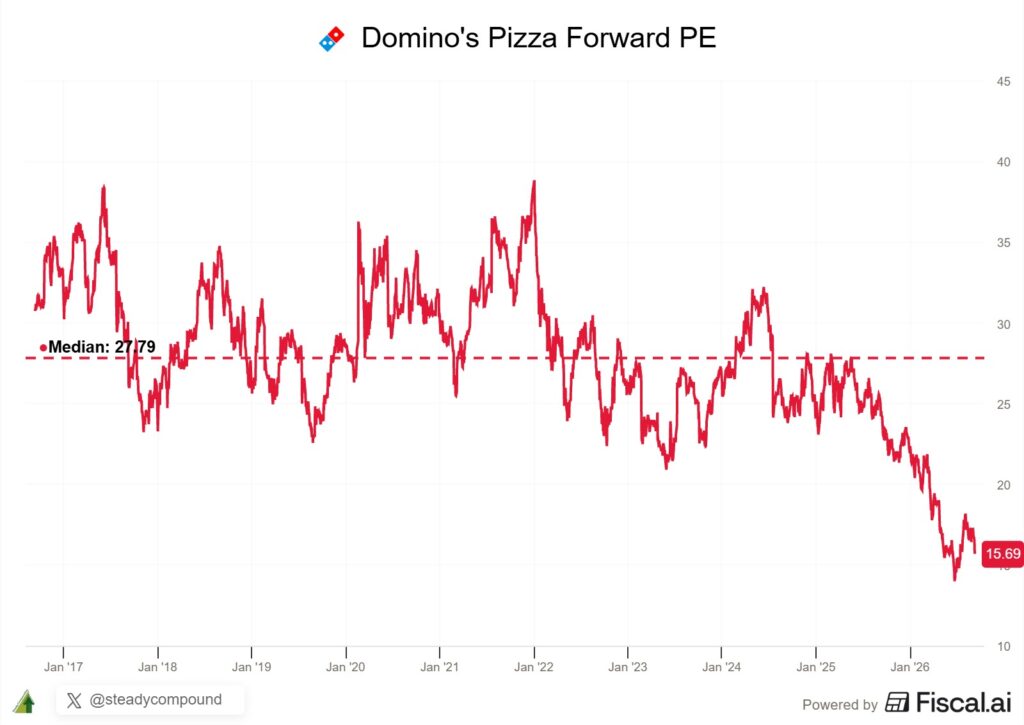
In conclusion, the multiple has come down a long way. But until Domino’s shows it can get the US comp back to its 3% algorithm and keep franchisees building, I’m abstaining from taking a slice.
Disclaimer: This research reports constitute the author’s personal views only and are for educational purposes only. It is not to be construed as financial advice in any shape or form. From time to time, the author may hold positions in the below-mentioned stocks consistent with the views and opinions expressed in this article. Disclosure – I do not hold a position in Domino’s at the time of publishing this article (this is a disclosure and NOT A RECOMMENDATION).